

ASTM F963-23 for US Toys: Which Edition Applies by Manufacture Date
Sep 11, 2026Updated Sep 11, 2026By CPS TOYS B2B Sourcing Editor
If your toy is manufactured after April 20, 2024, it must comply with ASTM F963-23, the mandatory version under 16 CFR part 1250—so choose suppliers who can prove production-date alignment with this edition, not an earlier one. This guide explains which ASTM edition applies based on manufacture date, how to verify your supplier's compliance through documentation like the Children's Product Certificate (CPC), and what additional CPSC rules still apply. Use this as your decision framework before signing a contract or placing a PO.
Key Takeaways for US Importers
- Which ASTM edition applies: For toys manufactured after April 20, 2024, CPSC requires ASTM F963-23 under 16 CFR part 1250. Toys made before that date may still be sold under the previous F963-17, but you must confirm the exact manufacture date with your supplier.
- CPC is non-negotiable: Every toy for children 12 and under must have a Children's Product Certificate (CPC) issued by the domestic manufacturer or importer, based on testing at a CPSC-accepted lab. The CPC must cite 16 CFR part 1250 and the correct ASTM version.
- Not all sections need third-party testing: Only sections listed in 16 CFR § 1112.15(b)(32) require third-party testing, but the CPC must certify compliance with all applicable sections. Ask your supplier for the test report to see exactly what was covered.
- Beyond ASTM F963: Separate CPSC rules still apply—small parts, lead paint (90 ppm), total lead (100 ppm), phthalates (0.1%), and tracking labels. Flammability is NOT part of the mandatory toy standard under 16 CFR 1250.2(b).
- Verify, don't assume: The applicable ASTM version is tied to manufacture date, not import date. Always request the supplier's test report and CPC before production, and confirm the lab is CPSC-accepted.
Which ASTM F963 Edition Applies to Your Toys?
If your toy is manufactured after April 20, 2024, the mandatory version is ASTM F963-23, as identified by CPSC under 16 CFR part 1250. For toys manufactured before that date, the previous version (F963-17) remains applicable for certification purposes. The key is the manufacture date—not the date you place the order, not the date the container lands at port.
This manufacture-date rule is the most common source of confusion. A supplier might show you a test report from 2023 that says 'ASTM F963' without specifying the edition. That report is only valid for toys made before April 20, 2024. If your production run starts after that date, the report must reference F963-23. Confirm the exact production date in writing with your factory—do not rely on 'current production' statements.
The standard itself applies to toys intended for children under 14, but federal law (CPSIA) only requires third-party testing and certification for toys intended for children 12 and under. If your product targets ages 13–14, it still must meet the standard's requirements, but you don't need the full certification paperwork unless the age grade is lower.
What Are the Key Changes in ASTM F963-23?
The most significant changes in F963-23 include:
Sound limits: New maximums for various toy categories—push/pull toys at 85 dB LAeq, 94 dB LAFmax, and 115 dB LCpeak; close-to-the-ear toys at 65 dB LAeq and 110 dB LCpeak. If your product has a sound function, verify the supplier's test report shows these exact limits.
Battery accessibility: The term 'tool' was clarified to 'common household tool' (e.g., screwdriver, coin, pliers). Fasteners must remain attached to the toy or compartment, or you must provide a specialty tool with instructions. Check that battery compartments are secured accordingly.
Expanding materials: The scope now includes small parts encased in outer coverings that dissolve, open, or break, and components that contract and re-expand. Water-absorbing toys are a key example—confirm your supplier has tested for this.
Use and abuse testing: Extended up to age 14, using parameters for 36–96 months for ages 8–14. This means more rigorous testing for older age groups.
Tracking labels: Now explicitly required under the standard, so ensure your product and packaging include the required tracking information (manufacturer, date, batch).
These changes directly affect design and compliance. If your supplier hasn't updated their test protocols or manufacturing processes, you risk costly rework or detention at the border.
How to Verify Your Supplier's Compliance with ASTM F963-23
Ask your supplier for four things before you sign a contract:
1. A copy of the CPC (Children's Product Certificate) that references 16 CFR part 1250 and explicitly states ASTM F963-23. The CPC must be issued by the domestic manufacturer or importer, not just the factory—in practice, the importer often issues it based on the supplier's test report.
2. The third-party test report from a CPSC-accepted laboratory. Verify the lab is on CPSC's list and that the report covers the sections listed in 16 CFR § 1112.15(b)(32). Don't accept a report from a non-accepted lab, even if it says 'ASTM F963'.
3. The production date of the actual batch you're buying, not a generalized 'we comply' statement. Get it in the PO or a separate confirmation.
4. A breakdown of which ASTM F963 sections were tested. The CPC must certify all applicable sections, but only some require third-party testing. Over-testing wastes money; under-testing risks non-compliance. Ask for the test matrix.
If the supplier can't provide these documents or hesitates to share the test report, that's a red flag. Legitimate manufacturers routinely share them with buyers.
What Documentation Do You Need for US Import?
You need three essential documents:
Children's Product Certificate (CPC): Required for every toy intended for children 12 and under. It must be based on testing at a CPSC-accepted lab and cite the specific ASTM F963 version (F963-23 for post-April 20, 2024 production). The CPC is your legal declaration of compliance.
Test report: Issued by the CPSC-accepted lab. It shows which sections were tested and the results. Keep it on file—CPSC may request it during audits or if a product is flagged.
Tracking label: Must be affixed to the product and packaging, including manufacturer name, location, date of manufacture, and batch/run information. This helps with recalls and traceability.
Beyond ASTM F963, you still need to comply with other CPSC rules: small parts ban for under-3s, lead paint limit (90 ppm), total lead content (100 ppm), phthalates (0.1%), and the FHSA flammability requirement for extremely/flammable solids. These are separate legal obligations, not part of the ASTM standard, so your CPC should cite the correct legal citations for each.
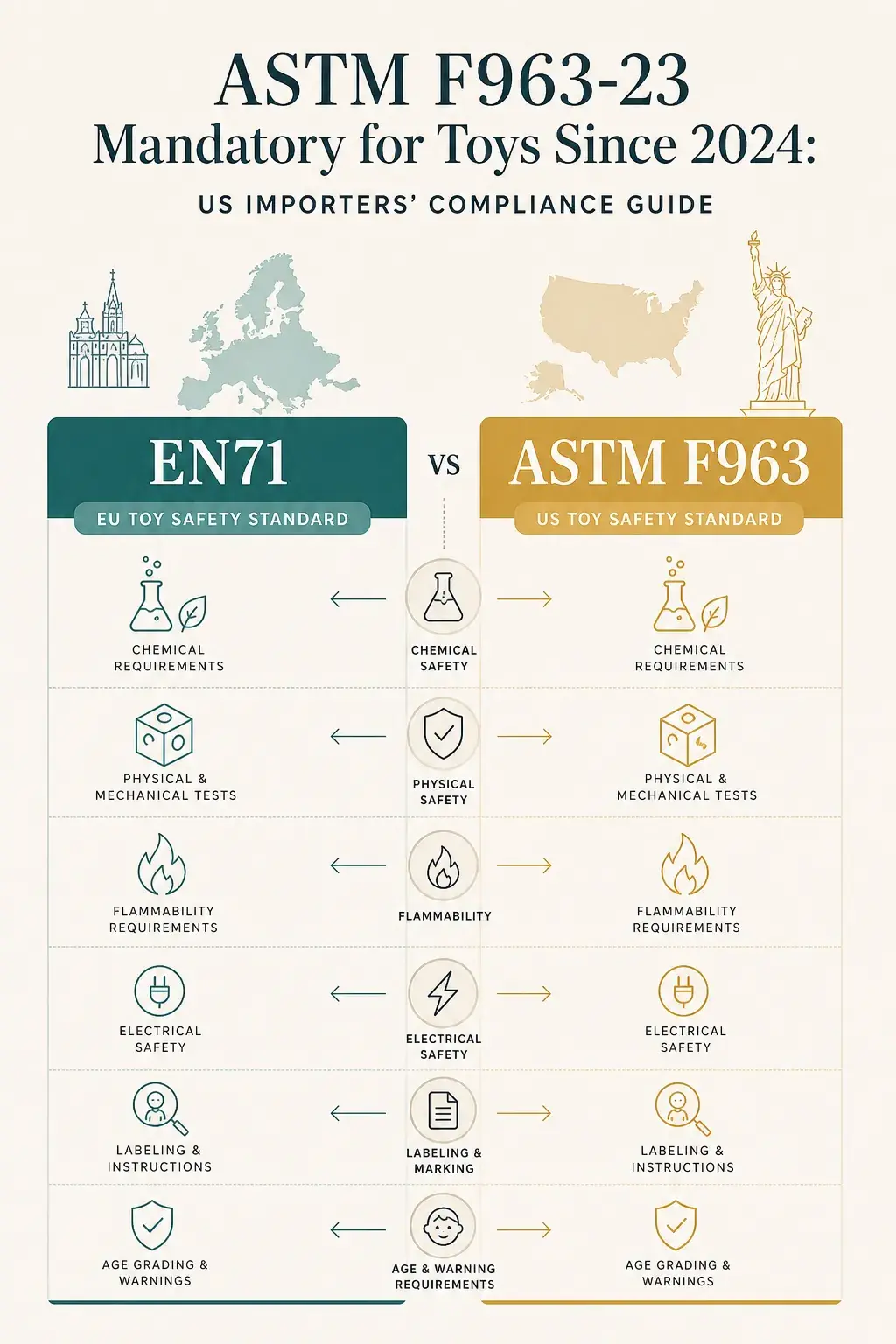
ASTM F963-23 vs. EN71: What's the Difference?
| ASTM F963-23 (US) | Mandatory for toys sold in the US under CPSIA; enforced by CPSC. Applies to children under 14, testing/certification for 12 and under. Key areas: mechanical/physical, chemical (lead, cadmium, phthalates), electrical, acoustic. Not all sections require third-party testing; CPC required. |
|---|---|
| EN71 (EU) | Series of standards under the EU Toy Safety Directive; mandatory for toys sold in the EU. Covers mechanical/physical, flammability, chemical, electrical, and more. Requires CE marking and a Declaration of Conformity. Different limits and test methods compared to ASTM. |
| Key difference | Both are mandatory in their respective markets, but they are not interchangeable. A toy tested to EN71 does not automatically comply with ASTM F963, and vice versa. You need separate testing for each market. |
Common Pitfalls and How to Avoid Them
Assuming 'ASTM F963' on a report means the latest version. Always check the edition number. If it says F963-17 and your toy is manufactured after April 20, 2024, it's non-compliant.
Over-testing or under-testing. Some importers think every section needs third-party testing, which inflates costs. Others skip testing for sections that do need it, risking non-compliance. Use the 16 CFR § 1112.15(b)(32) list as your reference.
Ignoring the manufacture date. The CPSC ties the applicable version to when the toy is made, not when it's imported. If your supplier has leftover stock from before the cutoff, it may be compliant under F963-17, but you must confirm the actual production date.
Forgetting other CPSC requirements. ASTM F963 covers a lot, but not everything—lead, phthalates, small parts, and tracking labels are separate. Make sure your compliance plan covers all of them.
Not verifying the lab is CPSC-accepted. A report from a non-accepted lab is worthless for compliance. Always cross-check the lab's name against CPSC's acceptance list.
How to Choose a Supplier That Meets ASTM F963-23
Evaluate suppliers against these five criteria:
1. Ask for their latest test report and CPC, and verify the lab is CPSC-accepted. If they hesitate or provide an outdated report, move on.
2. Confirm they understand the manufacture-date rule. A supplier who says 'we always test to the latest' may not realize they need a new test for your specific batch date.
3. Check if they have experience with F963-23's specific changes—battery compartments, sound limits, expanding materials. Ask how they've updated their manufacturing processes.
4. Request a copy of the test matrix to see which sections were tested and which were deemed not applicable. This shows whether they've done a thorough analysis.
5. Build compliance milestones into your contract: require the test report before production, the CPC before shipment, and the tracking labels on every unit.
Choosing a supplier that's already aligned with F963-23 saves you from last-minute surprises and customs holds.
FAQ
What is the difference between ASTM F963-23 and F963-17?
F963-23 is the latest mandatory version for toys manufactured after April 20, 2024. It includes changes to sound limits, battery accessibility, expanding materials, and extended use/abuse testing. F963-17 was the previous mandatory version and still applies to toys made before that date.
Can I sell toys manufactured before April 20, 2024 under F963-23?
No, if the toy was manufactured before the cutoff, it must comply with the version that was in effect at that time, which is F963-17. You can sell it, but you need to verify the manufacture date and ensure the test report and CPC reference the correct edition.
Do I need a CPC for every toy I import?
Yes, for any toy intended for children 12 and under, you need a CPC issued by the domestic manufacturer or importer. It must be based on third-party testing at a CPSC-accepted lab and cite the correct ASTM version.
How much does ASTM F963-23 testing cost?
Testing costs vary based on the product complexity and the lab. Typical ranges are USD 60–190 per component for heavy metals and USD 125–350 per component for phthalates, with full product testing potentially exceeding USD 1,000. Always get quotes from multiple CPSC-accepted labs.
Is flammability testing required under ASTM F963-23?
No, flammability is not a mandatory requirement under 16 CFR 1250.2(b). However, toys must not be extremely or highly flammable solids under the FHSA. Always confirm with your supplier that they are not applying the flammability section unnecessarily.
Sources
Request a Quote
Ready to source compliant toys? Contact us for a compliance review of your product specifications and get a quote for ASTM F963-23 testing and documentation support. We'll help you verify your supplier's compliance and ensure your shipment clears customs without delays.