

How to Request Toy Samples and Compliance Files: Email
Oct 23, 2026Updated Oct 23, 2026By CPS TOYS B2B Sourcing Editor
Request identified toy assortment samples and product-specific compliance files together, while keeping sample evaluation separate from bulk-order authorization. A useful buyer email states the destination market, selected variants, written specification, required evidence, and approval conditions. For sample-led assortment testing, compare the first physical samples with the agreed design requirements—not with a reference sample that has not yet been approved. Retain an approved production reference only after discrepancies are resolved and approval is recorded.
Use the template below for new-category screening or buyer approvals. Commercial sample review, regulatory evidence review, and the later bulk-production inspection are separate decisions.
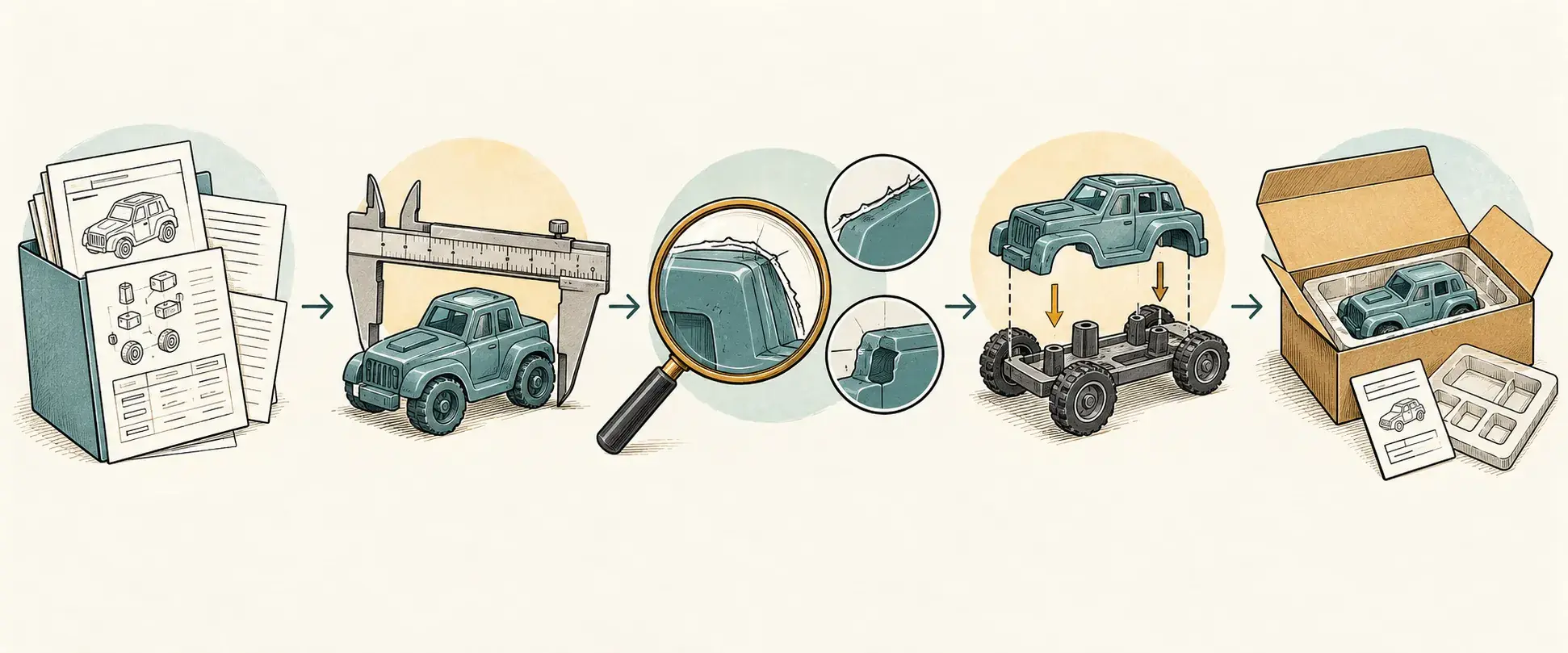
What should the sample and compliance-file request email say?
Ask the supplier to return an item-by-item sample proposal and document index against your attached specification.
Subject: Sample and compliance-file request — [toy assortment/project] — [destination market]
Hello [name], Please quote samples for our evaluation of [toy category/assortment] for [destination country and sales channel]. We are [company and buyer role]. This request is for sample review; please do not begin bulk production without our separate written authorization.
Our attached selection sheet identifies each requested model, color, size, accessory set, and sample quantity. Please confirm which variants you propose to send. Identify whether each sample is a catalog sample, prototype, or production-intent sample, and list any differences from the proposed bulk construction or packaging before dispatch.
Please confirm the written specification and design revision you will work to, including intended functions, component materials, dimensions, finish, accessories, instructions, and retail packaging. Flag any requirement you cannot match rather than substituting it without agreement.
For each selected item, please provide an indexed compliance-file package for [destination market]. Include the relevant complete test reports, product/model identification, tested construction, laboratory details, test dates, and standards or rules covered. Explain how each report relates to the sample and its variants. Please disclose construction, material, or component changes made since testing.
Please include the destination-specific documents listed in our attached market checklist, plus proposed product markings, retail label artwork, warnings, age grading and its supporting rationale, instructions, and traceability details for review. Keep US and EU document sets separately identified if both markets are proposed.
Please quote sample charges, delivery charges, and the proposed dispatch date separately. State which packaging will accompany the samples and identify any mock-up or unfinished artwork. If a mixed sample shipment is possible, please describe the proposed contents; do not substitute unapproved items.
We will compare the samples with the agreed written specification and return an itemized discrepancy record. Please confirm who will handle corrections and revised samples. After approval, we will agree how to identify and retain the approved production reference, alongside the specification and change history.
Please reply by [requested response date] with the sample proposal, quotation, document index, and any deviations requiring our decision. Thank you, [name / title / company / contact details]
Replace the bracketed fields and attach the selection sheet before sending. Sample quantities should reflect the planned commercial review and any laboratory work; do not assume a display sample will also remain available after laboratory testing.
What should buyers inspect when the first samples arrive?
| Identity and sample status | Inspect: model, variant, accessories, and declared sample stage. Compare with: selection sheet and supplier dispatch list. Failure signal: wrong variant, missing accessory, or an undeclared prototype substitution. Next decision: obtain the correct sample or explicitly limit the review to the features represented. |
|---|---|
| Function | Inspect: the operating sequence and each promised feature using the agreed instructions. Compare with: functional specification and design requirements. Failure signal: a feature does not operate, behaves inconsistently, or differs from the agreed sequence. Next decision: record the condition, request correction, and repeat the affected checks on the revised sample. |
| Materials and construction | Inspect: visible component arrangement, texture, seams, joints, and accessible assembly details. Compare with: component-level material specification, drawings, and supplier declarations. Failure signal: a visible construction difference or a declared substitution. Next decision: reconcile the specification and obtain a qualified assessment of any effect on test coverage. Touch alone does not identify a resin or prove chemical safety. |
| Finish | Inspect: color, print alignment, coating appearance, seams, and visible molding defects. Compare with: agreed artwork, finish requirements, and any agreed physical color reference. Failure signal: smearing, uneven coating, misplaced graphics, or a mismatch outside the agreed acceptance criteria. Next decision: require a corrected finish sample before approving that feature. |
| Dimensions and fit | Inspect: named measurement points, assembled fit, and accessory interfaces. Compare with: dimensioned drawing and buyer-agreed tolerances. Failure signal: an out-of-tolerance measurement or an interface that does not fit as specified. Next decision: log actual measurements and request correction or a formally agreed design revision. |
| Retail packaging and labels | Inspect: package format, item and accessory count, product identity, artwork, instructions, and legibility. Compare with: packing specification and destination-specific label checklist. Failure signal: incorrect contents, conflicting model references, omitted agreed text, or unreadable printing. Next decision: correct the artwork or packing arrangement and review the affected version before release. |
Which compliance files should buyers request for the US or EU?
Request a destination-specific, product-linked file rather than treating a generic certificate or catalog logo as approval for the assortment.
For the US, where a Children's Product Certificate is required, request the actual CPC and supporting test records. CPSC identifies the domestic manufacturer or importer as the certifier and specifies certificate information covering the test-record contact, manufacture, testing, and laboratory. For an imported product, check that the responsible importer and product identity are correctly represented. CPSC: Children's Product Certificate
For the EU, request the product-specific declaration of conformity, supporting assessment and test records, and arrangements for access to the relevant technical documentation. European Commission guidance places conformity assessment, technical documentation, the EU declaration of conformity, and CE marking within the manufacturer's responsibilities; importers and distributors also have responsibilities. A CE symbol on sample packaging is not a substitute for reviewing the supporting file. European Commission: CE marking
Ask the reviewer to identify the applicable rules, standard editions, and test scope for the product and intended market. Do not use an 'EN71/ASTM certificate' checkbox as a universal pass. Match the report's model description, photographs, components, materials, and variants to the proposed construction, and resolve differences before relying on it.
A buyer's hand inspection does not establish regulatory safety or determine age suitability. Refer safety questions to the applicable laboratory assessment. Likewise, a construction change calls for a coverage review—not an automatic assumption that every internal item number or batch needs a new report.
What should the sample inspection record contain?
Keep a revision-controlled record that connects each physical sample to the requirement checked and the resulting approval decision.
Use this copyable entry for each discrepancy: Sample ID and variant: [identifier] Sample stage and receipt date: [details] Specification/artwork revision: [reference] Requirement and acceptance criterion: [agreed requirement] Observed result or measurement: [actual finding] Supporting evidence: [notes, measurement record, and photographs where useful] Decision: [accept / correct and resubmit / hold for technical review] Action owner and agreed response date: [details] Recheck result and reviewer: [details]
Photographs help locate a defect, but a missing photograph alone does not invalidate a review supported by clear observations and measurements. Avoid recording only 'poor quality': name the affected part, requirement, and observed difference.
How would this check work for a toy piano with a microphone?
For a toy piano with a microphone, turn the product description into separate function, construction, and packaging checks before judging the sample.
The cataloged Rainbow Touch Piano includes a microphone and records ABS as a material. Request component-level material confirmation rather than assuming ABS describes every part. Against the agreed functional specification, check the key responses and microphone operation; compare the supplied microphone, connection, and accessories with the design and packing list.
As a hypothetical discrepancy, suppose the keys operate but the microphone produces no output during the agreed operating sequence. Record the setup and result, hold approval of that function, and request a corrected sample. Recheck the corrected function and any affected features before approval. Do not turn that observation into a safety conclusion or infer a production-wide defect rate.
When should a sample become the approved production reference?
Create the approved production reference only after the sample matches the agreed requirements and all approval-blocking discrepancies are closed.
Identify the retained sample with its model, variant, approval date, and specification revision. Record any explicitly accepted deviations and who authorized them. Keep the approved artwork, component specification, inspection findings, and change history with the reference; the physical sample complements those records rather than replacing them.
Bulk comparison comes next. Inspect production against the current specification, retained approved reference, packaging requirements, and authorized changes. Agree the production sampling plan separately: approval of a few development samples is not evidence that an entire production lot conforms.
Close the sample review with an explicit decision for each assortment item: advance to the next buying stage, correct and resubmit, or remove it from the test assortment. Request the next quotation or sample revision against that decision—not against an unresolved email thread.