

PPWR 2025/40: Toy Importers' Packaging Duties from Aug 2026
Aug 22, 2026Updated Aug 22, 2026By CPS TOYS B2B Sourcing Editor
The EU Packaging and Packaging Waste Regulation (PPWR) 2025/40 entered into force on 11 February 2025 and generally applies from 12 August 2026, bringing binding packaging obligations for every toy importer placing goods on the EU market—separate and distinct from the toy's own CE marking. If you import toys into the EU, packaging is now its own compliance layer: recyclability, labelling, a Declaration of Conformity, and Extended Producer Responsibility (EPR) registration. Ignoring this layer risks border rejection, even if the toy itself is fully CE compliant. This article explains what changes, what importers must do, and how to build packaging compliance into your sourcing contracts before the August 2026 deadline.
What Does PPWR Actually Require for Toy Packaging?
PPWR applies to all packaging placed on the EU market—primary, secondary, tertiary, and service packaging—regardless of material. For toy importers, this includes the blister pack, the retail box, and the shipping carton. The regulation sets requirements for manufacturing, composition, and the reusable or recoverable nature of packaging. Key obligations include: all packaging must be designed to be recyclable in an economically viable way by 2030; plastic packaging must meet minimum recycled content targets from 2030 and 2040; and packaging must avoid unnecessary weight and volume. For transport and e-commerce grouping packaging, there is a maximum empty space ratio of 50%. These are binding conditions for market access, not optional design preferences.
The regulation also phases in restrictions on certain single-use plastics, and PFAS are restricted in food contact packaging above thresholds. While most toy packaging is not food contact, the same principle of substance restriction signals that packaging materials are under scrutiny. The previous Packaging and Packaging Waste Directive 94/62/EC is generally repealed on 12 August 2026, though some provisions continue to apply. The transition is not a clean break; importers should monitor Commission guidelines (expected from March 2026) and FAQs (from August 2026) for practical details.
How Is Packaging Compliance Different from CE Marking for Toys?
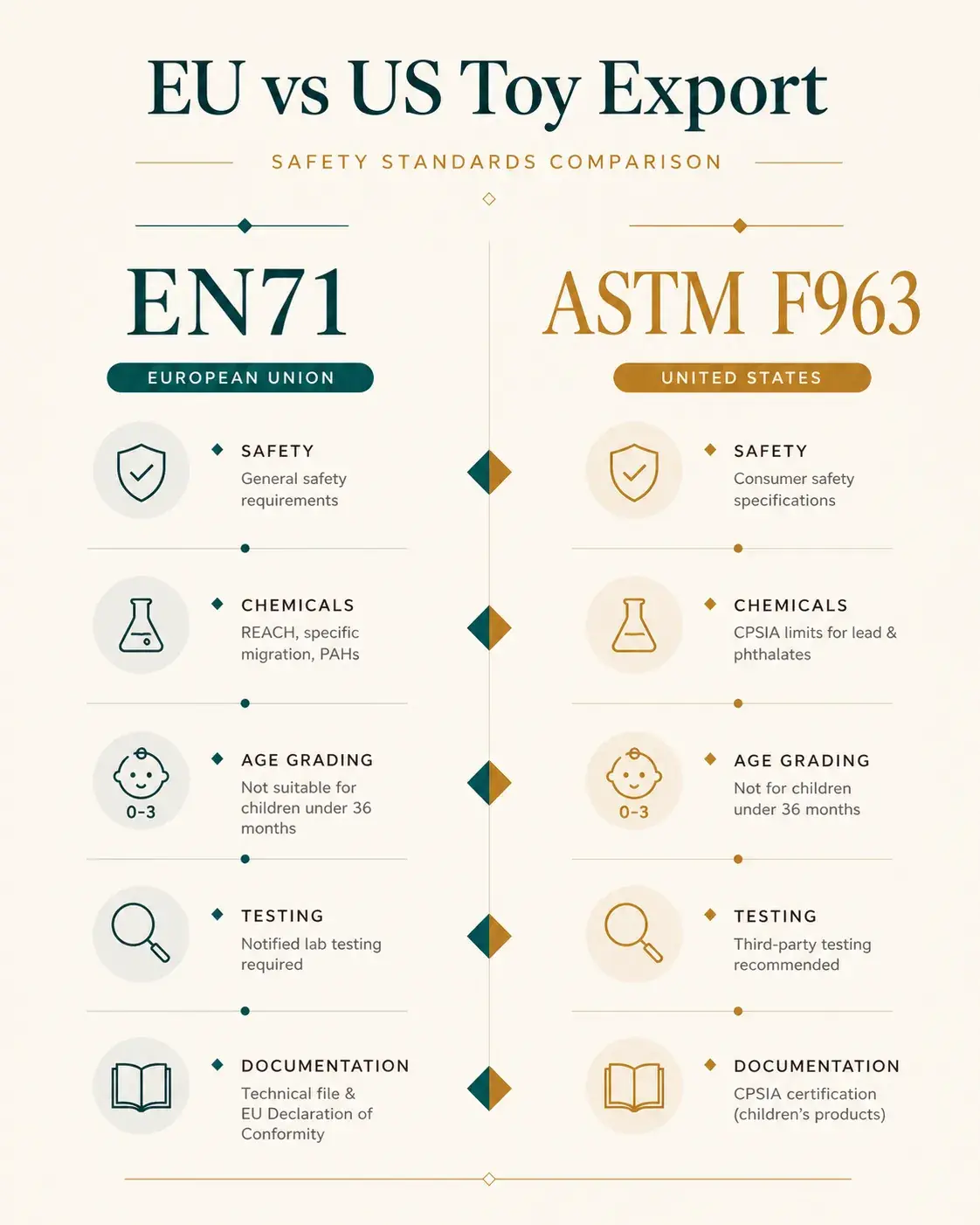
CE marking for toys, based on the Toy Safety Directive and harmonized standards like EN 71, concerns the product's safety—mechanical, chemical, flammability, and more. PPWR is a separate regulatory layer that addresses the packaging's environmental performance. They do not share the same deadline logic: CE marking is a continuous requirement for selling toys, while PPWR has a specific general application date of 12 August 2026. A toy can be perfectly CE compliant yet fail to meet PPWR packaging rules, and that failure can block your shipment. For electronic toys, RoHS and CE marking for EEE are related obligations, but they are not a substitute for toy-safety mechanical or chemical testing. Each requirement must be managed on its own track.
Practically, your compliance checklist must have separate columns: one for the product (EN71, ASTM F963, REACH, etc.) and one for the packaging (PPWR recyclability, labelling, Declaration of Conformity, EPR). When you audit a supplier, you cannot accept a single 'CE' certificate as covering everything. You must ask specifically about packaging conformity.
What Are the Importer's Specific Duties Under PPWR?
As an importer, you are an economic operator with direct responsibilities. Before placing packaging on the EU market, you must verify that the packaging manufacturer has carried out the required conformity assessment and has technical documentation and an EU Declaration of Conformity available. You must be able to present these to market surveillance authorities upon request. Technical documentation must be retained for 5 years for single-use packaging and 10 years for reusable packaging after placement. This is a record-keeping obligation, not a one-time checkbox.
You also inherit Extended Producer Responsibility (EPR) obligations. This means registering with the national authority in each EU country where you place packaging and reporting data on packaging type, weight, recyclability, and recycled content. Fees apply. If you are a non-EU importer, you may need to appoint an authorised representative to manage EPR locally. Micro-enterprises are subject to lighter rules, but they are not automatically exempt; they must still meet core obligations. If a micro-enterprise can pass the obligation to an EU-based packaging supplier in the same country, that may help, but it requires a specific supplier relationship—confirm this with your supplier.
PPWR Obligations at a Glance for Toy Importers
| Obligation | Detail |
|---|---|
| Recyclability | All packaging must be designed to be recyclable in an economically viable way by 2030 |
| Recycled content (plastic) | Minimum recycled content required in plastic packaging from 2030, increasing from 2040 |
| Empty space ratio | Transport/e-commerce grouping packaging: max 50% empty space |
| Labelling | Material composition label and digital code (e.g., QR) with reusability/tracking info |
| Declaration of Conformity | Required for each packaging type placed on the market from 12 August 2026 |
| Technical documentation retention | 5 years (single-use) or 10 years (reusable) after placement |
| EPR registration | Register with national authority in each EU country of sale; report packaging data |
What Should You Ask Your Supplier Now?
Ask a direct question: 'Is your packaging PPWR-compliant, and can you provide a Declaration of Conformity for each packaging type?' If the answer is a blank look, you have a problem. Request the technical documentation, not just a certificate. Ask for evidence of recyclability design, recycled content percentages, and an empty space ratio calculation for your shipping cartons. Do not accept a generic 'we meet EU requirements' statement.
Determine who holds the EPR registration. In many cases, the importer of record must register, but your supplier may offer a service to register on your behalf or provide the necessary data. Clarify this in your contract: who registers, who pays fees, and who is liable if packaging data is inaccurate. If you are a non-EU importer, consider appointing an EU authorised representative who can handle EPR and be the point of contact for market surveillance authorities.
Build packaging compliance into your product development timeline. If you are sourcing a new toy with a custom blister pack, the packaging design must be reviewed against PPWR criteria before you commit to tooling. Retrofitting an existing design after August 2026 will be more expensive and may delay your launch.
How to Choose Between Packaging Suppliers for PPWR Compliance
Do not rely solely on price when evaluating packaging suppliers. Assess their understanding of PPWR. A supplier that can show you a compliant packaging design, provide a Declaration of Conformity, and explain how they calculate recycled content is a partner, not just a vendor. Ask about their material sourcing: do they offer recycled-content plastic films or paperboard with certified recycled content? Can they adjust the empty space ratio without compromising product protection?
Consider the labelling requirement. The digital code (e.g., QR) must be printed on the packaging. Verify that your supplier can handle the artwork and data encoding without errors. A misprint could mean non-compliance at the border. If you are using a contract manufacturer for the toy itself, check whether they can integrate packaging compliance into the same production line, or whether you need a separate packaging supplier. Each option has trade-offs: a one-stop supplier may simplify documentation, while a specialist packaging vendor may offer better recyclability expertise.
How to Prepare for the August 2026 Application Date
The general application date is 12 August 2026. Timelines for specific provisions may vary by packaging type and are not all confirmed from official text; for example, the 2030 recyclability and recycled content targets are phased, and some reuse or single-use restrictions have their own dates. The official text does not confirm every application date for every obligation, so do not rely on secondary summaries for legal deadlines. Monitor the European Commission's guidelines and FAQs, which are expected to be published through 2026, and check with your legal counsel for the exact applicability to your product lines.
Run a packaging audit now. List every packaging type you use: retail boxes, blister packs, polybags, cartons, and any service packaging like mailer boxes. For each, assess: Is it recyclable? Does it have unnecessary empty space? Does it contain any restricted substances? What is the recycled content? Document the answers. This audit will become the basis for your Declaration of Conformity and your EPR reporting. Start collecting data on packaging weight and material composition from your suppliers; you will need it for national registrations.
FAQ: Toy Importers' Packaging Compliance Questions
What is the deadline for PPWR compliance for toy packaging?
PPWR entered into force on 11 February 2025 and generally applies from 12 August 2026. However, some obligations are phased (e.g., recyclability by 2030, recycled content targets from 2030 and 2040). Verify specific dates for your packaging types from the official text, as not every provision has a confirmed application date.
Does PPWR apply to my toy packaging even if I only ship from a non-EU country?
Yes. PPWR applies to all packaging placed on the EU market, regardless of where the manufacturer is located. As an importer, you are an economic operator and must ensure the packaging complies, including holding a Declaration of Conformity and fulfilling EPR obligations.
Can I rely on my toy supplier's CE certificate to cover packaging compliance?
No. CE marking for toys covers product safety, not packaging environmental requirements. PPWR is a separate regulation. You must obtain a separate Declaration of Conformity for the packaging and verify it meets recyclability, labelling, and other PPWR criteria.
What documents do I need to keep for PPWR compliance?
You must keep the EU Declaration of Conformity for each packaging type and technical documentation. Retention is 5 years for single-use packaging and 10 years for reusable packaging after placement. You must be able to present these to market surveillance authorities on request.
Do micro-enterprises get an exemption from PPWR?
Micro-enterprises are subject to lighter rules but are not automatically exempt. They must still meet core obligations. An exemption may be possible if a micro-enterprise can pass obligations to an EU-based packaging supplier in the same country, but this requires a specific supplier relationship—confirm this with your supplier.
How do I register for EPR for packaging in the EU?
You must register with the national authority in each EU country where you place packaging on the market and report data on packaging type, weight, recyclability, and recycled content. Fees apply. If you are a non-EU importer, you may need to appoint an authorised representative to manage EPR locally.
Sources
Related Products & Categories
Request a Quote
Need a sourcing partner who understands both toy safety and packaging compliance? Contact our team to discuss your next order and how we can support your EU market entry with the right documentation and packaging design.