

EU Toy Safety Regulation 2025/2509: Compliance Timeline for 2026
Aug 21, 2026Updated Aug 21, 2026By CPS TOYS B2B Sourcing Editor
Regulation (EU) 2025/2509 is now in force, but for importers and distributors the key date for 2026 is transition: the regulation entered into force on 1 January 2026, while most of its toy-safety requirements apply only from 1 August 2030. The one early exception is significant — Articles 28 to 44 and Articles 49 to 55, covering notified-body oversight, delegated powers, committee procedures, confidentiality, and penalties, apply from 1 January 2026. That means the legal machinery is already running even though your product may still be placed on the market under Directive 2009/48/EC until August 2030.
For a wholesale buyer deciding what to do now, the practical answer is: keep validating products against the current directive and EN 71, but start engineering for the 2030 regime today. The regulation is a regulation, not a directive, so it will apply uniformly across all EU member states with no national transposition. Every sourcing decision you make in 2026 — material choice, packaging design, data infrastructure, supplier contracts — should be tested against the question: will this still be compliant in 2030?
Key Takeaways
- Regulation (EU) 2025/2509 entered into force on 1 January 2026, but the main application date for most toy-safety requirements is 1 August 2030; Directive 2009/48/EC remains the operative regime for placing toys on the market during the transition.
- Articles 28 to 44 and Articles 49 to 55 apply from 1 January 2026 — these concern conformity-assessment body notification, delegated powers, committee procedures, confidentiality, and penalties, not product-level safety rules.
- The regulation introduces a Digital Product Passport (DPP) for all toys, replacing the paper EU Declaration of Conformity; the European Commission is expected to share carrier details by July 2026, and the DPP becomes mandatory by the end of the transition period.
- New chemical bans and limits — on PFAS, ten bisphenols, N-nitrosamines, and certain monomers — will apply from August 2030, so material and reformulation planning should start in 2026.
- Until new harmonized standards are published under the regulation, EC Declarations of Conformity may continue to reference Directive 2009/48/EC and current EN 71 standards.
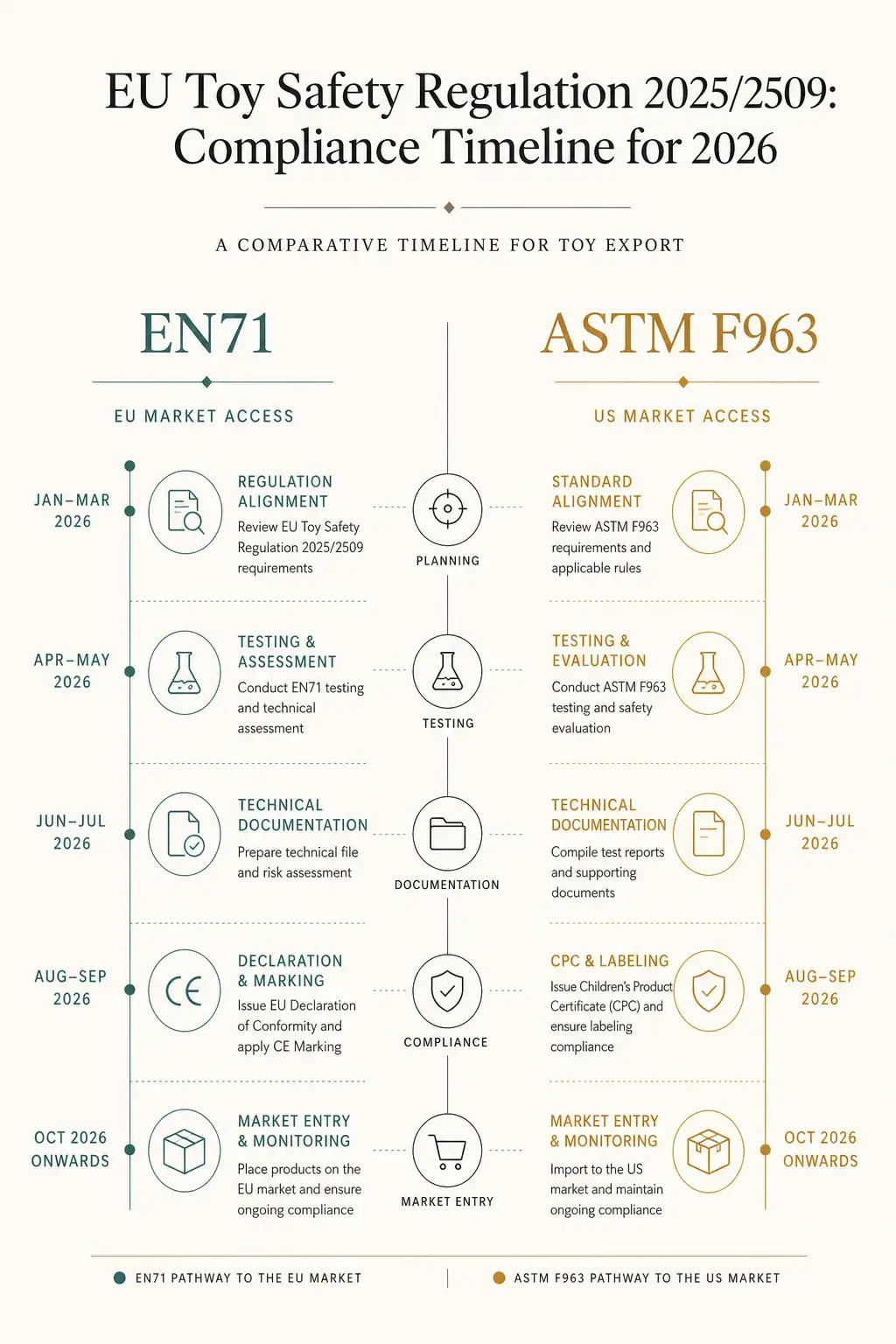
What Is Regulation (EU) 2025/2509 and Why Does the Timeline Matter?
Regulation (EU) 2025/2509 is the EU's new toy-safety law, published in December 2025, replacing Directive 2009/48/EC. Because it is a regulation rather than a directive, it applies directly and identically in every EU member state — no national implementing laws are needed. That single fact changes compliance planning: what was once a patchwork of national transpositions becomes one uniform rulebook.
The timeline matters because it splits into two very different obligations. The regulation entered into force on 1 January 2026. That is the date the legal text exists and the European Commission can exercise certain powers. But the substantive product-safety requirements — the bans, the limits, the Digital Product Passport — apply from 1 August 2030. Between those two dates lies a transition period during which toys may still be placed on the market under the existing directive.
For a buyer, the trap is reading a headline that says 'EU Toy Safety Regulation in force 2026' and assuming every toy must meet new rules on 1 January 2026. That is not what the official text says. The early application of Articles 28-44 and 49-55 is confirmed from January 2026, but most product-level requirements are not confirmed as applying before August 2030. Plan for 2030, not for a 2026 product freeze.
Which Requirements Apply in 2026 vs. Which Apply in 2030?
Separate the machinery from the product rules. From 1 January 2026, the provisions that apply are administrative and institutional: how conformity-assessment bodies are notified, how the Commission adopts delegated acts, how committees operate, confidentiality rules, and penalty frameworks. These are the gears turning in the background. They do not change what is printed on your toy's label tomorrow.
What applies from 1 August 2030 is the entire product-safety regime: chemical restrictions including bans on PFAS and ten bisphenols, migration limits for N-nitrosamines and certain monomers, the Digital Product Passport for every toy, cybersecurity safeguards for connected toys, new warning legibility rules, and stricter battery-access requirements. This is where your product design, material sourcing, and packaging will actually be tested.
There is one 2026 item that touches the product itself: online visibility of warnings. The regulation requires all warnings to be visible before purchase, including on online listings, aligning with the General Product Safety Regulation (EU) 2023/988. So while the full warning-legibility spec (font x-height minimum 1.2mm, warning triangle minimum 10mm) is part of the 2030 regime, the principle that a buyer sees warnings before buying applies to your e-commerce listings now under GPSR. Update your listings in 2026; redesign your packaging for 2030.
EU vs. US Toy Safety: Which Certification Applies Where?
| Market | European Union / EEA |
|---|---|
| Primary legal framework | Directive 2009/48/EC (current); Regulation (EU) 2025/2509 (applies fully from 2030-08-01) |
| Harmonized standard | EN 71 series (e.g., EN 71-1 mechanical/physical, EN 71-2 flammability, EN 71-3 migration of elements) |
| Conformity marker | CE marking, based on the manufacturer's Declaration of Conformity |
| U.S. legal framework | Consumer Product Safety Improvement Act (CPSIA); ASTM F963 incorporated at 16 C.F.R. part 1250 |
| U.S. certification requirement | Third-party testing by a CPSC-accepted laboratory, plus a Children's Product Certificate (CPC) |
| U.S. key limits | Lead in paint ≤90 ppm, total lead ≤100 ppm, phthalates ≤0.1% (1000 ppm), small parts ban, tracking labels |
| Buyer action | Specify both EN71 and ASTM F963 in the contract if selling in both markets; require the supplier's test reports and certificates |
What Is the Digital Product Passport and Why Start Now?
The Digital Product Passport (DPP) is one of the biggest operational changes in Regulation 2025/2509. It replaces the paper EU Declaration of Conformity with a digital record unique to each toy model, accessible via a QR code on the product or packaging. The data must be kept for 10 years. The mandate applies to all toys, not just connected or electronic ones.
The Commission is expected to share carrier details by July 2026. That does not mean the DPP is live in 2026 — it becomes mandatory by the end of the transition period in August 2030. But the data collection burden is real, and it is not something you can bolt on in 2029. You need a system for generating, storing, and updating unique passports per model, keyed to your bill of materials and test reports.
For a buyer sourcing from OEM manufacturers, the DPP shifts responsibility up the supply chain. Your supplier must be able to provide the underlying data — materials, test results, chemical composition — in a structured format. Add a clause to your 2026 supplier contracts requiring data readiness for the DPP, even if the passport itself is not yet due.
Which Certification Should a Buyer Require from a China Toy Supplier?
If you are importing wholesale toys from China, the certification you require depends entirely on your destination market. For the EU, the current benchmark is EN 71 compliance supporting the CE mark under Directive 2009/48/EC. For the U.S., it is ASTM F963 third-party testing with a Children's Product Certificate (CPC). A serious supplier should be able to produce both, but verify the test reports yourself rather than accepting a marketing claim.
Ask for the actual test report from an accredited laboratory, not just a certificate. Check that the report covers the specific EN 71 parts relevant to your product — EN 71-1 for mechanical/physical safety, EN 71-2 for flammability, EN 71-3 for migration of certain elements are the most commonly required. For U.S. market access, confirm the lab is CPSC-accepted and that the report references the specific ASTM F963 sections that require third-party testing under the rule.
One caution: a certification issued today references the current directive. As Regulation 2025/2509 comes into force, the standards landscape will shift — CEN has already published revised EN 71-1:2026 and EN 71-8:2026. Your supplier contract should include a clause that obliges the manufacturer to update certifications as new harmonized standards are published under the regulation, not just a one-time test at contract signing.
FAQ
Which safety certifications (e.g., EN71, ASTM F963) are mandatory for importing wholesale toys from China into the EU or US?
For the EU, EN 71 compliance supporting the CE mark under Directive 2009/48/EC is the current requirement. For the U.S., toys for children 12 and under must be third-party tested to ASTM F963 by a CPSC-accepted laboratory and covered by a Children's Product Certificate (CPC). They are separate regimes — one does not substitute for the other.
Which international safety certifications should a distributor require from an OEM toy manufacturer before signing a contract?
Require the certifications for your destination markets: EN 71 for the EU, ASTM F963 with CPC for the U.S. Ask for the underlying test reports from an accredited lab, confirm the lab is CPSC-accepted for U.S. shipments, and include a clause obliging the supplier to update certifications when new harmonized standards are published under Regulation 2025/2509.
What packaging and labeling options does an OEM toy manufacturer offer for retail-ready blister packs, and how do they handle import compliance documentation?
Packaging and labeling options vary by manufacturer and must be specified in your contract. For EU compliance, plan for the new warning legibility rules (font x-height minimum 1.2mm, warning triangle minimum 10mm) as they apply from August 2030, and the Digital Product Passport QR code on packaging. In 2026, ensure warnings are visible on online listings under GPSR. Compliance documentation typically includes the CE Declaration of Conformity and test reports.
Which safety certifications like EN71 or ASTM F963 should a US retailer verify before finalizing a contract with a China toy supplier?
For U.S. market access, verify ASTM F963 third-party testing by a CPSC-accepted laboratory and the existence of a Children's Product Certificate (CPC). Also confirm compliance with CPSIA limits: lead in paint ≤90 ppm, total lead ≤100 ppm, phthalates ≤0.1%. If you also sell in the EU, require EN 71 certification separately — the two standards are not interchangeable.
What safety certifications like EN71 or ASTM F963 do Chinese suppliers typically hold for wholesale toys?
Suppliers exporting to the EU typically hold EN 71 test reports; those exporting to the U.S. hold ASTM F963 test reports with CPCs. What a supplier 'typically holds' varies by their export focus, so always request the specific report for your destination market and verify it is from an accredited laboratory. Do not accept a generic certificate without the underlying test data.
If Regulation 2025/2509 is in force in 2026, do I need to change my product today?
No — most product-level requirements apply from 1 August 2030. In 2026, toys may still be placed on the market under Directive 2009/48/EC. The early-applying articles (28-44 and 49-55) cover administrative matters like notified-body oversight and penalties. Use 2026 to plan for chemical bans, the DPP, and new labeling rules rather than to redesign your product for the new regulation immediately.
Sources
Related Products & Categories
Plan Your 2026 Sourcing with the 2030 Rulebook in Mind
The transition period is your preparation window. Every material spec, packaging layout, and supplier contract you sign in 2026 should be built to survive the 2030 regime. If you are sourcing foam toys or other wholesale products and need to verify EN 71 compliance and supplier documentation before your next PO, send us your spec sheet and destination markets. We will confirm what certifications apply and what your supplier contract should require.