

Which Safety Certifications Are Mandatory for Importing Wholesale Toys?
Sep 04, 2026Updated Sep 04, 2026By CPS TOYS B2B Sourcing Editor
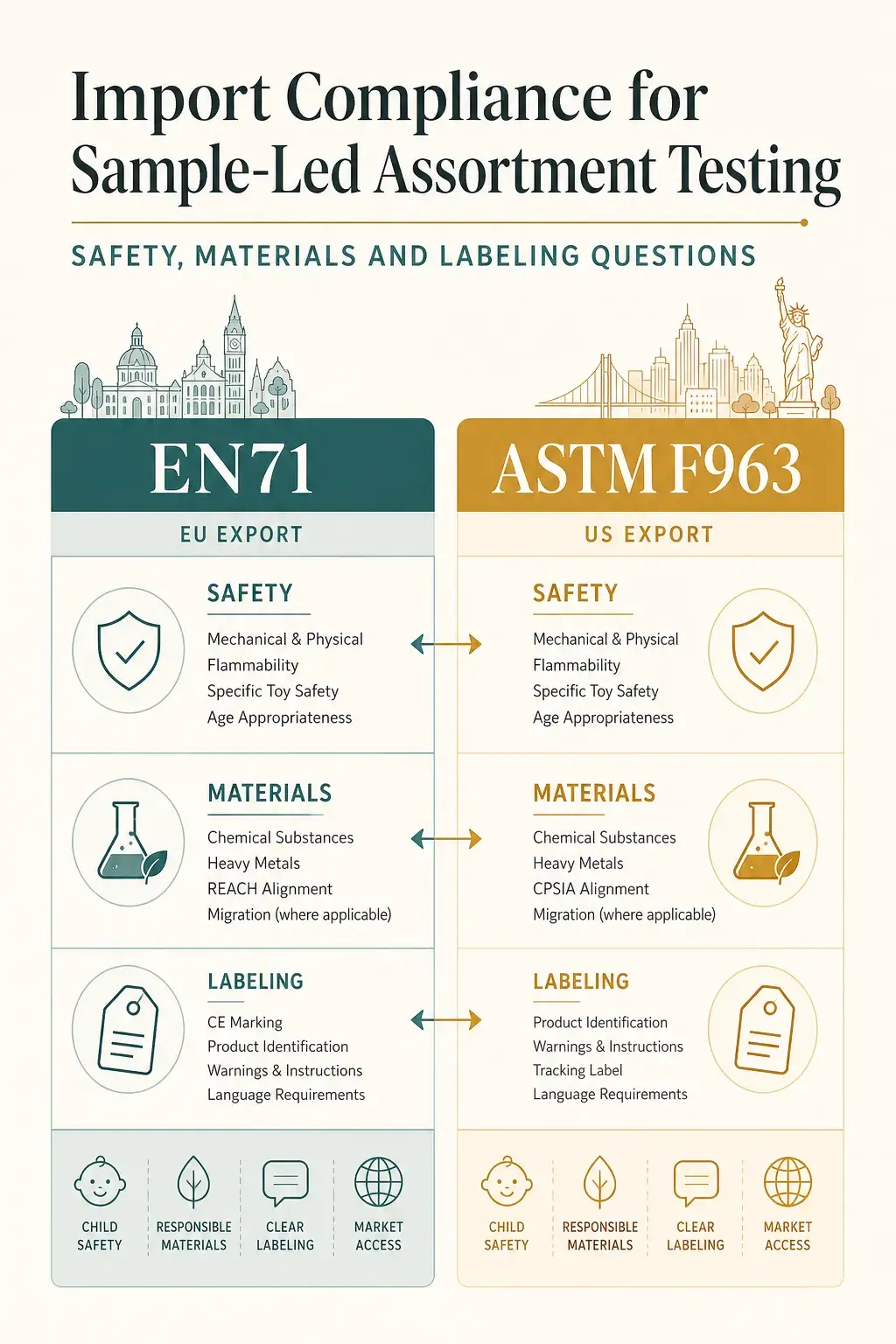
For toys sold in the U.S., ASTM F963-23 is the mandatory toy safety standard and children's products must be third-party tested and certified with a Children's Product Certificate (CPC); for the EU, EN71 is the applicable standard, but the mandatory legal framework is the Toy Safety Directive (2009/48/EC), not the standard itself. A buyer evaluating samples for an assortment should request the test report and certificate for the exact sample lot, verify the lab is accepted for the destination market, and confirm the certificate covers all applicable sections—before committing to a purchase order. This article gives you a decision framework for sample-led testing, separating mandatory certification from supplier claims, and covering material, labeling, and document checks that protect your margin and your brand.
Key Takeaways for Sample-Led Assortment Testing
- Certification is market-specific: U.S. toys need ASTM F963-23 testing and a CPC; EU toys need compliance with the Toy Safety Directive, typically demonstrated via EN71 test reports. A single 'CE' mark does not cover U.S. requirements.
- Sample evidence is lot-specific: A test report is only valid for the exact production lot tested; any change in material, design, or supplier requires retesting and a new certificate. Don't assume a sample report covers bulk production.
- Labeling is part of the certificate: Tracking labels with manufacturer identity, date/place of manufacture, and batch number are mandatory on U.S. toys and packaging—often missed in sample reviews.
- Separate certification from Incoterms: FOB, CIF, or DDP allocate cost and risk, but they do not certify product safety. Compliance documents are a separate deliverable on the PO.
- Verify the lab and scope: For U.S. children's products, the lab must be CPSC-accepted; check the lab's scope includes the specific sections of ASTM F963 relevant to your product (e.g., small parts, sound, batteries).
What Documents Should You Request with a Sample?
The first document to request is the test report for the exact sample you are evaluating. According to Eurofins, 'ASTM F963 test reports are only valid for the specific production lot or batch tested.' That means a report for a previous run, a similar toy, or a different material does not cover your sample. Ask the supplier for the report that corresponds to the sample's production lot and confirm the lab is accepted for your destination market (CPSC-accepted for the U.S., or an EU-notified body for certain aspects of the Toy Safety Directive).
The second document is the certificate that accompanies the product at import: a Children's Product Certificate (CPC) for U.S. children's toys, or a Declaration of Conformity (DoC) for EU toys. According to the CPSC, the CPC must be issued by the importer (for overseas products) and must accompany the shipment. The certificate should list the specific regulations and standards it covers—like 16 C.F.R. Part 1250 for the U.S.—and include the manufacturer's name, testing date, and place. If the supplier cannot produce this for the sample, that is a red flag before you commit to bulk.
Finally, ask for the supplier's testing program documentation. For general use (non-children's) products, the CPSC requires a 'reasonable testing program'—which should be in writing and based on factors like vendor relationships, materials, and process variability. For children's toys, the program must include third-party testing by a CPSC-accepted lab. A supplier that can show you their program, rather than just a single test report, is more likely to maintain compliance across production runs.
How Do Material Choices Affect Compliance Testing?
Material selection is not just a cost decision; it drives what testing is required. For example, the CPSC notes that certain materials—like unfinished wood and specific fibers—are exempt from soluble heavy metals testing. But a plastic like ABS will need to be tested for lead content (100 ppm total) and, for accessible parts that can be sucked or mouthed, for eight soluble heavy elements. A biofibre straw material, as used in some building block toys, may have different chemical properties than conventional PP or ABS, so confirm the test report covers the exact material in your sample.
A common misconception is that food-contact approval for a plastic means it is safe for toys. According to our verified facts, food-contact approval does not automatically demonstrate compliance with toy-specific mechanical, flammability, or chemical requirements. Similarly, silicone rubber is an elastomer, not a thermoplastic; it needs a different molding and material-compliance review than PP, ABS, or PVC. When evaluating samples, ask the supplier for the material data sheet and confirm the test report lists the material by name and grade.
For the EU, chemical requirements under the Toy Safety Directive include limits on certain heavy metals and phthalates. The EN71 standard has parts for mechanical, flammability, and chemical properties, but the directive itself is the legal requirement. A test report to EN71 is evidence of compliance, but the declaration of conformity (DoC) should reference the directive (2009/48/EC).
Which Labeling and Packaging Checks Are Mandatory?
Labeling is often the last thing buyers check, but it is a frequent cause of customs holds and retail rejections. For U.S. toys, the CPSC requires tracking labels that include the manufacturer's name, date and place of manufacture, batch or run number, and other identifying information. These must be on the product and packaging. For the EU, the Toy Safety Directive requires the CE mark, the importer's name and address, and warnings like 'Not suitable for children under 36 months' where applicable.
When reviewing samples for assortment testing, check that the label is physically on the sample, not just on the packaging. According to the CPSC, labeling and instructional literature are exempt from third-party testing, but they must still be included in the certification. That means a missing tracking label can invalidate the CPC even if the toy passes mechanical and chemical tests.
Labeling claims also have compliance consequences. If you put 'non-toxic' or 'BPA-free' on the packaging, you need test evidence to support that claim. The same applies to age grading—the age range on the box determines which sections of ASTM F963 apply (e.g., small parts for under-3). A mismatch between the stated age and the actual testing can create a compliance gap.
How to Use Sample Evidence to Decide Before a Purchase Order
The core idea of sample-led assortment testing is that you make purchase decisions based on documented evidence, not on a supplier's assurances. Before you commit to a PO, you should have: (1) a test report that matches the sample lot, (2) a certificate (CPC or DoC) that covers all applicable sections, (3) a tracking label check, (4) a material data sheet, and (5) confirmation that the lab is accepted for your market.
Use a checklist to compare the sample evidence against your requirements. For each product variant in your assortment, note which ASTM F963 sections apply (e.g., small parts, sound, batteries) and verify the test report covers those sections. For the EU, confirm the EN71 parts tested align with the product's features. If the supplier cannot provide the evidence for the sample, you have two options: ask for a new sample with proper documentation, or walk away. Early commitment to a PO without sample evidence shifts the risk to you—including the cost of rework, customs holds, and recalls.
Remember that Incoterms like FOB or DDP do not replace compliance documents. They only allocate cost and risk. You need to specify the compliance deliverables (test report, certificate, labels) as separate line items in the PO. This protects you if the shipment arrives without the required documents.
U.S. vs EU Toy Compliance at a Glance
| Mandatory legal framework | U.S.: CPSIA and 16 C.F.R. Part 1250 (incorporates ASTM F963-23). EU: Toy Safety Directive 2009/48/EC. |
|---|---|
| Key standard | U.S.: ASTM F963-23 (effective April 20, 2024). EU: EN71 series (parts for mechanical, flammability, chemical). |
| Certification document | U.S.: Children's Product Certificate (CPC) for toys; General Certificate of Conformity (GCC) for general use products. EU: Declaration of Conformity (DoC) referencing the directive. |
| Testing laboratory | U.S.: Must be CPSC-accepted for children's products. EU: Can be any lab, but notified bodies are required for certain aspects (e.g., if not using harmonized standards). |
| Labeling requirements | U.S.: Tracking labels with manufacturer, date/place of manufacture, batch number. EU: CE mark, importer details, age warnings. |
| Key limits (examples) | U.S.: Lead 100 ppm total, lead in paint 90 ppm, phthalates 1000 ppm. EU: Specific limits in Directive 2009/48/EC for heavy metals and phthalates. |
How to Choose the Right Supplier Evidence for Your Assortment
Not all suppliers provide the same level of evidence. A supplier that holds multiple certifications (e.g., EN71, ASTM F963, CPC, REACH) may still have gaps in the specific sections that apply to your product. For example, a supplier might have a test report for a similar toy, but not for your exact variant with a different battery compartment or sound module. Ask to see the test report for the specific sample you are evaluating.
Verify the report's date and lab. A test report is only valid for the lot tested; a report from two years ago on a different production run is not sufficient. For U.S. toys, the lab must be CPSC-accepted, and the report should list the standard and sections tested. For the EU, check that the report is from a lab that can issue a test report for the Toy Safety Directive—this is often a notified body for certain tests.
When comparing suppliers, create a matrix of the required documents for each product variant in your assortment. This helps you see at a glance which suppliers can meet your compliance needs and which cannot. It also gives you negotiating power: you can ask a supplier to retest a variant at your cost if they cannot provide the evidence, but that should be priced into the PO, not assumed.
What Are the Costs and Trade-Offs of Testing in Your Assortment?
Testing costs money, and for an assortment of many SKUs, the cost can multiply. The trade-off is between testing every variant versus testing a representative sample. According to the CPSC, you can rely on component part testing if suppliers provide test results and their testing program. This can reduce costs for common materials like PP or ABS, but it requires the supplier to document the testing program and any material changes.
The margin impact is real. If you are importing a bubble machine at $3.18 with a MOQ of 36 pieces, the testing cost per unit could be significant if you test each variant separately. But skipping testing to save money on the sample can lead to a failed audit or a recall, which costs far more. The CPSC's guidance on a 'reasonable testing program' allows for a risk-based approach, but it must be in writing and justified.
For new category tests, the cost is higher because there is no prior test data. Budget for testing as a line item in your product development cost, not as an afterthought. If you are working with a supplier that offers 'certified' products, verify what that certification covers—it may not include your specific variant.
What Should You Check in the Supplier's Test Report?
When you receive a test report, check these elements: (1) the product description matches your sample, (2) the standard and version (e.g., ASTM F963-23, not F963-17), (3) the sections tested are listed and match your product's features, (4) the lab is accepted for your market (CPSC-accepted for U.S.), (5) the test date is recent and matches the sample lot, and (6) the report includes the production lot or batch number. If any of these are missing, ask for clarification before you approve the sample.
Check the report for any 'N/A' or 'not tested' notes. For example, flammability is not a mandatory third-party test for U.S. toys, but the report should indicate if it was not tested. If your product is likely to be near a flame, you may need additional testing to avoid FHSA violations. For the EU, the EN71 test report should indicate which parts were tested; if a part is not tested, the DoC should state why it is not applicable.
Finally, verify that the certificate (CPC or DoC) is signed and includes the certifier's contact information. According to the CPSC, the certificate must be based on the test results and must accompany the product. A certificate without a test report is not valid; a test report without a certificate is not sufficient for import.
Frequently Asked Buyer Questions
Which safety certifications (e.g., EN71, ASTM F963) are mandatory for importing wholesale toys from China into the EU or US?
For the U.S., ASTM F963-23 is mandatory for toys, and children's products must be third-party tested and certified with a CPC. For the EU, compliance with the Toy Safety Directive (2009/48/EC) is mandatory, typically demonstrated via EN71 test reports. Always request the specific test report for your sample lot.
What is the MOQ impact on testing costs for a new category?
Testing costs are fixed per variant, so a low MOQ (e.g., 36 pieces) spreads the cost over fewer units, increasing per-unit cost. Consider testing a representative sample or relying on component part testing to reduce costs, but document your program per CPSC guidance.
Can I rely on a supplier's existing test report for my sample?
Only if the report is for the exact sample lot and covers your product's features. A report for a similar toy or an older version of the standard does not suffice. Always ask for the report that matches your sample's lot and verify the lab is accepted.
How do I handle labeling checks for a sample before bulk order?
Check that the tracking label (U.S.) or CE mark and importer details (EU) are physically on the sample and packaging. Verify the age grading matches the tested sections. Labeling is exempt from third-party testing but must be included in the certificate.
What if my supplier does not provide a CPC or DoC with the sample?
That is a red flag. The certificate must accompany the shipment, and it must be based on test results. Ask for the certificate before PO commitment; if it is not provided, consider another supplier or require it as a condition in the PO.