

Private-Label Electric Water Gun Assortments: Color, Logo, Packaging and Sample Decisions
Sep 02, 2026Updated Sep 02, 2026By CPS TOYS B2B Sourcing Editor
Yes, you can private-label electric water gun assortments, but the first decision is whether you buy OEM (your design), ODM (our design plus your brand), or stock plus logo—that choice sets your MOQ, tooling cost, and sampling timeline. For most importers, the fastest path to a branded summer line is ODM on an existing mold with custom colors, logo, and packaging, while a fully custom mold only pays off when you have the volume to justify it. This guide covers what you can change, what it costs in time and money, and the exact steps from inquiry to shipping, so you can brief any factory with confidence.
Key Takeaways
- ODM (existing mold + your brand) offers speed and a low MOQ; full OEM requires you to own the design and have the volume to justify a new mold. Stock-plus-logo is the fastest and cheapest entry but limits differentiation.
- MOQ is factory- and SKU-specific—there is no universal number. For molded ABS water guns, typical OEM MOQs in the Chenghai cluster start around 60–120 units per SKU for existing molds, but fully custom molds may require 1,000–3,000 units. Confirm the MOQ per item, not per order.
- Color matching is not about a Pantone code alone. The approved physical sample (golden sample) is the master for production; matching later lots to a PDF causes disputes. Always seal a physical chip in QC.
- Battery and electrical compliance (ASTM F963, 16 C.F.R. part 1505 for US; EN71 and EN IEC 62115 for EU) is a product, package, and transport review—not a single certificate. Any change in battery, charger, or packaging is a version change that requires re-verification.
- Labeling for small parts and choking hazards is non-negotiable: if your electric water gun has small parts or is marketed to children under 6, you must include cautionary statements on the principal display panel. Your logo must not obscure them.
OEM vs ODM vs Stock + Logo: Which Customization Route Fits Your Assortment?
| OEM (Your Design) | You own the design; factory builds a new mold. MOQ: typically 1,000–3,000 units for custom molds; tooling cost: yes, separate; lead time: includes mold-making, usually 20–35 days production after mold approval. |
|---|---|
| ODM (Our Design + Your Brand) | Factory's existing mold, but you customize colors, logo, packaging, and sometimes features. MOQ: often starts at 60–120 units per SKU for ABS water guns; tooling cost: none (factory owns mold); lead time: 20–35 days production. |
| Stock + Logo | Take an existing product as-is, add your logo to the body or packaging. MOQ: lowest, sometimes as low as a few dozen units; tooling cost: none; lead time: shortest, often 10–20 days if stock is available. |
What Can You Customize on Electric Water Guns?
You can customize color, size, material, packaging, logo, and private label—but each change has a different cost and lead time impact. Color is the most common request; packaging is the second; full material changes are rare because ABS is the standard for electric water guns.
Color: You can specify a Pantone or send a reference image. The factory will match to a physical chip, not just a digital code. For electric water guns, color affects the mold's surface finish and the glow/LED effects if any. A 'just change the color' request on a showroom sample can be misleading if the sample is not from the production tool—always confirm that the sample you approve is from the actual mold you will use.
Size: Changing dimensions usually requires a new mold, which is a significant cost. Minor size tweaks (e.g., a slightly larger tank) may be possible on existing molds, but confirm the mold's flexibility. For example, a 1000ml automatic electric water gun has a fixed intake design that may not suit all stall layouts—size changes are not trivial.
Material: ABS is the standard material for electric water guns. You can request ABS+PP for certain parts (e.g., handle or tank) to reduce cost or weight, but changing material affects durability and may require re-testing for compliance. Only do this if you have a specific reason—otherwise stick with ABS.
Packaging: You can choose retail-ready display boxes, polybags, or blister cards. Packaging MOQ is separate from product MOQ. Your artwork must include all required warnings (small parts, choking hazards, battery safety) and your logo. The factory will need the final artwork file in a specific format (e.g., AI or PDF) before printing. Packaging dimensions and carton quantity should be based on measured production packaging, not just the artwork file—this affects shipping costs and shelf fit.
Logo and private label: You can print your logo on the gun body, the packaging, or both. For private label, you can add your brand name to the product and manual. The logo file must be high-resolution and must be frozen on the purchase order before production starts—late logo changes lead to wrong sticker plates on the first carton.
MOQ, Tooling and Mold: What You Need to Know
MOQ for electric water guns is not a single number—it varies by factory, SKU, and customization level. Molded-toy MOQ is a commercial term affected by resin, mold, decoration, packaging, and production quantity; it should not be published as one universal industry fact. Your RFQ should ask for MOQ per item, not a blanket number.
For ODM on existing molds, MOQs often start low. In the Chenghai cluster, some factories offer OEM MOQs as low as 60–90 units per SKU for water blasters, but that is for stock or light customization. For custom colors and packaging, the MOQ may rise to 300–600 units per SKU. For fully custom molds, expect MOQs in the 1,000–3,000 unit range to amortize tooling costs.
Tooling cost is a one-time fee for creating a new mold. It depends on the complexity of the design—a simple gun body mold is cheaper than one with moving parts or electronics. Tooling is owned by the buyer if you pay for it, but many factories retain ownership for ODM. Always clarify mold ownership in writing before paying.
When you send an RFQ, include the following to get an accurate MOQ quote: destination market, age grade, materials and colors, packaging language, requested tests, sample policy, tooling terms, and trade term (FOB, CIF, etc.).
Sampling and Lead Time: What to Expect
Sampling is a multi-step process, not a single sample. You will typically go through: 1) a pre-production sample (PPS) to check color, logo, and packaging, 2) a golden sample (the approved master), and 3) a production sample from the first batch. Each step takes time, so plan for at least 2–3 sample rounds before mass production.
Sample lead time varies: a stock sample can ship in a few days, but a custom color and packaging sample may take 10–15 days. For ODM with existing molds, first-article samples are usually quick—7–10 days after mold setup. For full OEM with new mold, add 3–6 weeks for mold-making before the first sample.
Production lead time for electric water guns is typically 20–35 days for OEM orders, depending on quantity and factory load. Stock plus logo can be faster—sometimes 10–20 days if the base product is in stock. Always confirm the lead time per item, not as a blanket number.
During sampling, pay attention to the battery configuration. The sample must match the exact package configuration: battery type, included cells, charging method, and accessories. Any change in color, battery, charger, or package is a version change that requires rechecking sample, artwork, warnings, carton data, and documents.
Your sample approval should be in writing, with photos and notes. Seal the physical golden sample in QC, and never match later lots to a PDF. Color arguments end when the golden sample is in the room, not when the email thread is long.
The OEM/ODM Process (Step by Step)
Step 1: Brief and RFQ. Send a detailed inquiry: product type (electric water gun, model), target market (US, EU, etc.), age grade (e.g., 6+), quantity per SKU, colors, packaging requirements (display box, polybag, language), certificate needs (ASTM F963, EN71, EN IEC 62115), and desired sample policy. Ask: 'What is the MOQ per item for ODM with custom colors? What is the tooling cost if I need a new mold?'
Step 2: Quote and commercial terms. The factory quotes FOB or CIF price, MOQ, lead time, and sample cost. Confirm payment terms (typically 30% deposit, 70% before shipment) and whether the sample cost is deducted from the bulk order. Ask: 'Does the price include my logo and packaging? Are there separate packaging MOQs?'
Step 3: Sampling and approval. Request a pre-production sample with your colors, logo, and packaging. Review it against your spec: color matching to a physical chip, logo placement, battery compartment access, and warning labels. Approve the golden sample in writing. Ask: 'Is this sample from the production tool? What is the revision number?'
Step 4: Tooling (if OEM). If you are doing full OEM, the factory makes the mold. Confirm mold ownership in the contract. Ask: 'Who owns the mold, and what happens if I stop ordering? Is the mold tested with a first-article sample before mass production?'
Step 5: Mass production. Once the golden sample is approved, the factory starts production. Freeze the logo, color, carton mark, and battery door on the PO before any printing or tooling is released. Ask: 'What is the production schedule? When will you send the production sample for my final check?'
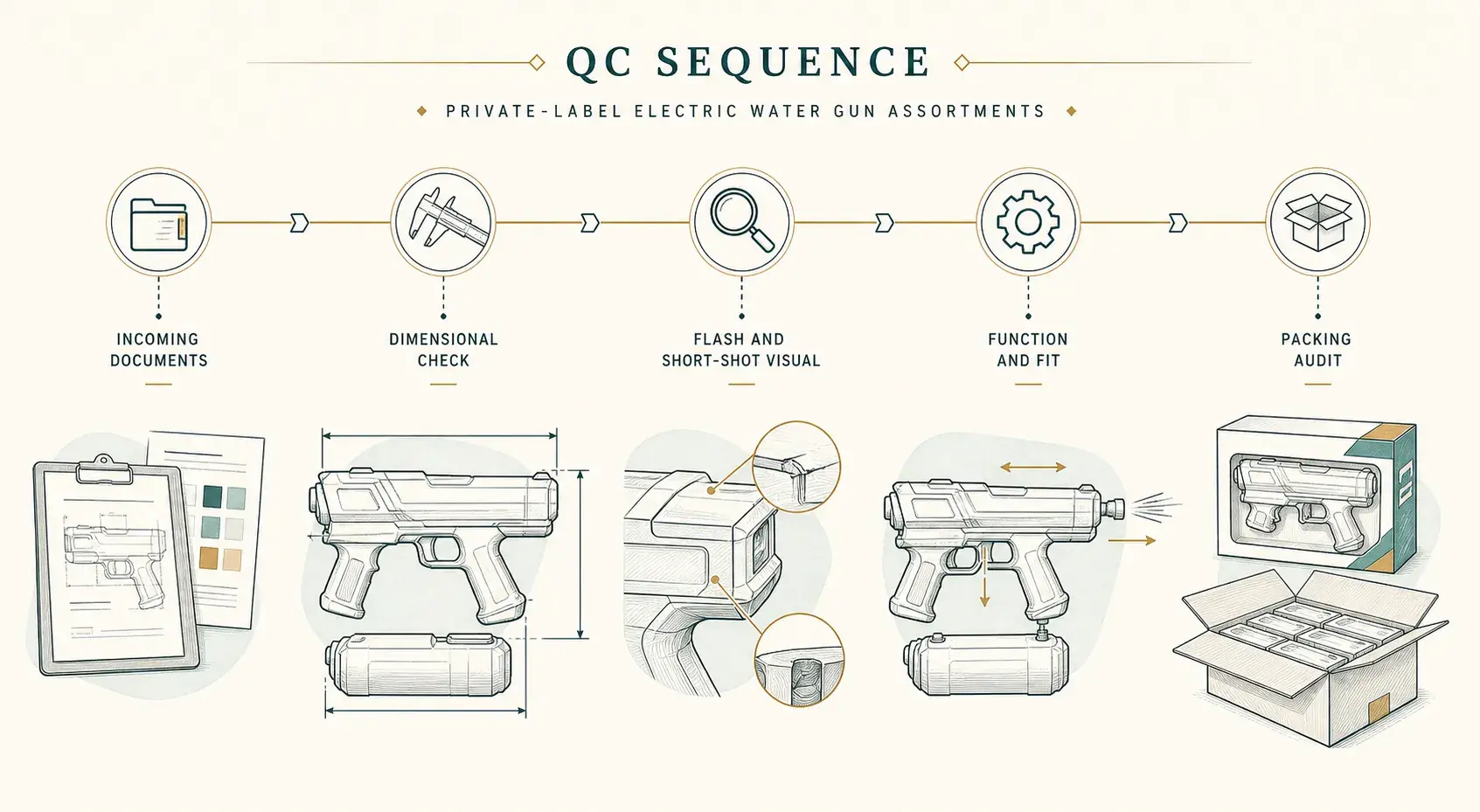
Step 6: QC and inspection. Before shipment, you or a third-party inspector should check the goods against the golden sample: color, logo, packaging, battery configuration, and warning labels. Use an AQL sampling plan (e.g., ISO 2859-1) to decide how many units to inspect. Ask: 'Can you provide a pre-shipment inspection report? What is your defect rate for this product?'
Step 7: Shipping and documents. Confirm the packing list, carton dimensions, and shipping marks. Ensure the carton has the correct barcode per SKU—mixed cartons without an assortment list get bounced at the DC. Ask: 'Do you provide the certificate of conformity (e.g., CPC for US, CE declaration for EU)? What is the carton’s CBM and gross weight?'
Worked Example (illustrative, not a real shipment)
A US importer plans a summer assortment of electric water guns for pool and outdoor retailers. They want three SKUs: a 1000ml auto-absorb model, a LED light-up model, and a basic continuous-firing model. They decide to go ODM on existing molds to keep costs down.
They send an RFQ with target market (US), age grade (8+), colors (blue, orange, green), packaging (retail-ready display box with logo), and certificate needs (ASTM F963, CPSIA). The factory quotes MOQ of 120 units per SKU for ODM with custom colors and packaging, and a lead time of 25–30 days. They order 120 units of each SKU, total 360 units.
They request a pre-production sample for each SKU. The first sample arrives with the wrong logo color—the Pantone was not matched. They reject it and ask for a re-sample. The second sample matches the physical chip. They approve the golden sample in writing. Production starts, and they arrange a pre-shipment inspection using AQL 1.5. The inspector finds a few units with loose battery covers, but the defect rate is within the acceptable level. They ship to two destinations: 180 units to a West Coast warehouse, 180 to an East Coast distributor. The cartons have the correct barcode per SKU, and they include the assortment list on the carton to avoid DC rejections.
Color matching and packaging compliance are the two most common failure points. A clear golden sample and a detailed PO that freezes logo, color, and carton marks prevent most problems.
Compliance and Labeling: What to Check Before You Ship
Electric water guns are electrically operated toys, so they must meet specific safety standards. In the US, ASTM F963 is mandatory for toys under CPSIA, and electrically operated toys must comply with 16 C.F.R. part 1505. Battery-operated toys must have secure battery compartments and proper labeling to prevent access and overheating. Toy guns must be permanently marked with bright colorations to avoid being mistaken for real firearms—this affects your color and logo choices.
In the EU, the Toy Safety Directive (2009/48/EC) applies, and you need CE marking and EN71 compliance. For electric toys, EN IEC 62115 is the relevant standard. Note that EN IEC 62115 is an update to the older EN 62115, and the transition period ended—check the latest version applied in the EU. For shipping, battery type affects transport regulations (e.g., lithium batteries require UN38.3 test report).
Labeling: If your water gun has small parts (e.g., detachable caps) or is marketed to children under 6, you must include cautionary statements on the principal display panel per 15 U.S.C. 1278. This is a non-negotiable part of your packaging design. Your logo must not obscure these warnings.
For private-label orders, the importer of record is responsible for compliance. You cannot rely solely on the factory's word—request item-level certificates (e.g., CPC for US, Declaration of Conformity for EU) and match them to the exact SKU, battery configuration, and package. Any change in color, battery, or packaging is a version change that requires a new review.
This year, there are no new US federal regulations specific to water guns, but the CPSC continues to enforce ASTM F963. For the EU, the General Product Safety Regulation (GPSR) applies to all consumer products, and the Digital Product Passport (DPP) is separate from the Toy Safety Directive—do not confuse the deadlines. The timeline for DPP is not confirmed from official text for toys, so check with your compliance partner before assuming a date.
FAQ: Private-Label Electric Water Gun Sourcing
What is the minimum order to customize an electric water gun?
For ODM on existing molds, MOQs often start at 60–120 units per SKU for light customization (color/logo). For custom packaging, the MOQ may be higher (e.g., 300–600 units). For a fully custom mold, expect 1,000–3,000 units. Confirm per item with your factory.
How much does a sample cost, and is it refundable?
Sample cost varies by factory; many deduct the sample fee from the bulk order. For a stock sample, it may be free (you pay shipping). For a custom sample with your colors and logo, expect a fee—ask if it is deductible. Always get the sample in the exact configuration you plan to order.
Who owns the mold if I pay for tooling?
If you pay for the mold, the mold is typically your property, but the factory may hold it. If the factory owns the mold (ODM), you cannot take it elsewhere. Clarify mold ownership in writing before paying any tooling fee.
Can you print our logo and use our packaging?
Yes, most factories offer logo printing and custom packaging. You must provide a high-resolution logo file and approve the artwork before production. Confirm whether packaging MOQ is separate from product MOQ, and ensure your packaging includes all required warning labels.
Will you sign an NDA to protect my design?
Many factories will sign an NDA, but it is not automatic. Ask early in the conversation. For OEM designs, an NDA is important, especially if you are sharing unique specifications. Some factories may decline for small orders—be prepared to negotiate.
What is the typical lead time for a private-label order?
For ODM with existing molds, production lead time is usually 20–35 days. Add 7–10 days for sampling. For full OEM with a new mold, add 3–6 weeks for mold-making. Stock plus logo can ship in 10–20 days if stock is available.
Sources
Request a Quote for Your Private-Label Electric Water Guns
Send us your design or product specifications—target market, age grade, colors, packaging, and quantity—and we will provide a custom quote with MOQ, sampling, and lead time. We can also discuss mixed-carton options for seasonal assortments. Contact our wholesale/OEM team to start the process.