

Start with samples, not purchase orders, when you test a new toy category
Sep 05, 2026Updated Sep 05, 2026By CPS TOYS B2B Sourcing Editor
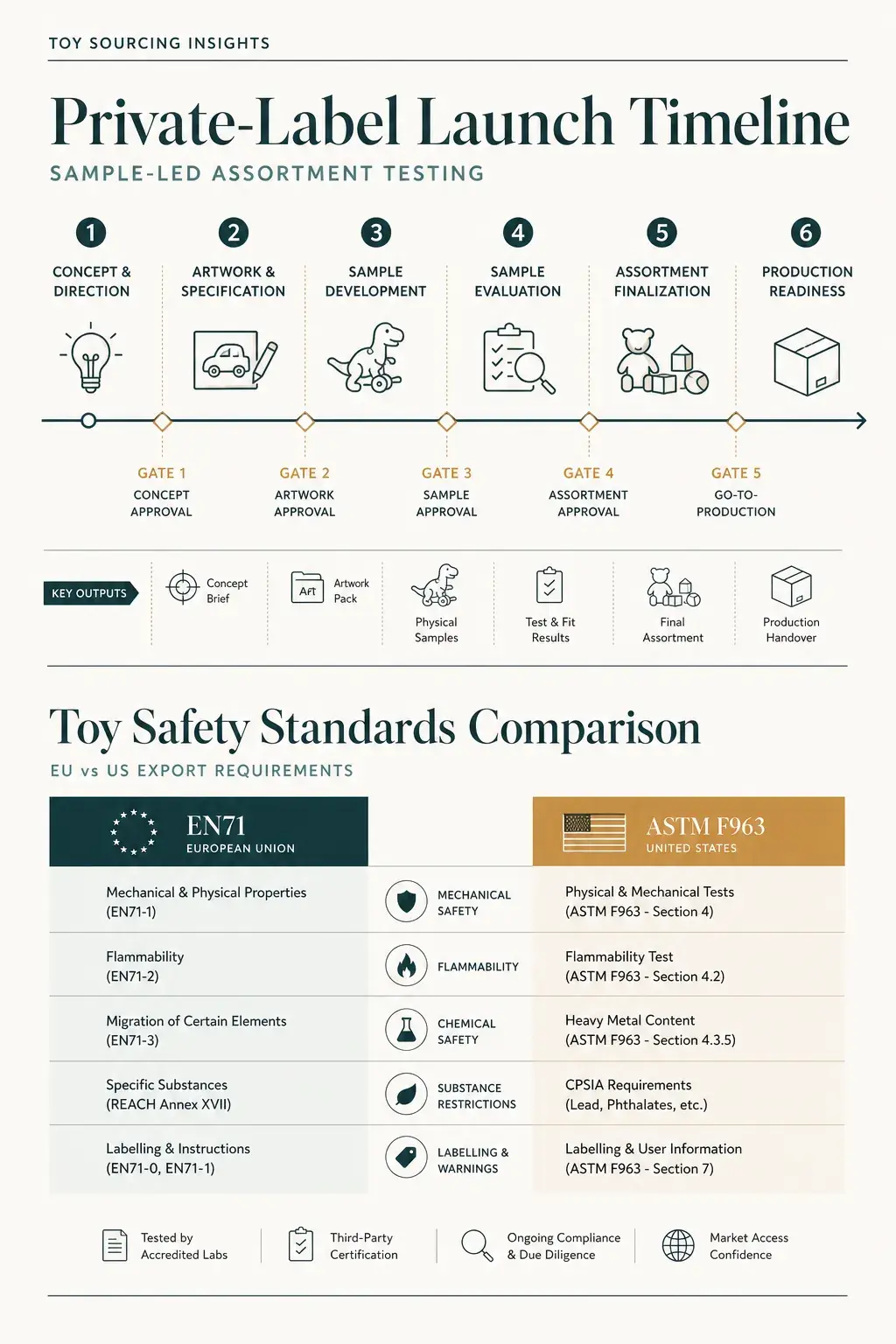
A sample-led assortment test is the fastest way to decide whether a new toy category belongs on your shelf: you approve artwork and samples first, gate the launch on compliance documents, and only then commit to a purchase order. For toy importers, distributors, retail buyers and ecommerce category managers, the practical decision is to structure the pre-order phase into three approval gates — artwork, physical sample, and compliance file — because each gate converts an operational detail into evidence you can compare across suppliers.
The stakes are concrete. Under U.S. rules, all toys intended for children 12 and under must be third-party tested by a CPSC-accepted lab and certified with a Children's Product Certificate (CPC) under 16 C.F.R. part 1250, which incorporates the current ASTM F963-23 standard. A sample without a test report is not a sample you can sell — it is a design proposal. This article gives you the gate-by-gate timeline, the documents to request, and the email-ready questions to ask before you sign a contract.
Key Takeaways
- Treat the physical sample as a provisional design, not a sellable unit: a toy for children 12 and under needs third-party testing from a CPSC-accepted lab and a Children's Product Certificate before it can be imported into the U.S. market.
- Set three approval gates before any purchase order: artwork sign-off, physical sample sign-off, and compliance-file sign-off (CPC, test reports, tracking labels). Each gate is a hard stop; skipping one pushes risk to the container.
- Age grading changes your certification cost: toys intended primarily for children 12 and under require third-party testing and a CPC, while toys for ages 13+ must still meet ASTM F963 but do not require third-party testing under the same rule.
- For EU-bound assortments, request EN71 test reports from the supplier as part of the sample package; do not assume a U.S. CPC covers EU market access.
- Confirm tracking labels on both product and packaging before approving artwork — the label must include manufacturer or private labeler identity, date and place of manufacture, and batch or run number.
Why sample-led assortment testing beats committing to a purchase order first
When you test a new category with samples instead of a full purchase order, you buy information cheaply. A sample lets you verify three things that a catalog page cannot: whether the artwork survives the actual packaging material, whether the toy's age grading matches your shelf, and whether the supplier's compliance documents match the product in your hand.
The cost of skipping this is asymmetric. A handful of samples plus courier fees is small next to a container of product that fails a small-parts check or arrives without the right tracking label. The CPSC defines a toy as any object designed, manufactured, or marketed as a plaything for children under 14, and the testing and certification requirement applies to toys intended primarily for children 12 and under. That distinction — 12 and under versus 13+ — is exactly the kind of detail you want to resolve at the sample stage, not after production.
Comparison is the second reason to lead with samples. When you evaluate three suppliers for the same category, the artwork proof and the sample tell you who runs a tighter process. A supplier who sends a sample with a matching specification sheet, a test report reference, and a clear labeling plan is giving you evidence you can compare. A supplier who sends only a photo is asking you to buy on trust.
What are the approval gates in a sample-led launch timeline?
Artwork approval is the first gate. This is where you lock the brand elements that appear on the product and packaging: logo, color codes, warning copy, and the tracking label. The tracking label is not optional decoration — under CPSC rules it must include the manufacturer or private labeler identity, the date and place of manufacture, and the batch or run number, plus the plant address. Approve the artwork only when the tracking label text is correct, because changing it after tooling or printing starts is expensive.
The physical sample is the second gate. Evaluate it against the approved artwork, not against the catalog image. Check the material against your specification, confirm the age grading is appropriate for your target customer, and if the toy has electronic components, ask whether a water ingress or splash assessment has been done — a dry electrical bench test is not enough for a water-contact toy.
The compliance file is the third gate. For the U.S. market, this means a Children's Product Certificate and test reports from a CPSC-accepted lab covering the applicable sections of ASTM F963. For the EU, it means EN71 test documentation. Do not pass this gate on promises; request the actual documents before you issue a purchase order.
Which safety certifications are mandatory for U.S. and EU toy imports?
For the U.S. market, ASTM F963 is a mandatory consumer product safety standard under CPSIA Section 106, codified at 16 C.F.R. part 1250. The current version, ASTM F963-23, became effective on April 20, 2024, replacing the earlier F963-17. Any toy manufactured on or after that date must be tested by a CPSC-accepted third-party laboratory.
Not every section of ASTM F963 requires third-party testing. Only the sections listed in 16 C.F.R. § 1112.15(b)(32) require testing; other sections, such as certain labeling and visual inspection requirements, are exempt from testing but still fall under the certification obligation. A CPC covers all applicable sections, but the test report only needs to cover the listed ones. Ask your supplier for an itemized test scope so you are not paying for unnecessary tests and are not missing required ones.
The substance limits are specific and worth knowing before you approve a sample: lead in paint is capped at 90 ppm for children 12 and under, total lead content in any accessible component is capped at 100 ppm, and phthalates are limited to 0.1% (1000 ppm) for any regulated phthalate in accessible parts. Small parts are banned for products intended for children under 3, with cautionary labeling required for certain other toys. If your assortment includes paint or surface coatings, the certificate must cite 16 C.F.R. part 1303; for accessible substrates, it must cite 15 U.S.C. § 1278a.
For the EU, the relevant framework is the EN71 series of toy safety standards. A supplier serving both markets should be able to provide EN71 test reports alongside the ASTM F963 documentation. The two regimes are separate: a U.S. CPC does not grant EU market access, and EN71 test reports do not satisfy the U.S. third-party testing requirement.
One boundary to keep in mind: the CPSC's testing and certification requirement applies to toys intended primarily for children 12 and under. Toys intended for children 13 and older must still meet ASTM F963 but do not require third-party testing or a CPC under the same rule. Confirm the intended age grade of each sample with your supplier, because it changes your compliance cost and timeline.
Compliance document checklist by market
| U.S. — core standard | ASTM F963-23, mandatory under CPSIA, codified at 16 C.F.R. part 1250; effective for toys manufactured on or after April 20, 2024. |
|---|---|
| U.S. — certification document | Children's Product Certificate (CPC) issued by the manufacturer or private labeler, based on third-party testing in a CPSC-accepted lab. |
| U.S. — third-party testing scope | Only sections listed in 16 C.F.R. § 1112.15(b)(32) require testing; other sections are certified without testing. Ask for an itemized scope. |
| U.S. — substance limits | Lead in paint: 90 ppm. Total lead in accessible parts: 100 ppm. Phthalates: 0.1% (1000 ppm) per regulated phthalate. Small parts banned under 3 years. |
| U.S. — tracking label | Must include manufacturer/private labeler identity, date and place of manufacture, batch/run number, and plant address. Verify on product and packaging. |
| U.S. — age grade boundary | Third-party testing and CPC required for toys intended primarily for children 12 and under. Toys for 13+ must still meet ASTM F963 but not third-party testing. |
| EU — core standard | EN71 series of toy safety standards. Request EN71 test reports as part of the sample package. |
| Key distinction | A U.S. CPC does not grant EU market access; EN71 reports do not satisfy U.S. third-party testing. Treat the two regimes as separate gates. |
What QC checks should your sample evaluation include?
The physical sample is your only chance to catch design flaws before they become container-load problems. Three checks matter more than the others in a sample-led assortment test.
Flex and stress points come first. Flexible rods, handles, blades, wings and thin molded features may need repeated or static flex checks based on their foreseeable use. A part that snaps under a flex test in your office will snap in a child's hand, and it will fail the same way in a lab.
Electronics and water are the second check. If your toy has electronic components and could contact water, it needs an ingress or splash assessment that matches the intended use. A dry electrical bench test is not enough. This applies to items like water guns with LED components — confirm the supplier has done the right ingress check, not just a bench test.
Packaging and stacking is the third check. Carton compression or stacking checks help verify that lower cartons will not crush and damage toy packaging during pallet and container storage. A beautiful blister pack that arrives crushed is a customer-returns problem, not a logistics quirk.
Finally, before shipment release, final inspection should verify the product, packaging, markings, quantity, documents and test status. That is the last gate before your purchase order turns into inventory.
How to choose a supplier for a sample-led assortment test
Choose a supplier who can produce the compliance file at the sample stage, not one who promises it after the order. Ask for the applicable ASTM F963 section numbers and the test report from a CPSC-accepted lab before you approve the artwork. A supplier who hesitates on this is signaling that compliance is an afterthought.
Prefer a supplier who gives you a specification sheet with every sample. The spec sheet is the bridge between the approved sample and the production order — it is what you will check the final inspection against. If the spec sheet is vague on materials or age grading, the production run will be vague too.
For a first category test, keep the assortment small. A narrow test with three to five SKUs, each with a full compliance package, tells you more than a wide test with twenty SKUs and thin documentation. You can always expand the assortment after the first container proves the process.
A category entry point like the Dinosaur Projector Drawing Toy — an ABS plastic toy with LED projection components, listed with EN71 certification — fits a sample-led test: a defined material, a clear certification, and a distinct age group. The same logic applies to any category you are considering, from water guns to educational toys.
FAQ
Which safety certifications (e.g., EN71, ASTM F963) are mandatory for importing wholesale toys from China into the EU or US?
For the US, ASTM F963 is mandatory under CPSIA (16 C.F.R. part 1250), and toys for children 12 and under need third-party testing in a CPSC-accepted lab plus a Children's Product Certificate. For the EU, the EN71 series is the relevant framework. The two are separate — a US CPC does not cover EU market access, and EN71 reports do not satisfy US third-party testing.
Which international safety certifications should a distributor require from an OEM toy manufacturer before signing a contract?
Require the compliance file at the sample stage, not at the contract stage. For the US, ask for a CPC and test reports from a CPSC-accepted lab covering the applicable ASTM F963 sections listed in 16 C.F.R. § 1112.15(b)(32). For the EU, ask for EN71 test reports. Also verify the tracking label content before you sign.
What packaging and labeling options does an OEM toy manufacturer offer, and how do they handle import compliance documentation?
Packaging and labeling capability varies by supplier, so confirm what is included in the sample package. What you must verify regardless of options: the tracking label on product and packaging must include manufacturer/private labeler identity, date and place of manufacture, batch/run number, and plant address. Compliance documentation should include the CPC and itemized test scope for the US, and EN71 reports for the EU.
Which safety certifications should a US retailer verify before finalizing a contract with a China toy supplier?
Verify the ASTM F963-23 test report from a CPSC-accepted lab and the Children's Product Certificate before finalizing a contract. Confirm the test scope covers the sections listed in 16 C.F.R. § 1112.15(b)(32), the lead and phthalate limits (90 ppm paint, 100 ppm substrate, 0.1% phthalates), and that the tracking label is on the product and packaging. If the toy is for children under 3, verify the small parts ban.
What safety certifications like EN71 or ASTM F963 do Chinese suppliers typically hold for wholesale toys?
Suppliers exporting to both the US and EU typically hold test reports for ASTM F963 and the EN71 series. What matters is not the certificate name but the test report from an accredited lab and whether it covers your specific product's applicable sections. Ask for the itemized test scope before you approve samples.
How long should I plan for the sample and compliance phase of a private-label toy launch?
Timelines vary by supplier and product, so confirm the schedule in writing. What is certain is that the compliance gate — third-party testing and certificate issuance — takes time and must happen before you can import to the US. Build in time for artwork revisions and sample shipping, and treat the compliance file as a hard gate before purchase order.
Sources
Related Products & Categories
Request Certificates and Samples
When you are ready to test a new category, request a quotation, a sample, or a mixed-carton discussion with your supplier. Ask for the sample package to include the specification sheet, the itemized test scope, and the compliance documents — CPC for the US market, EN71 reports for the EU — so your approval gates are built on evidence, not promises.