

Sample scoring sheet for bubble machines and bubble guns: fit, finish, packaging and evidence
Sep 06, 2026Updated Sep 06, 2026By CPS TOYS B2B Sourcing Editor
Score every bubble machine and bubble gun sample on four dimensions—fit, finish, packaging, and evidence—to move from sample approval to shipment with fewer omissions. This scoring sheet turns operational details like battery doors, nozzle alignment, carton marks, and test reports into a comparison table you can use across suppliers. The physical sample, not the catalogue photo, is the starting point: the plastic parts that feel right in your hand are the ones that will survive a warehouse check.
Key Takeaways
- Fit comes before function: check battery door screws, trigger travel, nozzle alignment, and the detach joint on convertible designs before you count bubble holes.
- Finish is a material story: on clear ABS parts, ask for the last 20 shots, the purge log, and a scuff test on the packed sample—cloudy or scuffed clear parts fail on the shelf.
- Packaging is receiving: carton marks must identify SKU, quantity, destination, handling, and lot reference; a mixed carton without an assortment list will bounce at the DC.
- Evidence is non-negotiable: request item-specific test reports (ASTM F963, EN71, EN IEC 62115), not a generic certificate page, and verify the certificate covers your exact SKU and market.
- Golden sample rules: seal the agreed physical sample with the supplier and compare bulk against that piece—colour arguments end when the golden sample is in the room, not in an email thread.
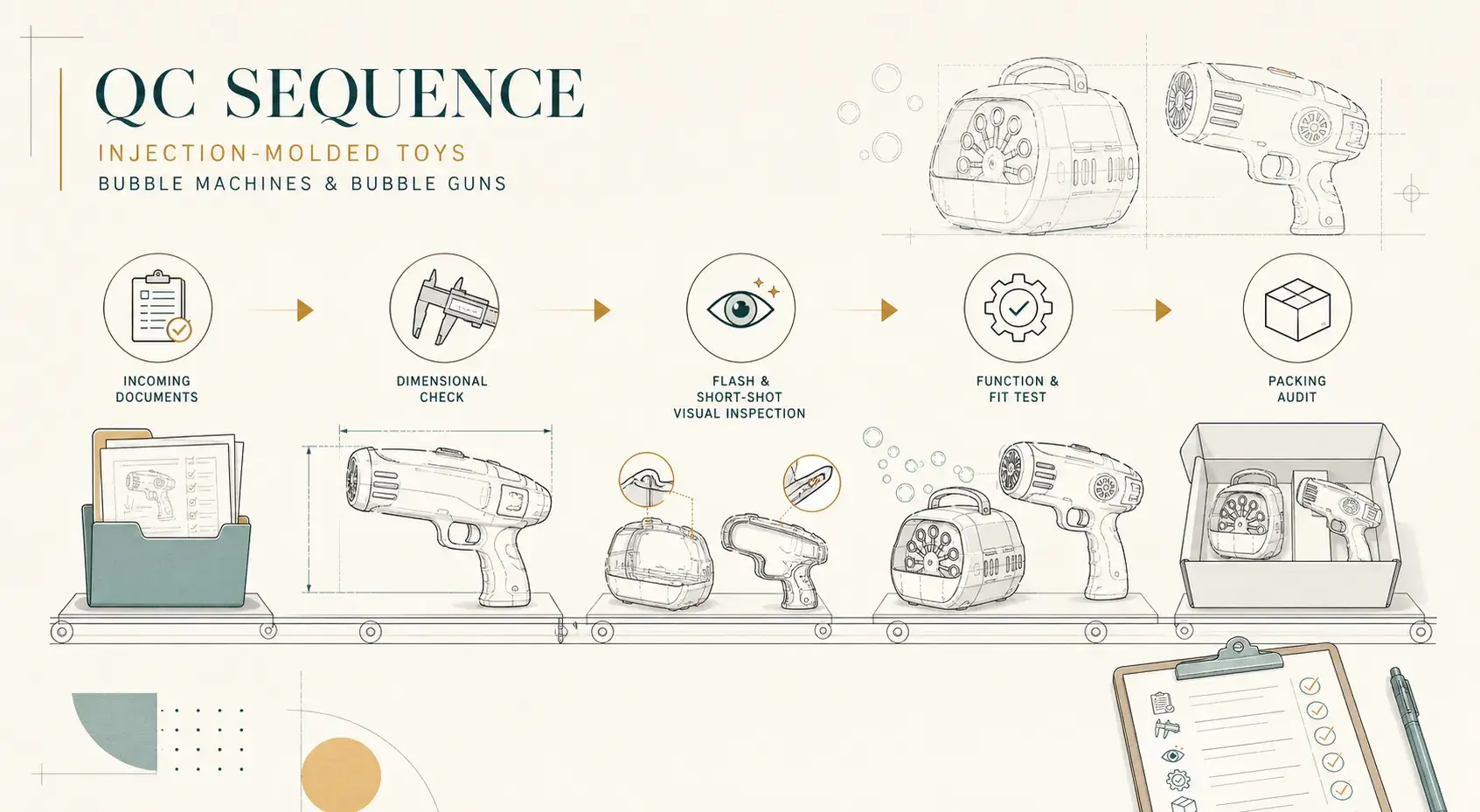
Sample Scoring Dimensions Compared
| Fit | Battery door, trigger, nozzle, detach joint, screw retention |
|---|---|
| Finish | Colour match, flash, scuff resistance, clear-part clarity |
| Packaging | Inner and master carton marks, assortment list, carton cube, handling info |
| Evidence | Item-specific test reports, certificate validity, golden sample, lot reference |
What to check on a bubble machine or bubble gun sample
Battery doors on AA-powered guns are the classic weak point: a screw that strips, a hinge that cracks, or a door that pops open during play. For rechargeable units, the port is the next suspect. One Chenghai factory found a USB jack glued onto an old battery door—it loosened after three hours on a demo table. The fix was a screw-retained port with the AA door kept as backup. Ask for the port pull-test result and check the screw type: Phillips or cross-head screws that strip are a red flag.
Trigger travel and nozzle alignment matter more than hole count. A 64-hole stage machine might be perfect for an atrium but too noisy for a jewellery kiosk. A 20-hole handheld gun suits a tight aisle. Format follows footprint and refill, not just bubble output. Test the trigger pull: it should be smooth, not sticky, and the nozzle should sit flush with the housing. On convertible designs—bubble gun that becomes a fan—the detach joint is the stress point. Pull it apart and reattach it ten times. If it wobbles, it will fail in the box.
Finish is where colour arguments start. Compare the sample to the agreed Pantone chip, not a PDF. One buyer found the catalogue colour, the requested Pantone, and the last bulk lot were three different shades. Seal the golden sample in QC and match bulk against that physical piece. For clear ABS parts, purge and scuff are the two defects to probe. Ask for the last 20 clear shots from the tool, the purge log, and a scuff test on a packed sample. Clear parts that look cloudy or scratch in the box will come back as returns.
Packaging is the silent killer. Carton marks should identify SKU, quantity, destination, handling information, and lot or shipment reference. A mixed carton with one barcode covering two SKUs will bounce at the retailer's DC. Insist on reprinting inner and master codes per SKU, and refuse mixed cartons without an assortment list on the carton. Measure the actual carton cube and loading pattern, not the nominal size; container utilisation is calculated from real cartons, not a spec sheet.
How to verify evidence before you approve a sample
Request item-specific test reports for the exact SKU and destination market—not a generic certificate page. For the US, that means ASTM F963 and CPSIA; for the EU, EN71 and EN IEC 62115. Check the certificate covers your product model, not just the factory's general line. A certificate that lists 'toy gun' without a model number is worth less than the paper it's printed on.
The golden sample is the second piece of evidence. Seal the agreed physical sample with the supplier, sign a golden-sample sheet, and store a copy in QC. When the bulk lot arrives, compare colour, fit, flash, and function against that piece. Emails and PDFs do not settle colour disputes; the physical chip does. If the supplier resists sealing a sample, treat it as a warning.
Third, verify production capacity claims. A factory's stated capacity is a planning input, not a fact, until you check the product type, machine mix, shifts, tooling, and recent records. Ask for a production schedule for your order, not a brochure number. A supplier who can show you a line plan for your SKU is more credible than one who quotes a monthly output figure.
Worked example (illustrative, not a real shipment)
Imagine a 2,000-unit order of bubble guns split between a US retail chain and a UK distributor. The US cartons are marked with the SKU, quantity, and 'Handle with care'; the UK cartons add the lot reference and the EN71 certificate number on the packing list. The supplier sends one golden sample for each market, sealed and signed. At the DC, the US cartons pass receiving because the barcode matches the SKU; the UK cartons pass because the assortment list is on the carton. The order ships on time. Now imagine the same order with one barcode covering both SKUs and no assortment list. The US DC bounces the shipment; the UK distributor rejects it for missing the certificate reference. The difference is not the injection machine—it is the scoring sheet that caught the packaging and evidence gaps before the container left the factory.
This example is illustrative, not a real shipment. Use it as a template: fill in your own quantities, destinations, and packaging differences, and run the same checks on your samples.
What to ask suppliers before you commit
When you request a quote, include the product type, target market, quantity, package requirement, certificate need, deadline, and any reference image or item number. Then ask these four questions:
1. What is the MOQ per SKU, and does it change with packaging or certificate requirements? MOQs for bubble toys in Chenghai typically range from 240 to 1,200 units, but confirm for your specific item.
2. Can you provide item-specific test reports for ASTM F963, EN71, or EN IEC 62115, dated within the last year?
3. What is the lead time, and does it include tooling, first article inspection, and quarantine before shipping?
4. Will you seal a golden sample with a signed sheet, and will the bulk lot be compared against it in QC?
FAQ
What MOQ should I expect for a custom bubble gun order?
MOQs for bubble toys from Chenghai suppliers typically range from 240 to 1,200 units, but the exact number depends on the product, packaging, and certificate requirements. Ask for a per-SKU MOQ in writing, and confirm whether it changes if you add a custom colour or a mixed carton.
How do I verify a supplier's test certificates for bubble machines?
Request item-specific test reports that list your exact model number and the applicable standard (ASTM F963, EN71, EN IEC 62115). A certificate page that covers the factory's general line is not enough—check the report date and scope before you approve a sample.
What are the hidden costs when sourcing bubble toys from a new supplier?
Mold fees, packaging design, and shipping are the usual extras. Confirm whether the quoted price includes the mold, the inner box, the master carton, and the certificate testing. Ask for a full cost breakdown before you place an order.
How do I check the packaging before approving a sample?
Inspect the inner and master carton marks: SKU, quantity, destination, handling, and lot reference. If you order a mixed carton, demand an assortment list on the carton. Measure the actual carton cube and loading pattern to verify container utilisation.
What is the best way to settle a colour dispute on a bubble gun?
Seal a golden sample with the supplier and compare bulk lots against that physical piece, not a PDF or email. The factory that keeps a golden sample on the QC shelf is the one that settles colour arguments without rework.
Should I order a sample or a mixed carton first?
Start with a single golden sample to verify fit, finish, and evidence. If you need multiple SKUs, ask for a mixed carton with an assortment list to test packaging and receiving. This avoids committing to a full container before you know the product works.
Sources
Request a Quote
Ready to move from sample scoring to shipment? Request a quotation or sample from a supplier that seals golden samples and provides item-specific certificates. Ask for a mixed-carton discussion to test packaging and receiving before you commit to a full order.