

Supplier document-room checklist for RC and electronic toy assortments import qualification
Sep 01, 2026Updated Sep 01, 2026By CPS TOYS B2B Sourcing Editor
Choose a supplier whose document room proves risk-based testing and a locked golden sample over one that only shows a catalog page. For RC and electronic toy assortments, import qualification starts with evidence: test reports per destination market, an AQL plan tied to the PO, battery and electrical safety documents, and age grading that matches the design. This guide gives you a practical supplier document-room checklist, a worked example of where a shipment gets held, and email-ready questions to send before you place a bulk order.
Key Takeaways
- Testing scope is risk-based: for RC and electronic toys, plan for battery compartment security, insulation resistance, electric shock protection, abnormal operation, and temperature rise—plus mechanical and chemical tests per destination standard.
- AQL is not a supplier promise: agree the inspection level (I, II, III or special S-1 to S-4), batch size, and AQL values for critical, major, and minor defects in the PO—do not accept a catalog sentence.
- A sealed golden sample is the production-QC reference for color, texture, logo, and assembly—but it does not replace required market testing. Lock it before bulk production.
- Age grading and labeling are common non-conformity causes: request a labeling review as part of pre-production inspection, covering warning statements, traceability, and hazard communication.
- Button/coin cell batteries trigger extra requirements: confirm battery compartment security and labeling documentation before ordering.
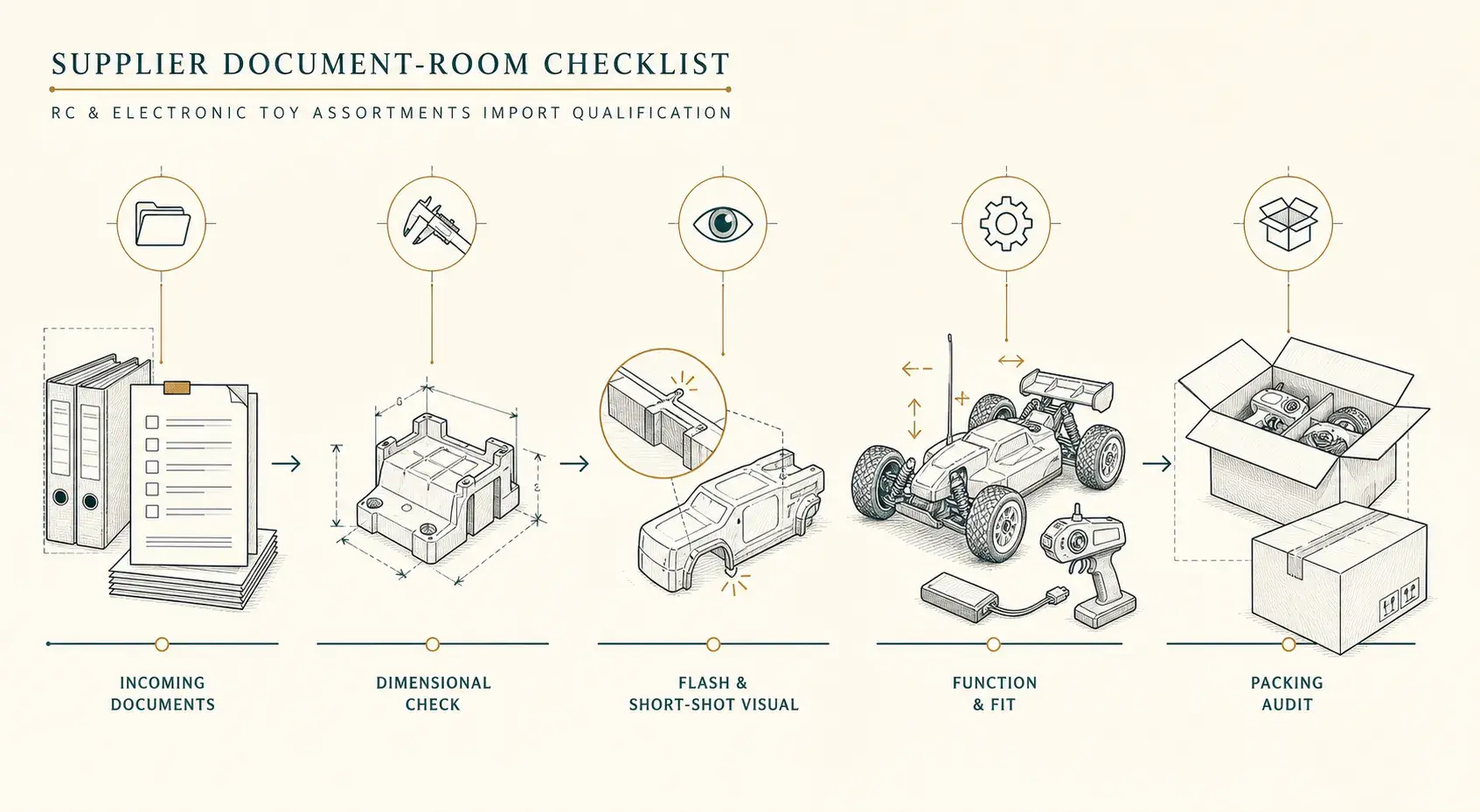
What documents should a supplier have for RC and electronic toys?
A supplier document room for RC and electronic toy assortments should include test reports per destination market, a quality manual, an AQL sampling plan template, battery and electrical safety documents, and age grading/labeling files. The scope of testing is determined by product-specific risk assessment: design, materials, age group, functionality, and foreseeable misuse all change what you need to see.
Common standards include ASTM F963 for the US, EN71 for the EU, AS/NZS ISO 8124 for Australia/New Zealand, and GB 6675 for China. For battery-operated toys, mechanical testing, battery safety testing, abnormal operation testing, and temperature rise testing are typical modules. Electrical/electronic toys add battery compartment security, insulation resistance, electric shock protection, wiring integrity, and abnormal operation testing.
What should the inspection plan specify?
An inspection plan should specify three parameters: batch size (number of units), inspection level (general I, II, III or special S-1 to S-4), and AQL values for critical, major, and minor defects. The inspection level and AQL are agreed between the buyer and supplier before the batch is produced. AQL stands for Acceptable Quality Limit, defined in ISO 2859-1 as the maximum number of defective units that will be accepted—exceeding that number rejects the batch.
Importers typically set different AQL levels for critical, major, and minor defects. The smaller the AQL number, the stricter the requirement. Do not accept a supplier's 'AQL 2.5' as a blanket statement—ask which defect class it applies to and confirm the inspection level in the PO.
How do you verify factory audit and production capacity?
Supplier qualification should evaluate capability, material control, quality records, compliance evidence, capacity claims, and subcontracting—not just a catalog page. Ask for the factory audit report, quality records from past lots, and evidence of capacity for your order size. If the supplier subcontracts assembly, ask for the subcontractor's audit report and how QC is managed at that site.
Capacity claims are only credible with evidence: production line photos, machine list, and a realistic lead time for your batch. Do not rely on a MOQ figure alone—ask how many units they can ship per week and what happens if you double the order.
What is the role of the golden sample?
Production release should use an identified approved sample, not a loose reference photo—especially for color, texture, logo, and assembly. A sealed golden sample with the approved material, color, decoration, dimensions, and photos is a practical production-QC reference, but it does not replace required market testing.
A common failure: a buyer compares three samples on the table—current catalog color, requested Pantone, and the last bulk lot—and they are not the same. Lock the agreed physical chip in QC and stop matching later lots to a PDF. Color arguments end when the golden sample is in the room, not when the email thread is long.
Supplier document-room checklist
| Test reports | Check for ASTM F963 (US), EN71 (EU), AS/NZS ISO 8124 (AU/NZ), GB 6675 (CN) as applicable; for RC/electronic toys confirm battery safety, electrical, temperature rise, and abnormal operation tests. |
|---|---|
| AQL plan | Confirm batch size, inspection level (I/II/III or S-1 to S-4), and AQL values for critical/major/minor defects; must be in the PO, not a catalog sentence. |
| Golden sample | Sealed physical sample with approved material, color, decoration, dimensions, and photos; used for production QC but does not replace market testing. |
| Battery and electrical docs | Battery compartment security, insulation resistance, electric shock protection, wiring integrity, abnormal operation, temperature rise; button/coin cell extra requirements. |
| Age grading and labeling | Warning statements, traceability markings, hazard communication, regulatory labeling; request labeling review as part of pre-production inspection. |
| Factory audit and capacity | Evaluate capability, material control, quality records, compliance evidence, capacity claims, and subcontracting; request audit report and evidence. |
Worked example (illustrative, not a real shipment)
Imagine a 5,000-unit RC car assortment, split between a US retail order and an EU ecommerce order. The US units need ASTM F963 and battery safety reports; the EU units need EN71 and RED traceability documentation. The supplier provides a test report for the US version but not for the EU version, and the AQL plan in the PO lists only a single 'AQL 2.5' without specifying defect class. The inspection plan calls for general inspection level II with AQL 1.0 for critical, 2.5 for major, and 4.0 for minor defects. The supplier's batch has 3 critical defects in the sample, which exceeds the allowed count—the lot is held. The golden sample was a prototype with a different battery door; the bulk unit has a glued USB port instead of a screw-retained one. The inspector flags the port as a safety risk. The shipment is delayed until the port is reworked and the EU test report is provided. This is a typical failure pattern: missing documents, unclear AQL, and a golden sample that didn't match production.
What is new to watch in 2026?
For radio equipment, including many RC toys, the EU RED framework has strengthened traceability obligations for manufacturers, importers, and distributors. This affects documentation you should request from suppliers: traceability records may need to cover the supply chain from factory to distributor. The timeline for specific application is not confirmed from official text—do not assume a specific date without checking the official regulation. Keep the classic document-room checklist as your baseline and add RED traceability questions for EU-bound assortments.
What to ask suppliers before ordering
Send these questions in your RFQ to turn operational details into comparable evidence. Ask: 'Which test reports do you hold for this model per destination market—ASTM F963, EN71, AS/NZS ISO 8124, or GB 6675?' 'What is your AQL plan for this PO—inspection level, batch size, and AQL values for critical, major, and minor defects?' 'Can you provide the sealed golden sample for production QC, and does it match the final production version?' 'What battery and electrical safety tests have been done—battery compartment security, insulation resistance, electric shock protection, abnormal operation, temperature rise?' 'For button/coin cell batteries, what additional safety requirements are documented?' 'What is your factory audit report and capacity evidence for this order, and do you subcontract any assembly?' 'What are the common non-conformities in your past lots, and how do you handle rework?'
FAQ
What AQL should I use for RC and electronic toys?
Set AQL values per defect class—critical, major, minor—and confirm the inspection level (I, II, III or special S-1 to S-4) in the PO. Common practice is AQL 1.0 for critical, 2.5 for major, and 4.0 for minor, but the final numbers must be agreed with the supplier before production.
How do I verify a supplier's factory audit and production capacity?
Request the factory audit report, quality records from past lots, and evidence of capacity—production lines, machine list, and realistic lead time for your batch. Evaluate capability, material control, quality records, compliance evidence, and subcontracting rather than relying on a catalog page.
What test reports do I need for RC toys in the US and EU?
For the US, ASTM F963 is the common standard; for the EU, EN71 applies. RC and electronic toys also need battery and electrical safety tests—battery compartment security, insulation resistance, electric shock protection, abnormal operation, and temperature rise. Confirm which standards apply to your destination market before ordering.
What are the hidden costs when sourcing from a new supplier?
Common hidden costs include mold fees, packaging design, testing fees, and shipping. Ask for a full cost breakdown in the RFQ, including any tooling fees, storage periods, and rework costs. Also confirm who owns the tool after the mold fee is paid.
Sources
Request a Quote
Ready to qualify a supplier for your RC and electronic toy assortment? Request a quotation or sample discussion to review document-room evidence and AQL plans before you commit to a bulk order.