

Supplier evaluation for electric water gun assortments: a buyer checklist before the PO
Aug 30, 2026Updated Aug 30, 2026By CPS TOYS B2B Sourcing Editor
Shortlist an electric water gun supplier on documented product fit, assortment economics, and verifiable safety evidence — not on a glossy catalogue or a low first quote. A supplier that can show you a Children's Product Certificate (CPC) with seven elements for the exact SKU, a golden sample sealed in QC, and a per-SKU MOQ that fits your cash flow is worth a sample order. One that answers with a generic 'we have EN71' email is not. This checklist covers what to ask, what to verify, and what to freeze on the PO before you commit.
Key Takeaways: What Separates a Usable Water Gun Supplier from a Risky One
- Product fit beats best-list claims: Evaluate SKU variety (retractable barrels, glowing bodies, transparent shells, auto-absorb) against your target channel, not against a generic ranking. A festival-stall buyer needs a fast dunk time; a night-backyard program needs a split glow circuit.
- MOQ is a per-SKU number, not a slogan: In a typical Chenghai assortment, MOQs range from 60 to 240 units per SKU. A 60-unit MOQ on a hero SKU is flexible; a 240-unit MOQ on a niche variant may stall your assortment economics. Ask for the MOQ per SKU, not a blended 'low MOQ' claim.
- Safety evidence is SKU-specific: A CPC under 16 CFR Part 1250/ASTM F963 and an EU Declaration of Conformity under Directive 2009/48/EC must match the exact product configuration, age grade, and standard edition. A factory-level 'we are certified' is not evidence.
- The golden sample is the contract: Seal the physical colour chip, the O-ring kit spec, and the tooling revision on the PO. Field failures on auto-absorb guns come from missing seals, not from the slogan printed on the barrel.
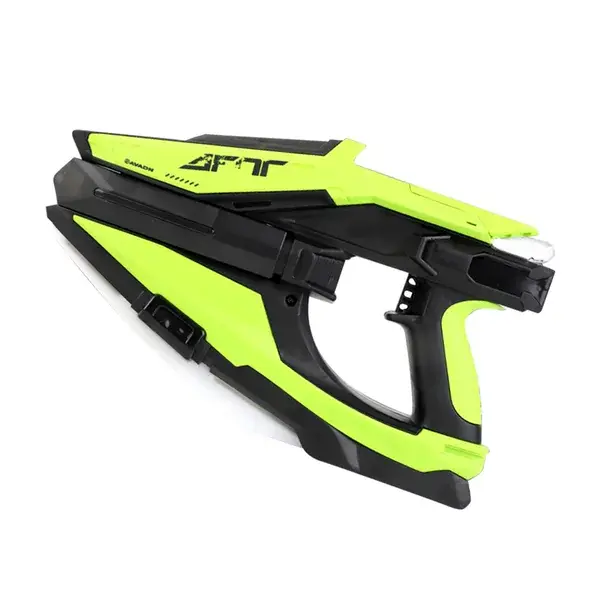
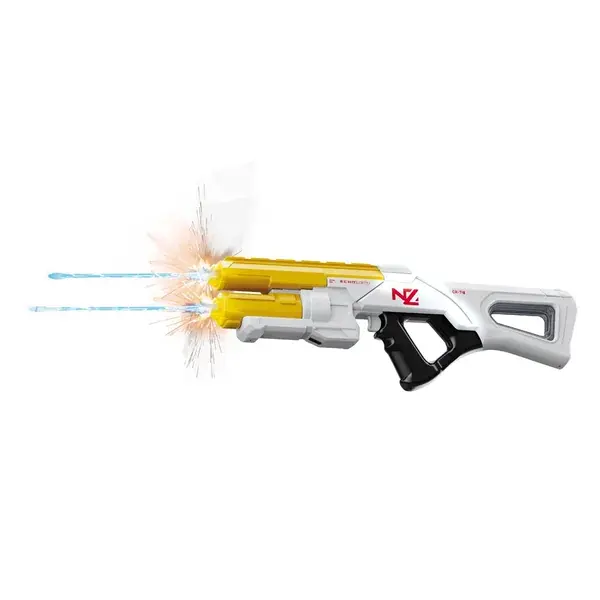
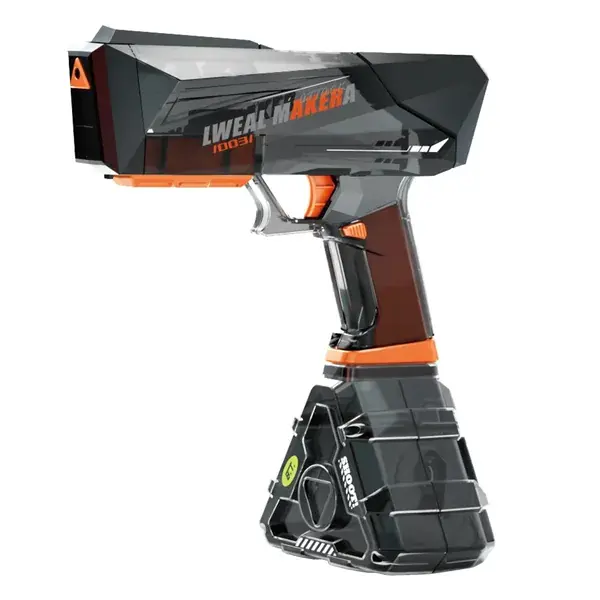
What does 'product fit' mean for an electric water gun assortment?
Product fit is more specific than 'summer toys'. Electric water guns differ across price points and play contexts. A 240-unit MOQ chambering-linkage SKU with muzzle-light linkage targets a different buyer than a 60-unit glowing-body SKU for a night event. A transparent-body gun (clear ABS) is a different manufacturing problem than a solid-colour one — purge and scuff defects are documented failure modes for clear Chenghai ABS.
Map your channel to the feature set. A festival-stall operator needs an auto-absorb gun that primes in a shallow bucket; a backyard program needs a glow circuit that does not dim after ninety seconds because the LED shares the motor feed. Ask the supplier to demo at dusk, not at noon, and to photograph the gun next to the actual stall bucket. Absorb speed is a stall-layout spec. Colour is not.
The assortment should also be checkable. If you plan a mixed carton of water guns and bubble wands, a single barcode covering two SKUs will bounce at a retailer's DC. A supplier that refuses mixed cartons without an assortment list on the carton is protecting your receiving speed, not their packing line.
How do I verify a supplier's factory audit and production capacity?
Verification starts with documents, not with a video tour. Ask for a current BSCI or SEDEX audit report, and confirm the report covers the factory that will actually produce your SKU — not a holding company. Then ask for the mould plate and revision card for the sample in your hand. A showroom sample that is last year's steel with this year's sticker wastes a season.
For clear or translucent bodies, the 'can do clear' claim is proven by process, not by a render. Ask for the last 20 clear shots, the purge log, and a scuff test on the packed sample before any steel is cut. For glowing SKUs, ask for the charge port location in the listing photos and a dusk runtime demo. Capacity is easier to verify indirectly: ask how many injection machines run clear ABS, how many shifts, and whether the tool is in-house or subcontracted. A factory that cannot show you the tool plate is not ready for a bulk PO.
One practical test: ask the supplier to walk you through a past field failure. A serious factory will have a corrective-action story — a seal kit that was frozen on the PO, a barcode protocol that was rewritten, a dusk demo that replaced a noon one. A factory with no failure stories is either new or not testing.
What MOQ should I expect for custom orders on electric water guns?
MOQ varies by spec, and it is a per-SKU economic decision. In a representative Chenghai electric water gun assortment, MOQs range from 60 to 240 units per SKU. Six of twelve SKUs in one catalogue sit at 60 units; a chambering-linkage variant sits at 240. The MOQ reflects tooling amortisation, not the factory's ego.
For custom packaging and branding, the MOQ question splits into two: the MOQ for the product and the MOQ for the packaging run. A 60-unit product MOQ does not guarantee a 60-unit custom-box run. Ask for the packaging MOQ separately, and ask whether the supplier will print inner and master codes per SKU. If you plan a mixed assortment, ask whether the supplier will pack a small bag of matched O-rings in the master carton — for auto-absorb guns, the seal kit is the difference between a working unit and a field failure.
Peak season compounds the MOQ question. Orders placed by March avoid the 30-50% shipping cost spike that typically runs from April to June. If your MOQ is low and your timeline is late, you are paying twice: once for the small run, once for the freight.
Which certification applies to electric water guns sold in the EU and US?
The certification question is SKU-specific, not factory-specific. For the EU, the Toy Safety Directive 2009/48/EC sets essential safety requirements covering physical/mechanical, flammability, chemical, electrical, hygiene, and radioactivity. CE marking is the sole conformity mark, and the manufacturer or importer must hold a Declaration of Conformity. The General Product Safety Regulation (EU) 2023/988 adds a horizontal safety requirement for all consumer products, including a risk assessment that considers vulnerable consumers (children), and it applies to distance selling targeted at EU consumers.
For the US, the CPSC requires third-party testing at a CPSC-accepted laboratory and a Children's Product Certificate (CPC) for toys intended primarily for children 12 and under. The CPC must include seven elements: product identification, safety rule citations, manufacturer/importer identification, test record contact, date and place of manufacture, date and place of testing, and lab identification. Electrically operated toys must also comply with 16 CFR Part 1505. Note that a CPC is product-specific — it is not a blanket factory certificate. Starting July 8, 2026, importers must electronically file certificates with U.S. Customs via a PGA Message Set.
Practical buyer steps: ask for the test report that matches your SKU, confirm the standard edition (e.g., the current ASTM F963), and verify the lab is CPSC-accepted. Ask for the EU Declaration of Conformity and the importer's name and address on the product or packaging, as required by the directive. Treat packaging wording and product markings as controlled fields that can change with the SKU.
Supplier evaluation snapshot for electric water gun assortments
| Product assortment fit | Evaluate SKU variety (retractable, glowing, transparent, auto-absorb) against channel; confirm feature names with a dusk/field demo |
|---|---|
| MOQ posture | Typical range 60–240 units per SKU; ask for MOQ per SKU, packaging MOQ separately, and mixed-assortment rules |
| Material consistency | ABS is the standard shell material; confirm grade and ask for purge/scuff evidence on clear or translucent SKUs |
| Safety evidence (EU) | CE marking + EU Declaration of Conformity under Directive 2009/48/EC; GPSR (EU) 2023/988 risk assessment; match to SKU and standard edition |
| Safety evidence (US) | CPC with 7 elements under 16 CFR Part 1250/ASTM F963; 16 CFR Part 1505 for electrical toys; CPSC-accepted lab report in English |
| OEM/ODM capability | Confirm custom colour (sealed chip), custom packaging (inner/master codes per SKU), and tooling revision traceability |
| Factory audit evidence | BSCI/SEDEX report covering the producing factory; mould plate and revision card for the sample in hand |
How do I verify a supplier's factory audit and production capacity before placing a bulk order?
Verification is a document exercise, not a trust exercise. Start with the audit report — BSCI or SEDEX — and confirm the report covers the producing entity, not a trading company. Then ask for the mould plate and revision card for the sample in your hand. A showroom sample that is last year's steel with this year's sticker wastes a season.
For clear or translucent bodies, the 'can do clear' claim is proven by process, not by a render. Ask for the last 20 clear shots, the purge log, and a scuff test on the packed sample before any steel is cut. For glowing SKUs, ask for the charge port location in the listing photos and a dusk runtime demo. Capacity is easier to verify indirectly: ask how many injection machines run clear ABS, how many shifts, and whether the tool is in-house or subcontracted.
One practical test: ask the supplier to walk you through a past field failure. A serious factory will have a corrective-action story — a seal kit frozen on the PO, a barcode protocol rewritten, a dusk demo replacing a noon one. A factory with no failure stories is either new or not testing.
What should I request from the supplier during the OEM inquiry for custom packaging and branding?
The OEM inquiry is where assortment economics and legal compliance meet. Request, in writing, the following: the MOQ per SKU and the MOQ for custom packaging separately; the sealed colour chip (not a PDF) for your Pantone; the golden sample with tool number and revision; the O-ring kit spec (material, inner diameter, spare quantity) for auto-absorb SKUs; the inner and master barcode protocol per SKU; and the packaging film thickness or perforation spec if you plan retail-ready packaging.
Ask how the supplier handles mixed cartons. A supplier that refuses mixed cartons without an assortment list on the carton is protecting your receiving speed. Ask whether the charge port is screw-retained, not glued — a glued USB jack on a housing will fail mid-mall, as a rental buyer learned on a stage bubble machine. And ask for the dusk demo if the SKU glows; a ninety-second muzzle light that dims because the LED shares the motor circuit is a specification problem, not a marketing problem.
Finally, ask for the compliance documents that match the custom SKU: the CPC with seven elements for the US, the EU Declaration of Conformity for the EU, and the GPSR risk assessment. A custom colour change does not invalidate a test report, but a custom packaging change might — packaging film thickness and small parts are part of the standard.
FAQ: Electric Water Gun Supplier Evaluation
What is a realistic MOQ for a custom electric water gun order?
A realistic MOQ per SKU is typically 60–240 units, depending on the feature set and tooling amortisation. A chambering-linkage variant may sit at 240 units; a simpler glowing-body SKU may sit at 60. Ask for the MOQ per SKU and separately for custom packaging, since a 60-unit product MOQ does not guarantee a 60-unit custom-box run.
How can I verify a China supplier's factory audit before a bulk order?
Ask for a current BSCI or SEDEX report covering the producing factory, not a holding company. Then request the mould plate and revision card for the sample in your hand, and ask for process evidence on clear ABS (last 20 shots, purge log, scuff test) if you source transparent bodies. A factory that cannot show the tool plate is not ready for a bulk PO.
What certification do I need for electric water guns sold in the US?
For toys intended primarily for children 12 and under, you need a Children's Product Certificate (CPC) based on third-party testing at a CPSC-accepted lab, citing the applicable rules such as ASTM F963 (16 CFR Part 1250) and 16 CFR Part 1505 for electrical toys. The CPC must include seven elements and the test report must be in English. Starting July 8, 2026, importers must file certificates electronically with U.S. Customs.
What certification do I need for electric water guns sold in the EU?
You need CE marking and an EU Declaration of Conformity under the Toy Safety Directive 2009/48/EC, covering physical, chemical, electrical, and sound requirements. The General Product Safety Regulation (EU) 2023/988 adds a horizontal safety requirement, including a risk assessment for children, and applies to distance selling targeted at EU consumers. Confirm the importer's name and address appear on the product or packaging.
What should I freeze on the PO to avoid field failures on auto-absorb water guns?
Freeze the seal kit specification: material, inner diameter, and spare quantity. In one documented case, auto-absorb blasters failed after week two because the spare seals and O-rings were never on the first PO. Also freeze the golden colour sample, the tooling revision, and the barcode protocol per SKU. Wholesale speed is lost at receiving, not at the injection machine.
When should I place my electric water gun order to avoid peak-season freight spikes?
Place orders by March to avoid the 30-50% shipping cost spike that typically runs from April to June. Sea freight from Shenzhen or Shantou to the US West Coast typically takes 25-40 days. Factor that transit time into your seasonal timeline, and confirm the HS Code (9503.00 for plastic toys) with your customs broker to verify duty status.
Sources
Request a Quote or Schedule a Factory Audit
If you are shortlisting suppliers for an electric water gun assortment, we can share our current SKU list with per-unit MOQs, a golden sample protocol, and a factory walkthrough of our tooling and QC process. Send us your target channel, your destination market, and your season — we will come back with a documented fit, not a generic quote.
Contact us to request a quote or to schedule a factory audit focused on the checklist above: seal kits, barcode integrity, clear ABS process, and glow-circuit runtime.