

How to Choose Toy Manufacturers in China for Wholesale
Oct 22, 2026Updated Oct 22, 2026By CPS TOYS B2B Sourcing Editor
Choose toy manufacturers in China by product-specific production capability, traceable test records and workable order terms—not a single cross-category ranking. For wholesale buyers of bubble toys, educational flash cards, building blocks and electric water guns, the practical shortlist should separate these four segments, then compare factories against the same written specification. Advance suppliers whose samples, production arrangements and quoted commitments match your intended market; keep attractive catalog breadth secondary.
Use the same qualification process for candidates in Chenghai/Shantou, Shenzhen and Dongguan. A location belongs on the supplier record, but it should not substitute for evidence that the quoted manufacturer can make your particular toy.
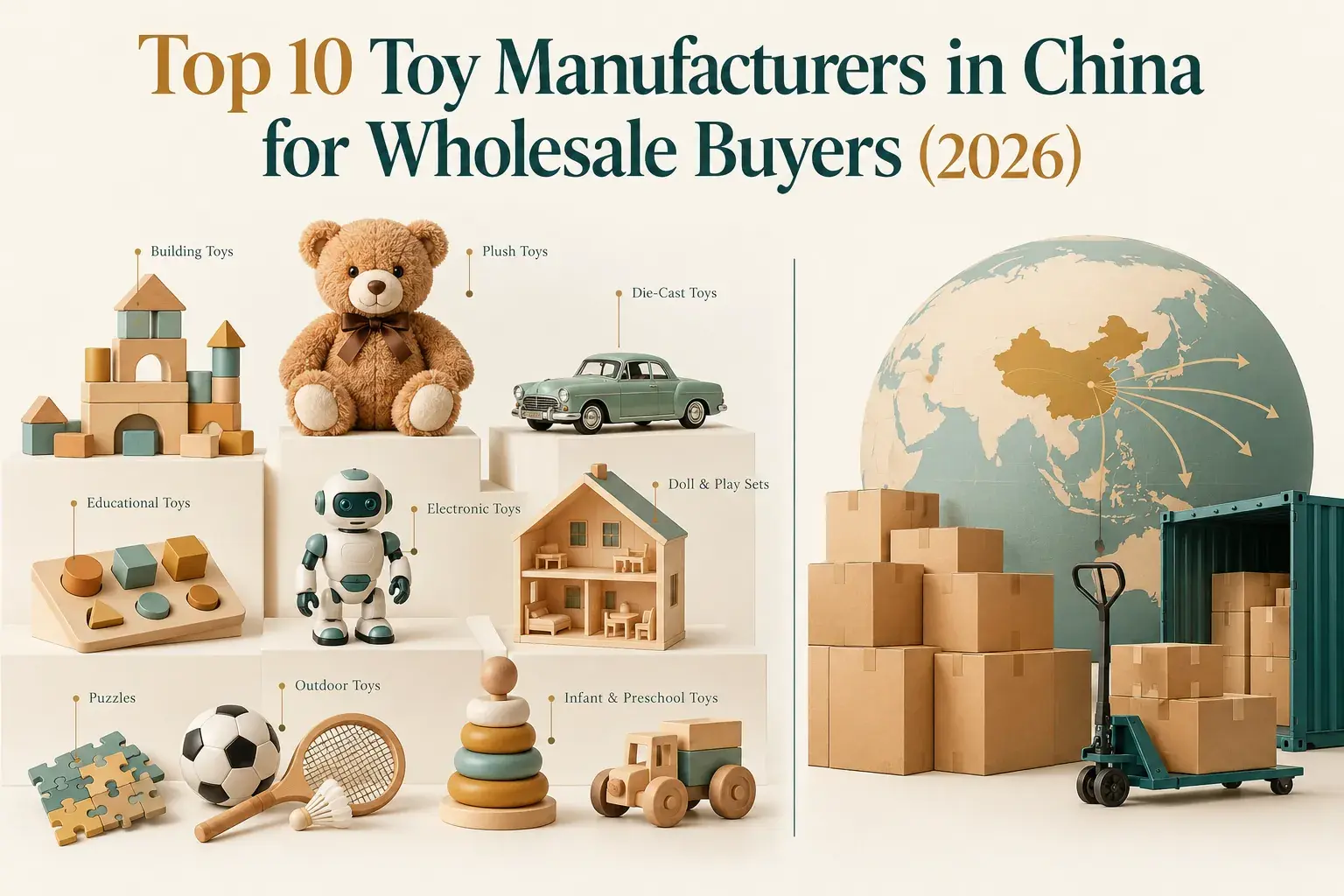
Which Manufacturer Profile Fits Each Toy Category?
| Bubble toys | Request a sample of the exact manual or powered version being quoted. Check bubble output consistency, liquid leakage, refill handling and packaging containment. Ask who makes the mechanism, who supplies the solution if included, and where final assembly occurs. |
|---|---|
| Educational flash cards | Separate printed-only cards from electronic reader sets. Check card count, print legibility and content accuracy; for reader sets, verify that each card triggers the intended audio. Confirm responsibility for artwork, recordings, electronics and final content approval. |
| Building block sets | Examine burrs and sharp molding flash before appearance. Compare fit across multiple pieces and assembled samples, then reconcile the actual parts against the packing list. For magnetic designs, evaluate magnet retention and the applicable safety requirements separately. |
| Electric water guns | Check filling, leakage, trigger operation and access to electrical components under an agreed sample-use procedure. Request the actual battery and charging configuration. For translucent housings, inspect clarity and scuffing on packed samples rather than approving from renderings. |
How Can I Verify a Supplier’s Factory Audit and Production Capacity?
Verify the manufacturing site and the operations it performs before treating an audit or capacity statement as evidence for your order. Match the audit’s legal entity, address, date and scope to the facility proposed for production; review relevant findings and corrective actions rather than relying on a cover-page logo.
Request a process map identifying molding, printing, electronics assembly, filling, packing and any subcontracted work relevant to your toy. A supplier using outside specialists can still be a candidate, but the quotation should identify who controls materials, inspections and changes.
For capacity, ask for the proposed line allocation, production calendar and output assumptions for your configuration. Separate machine output from finished, inspected and packed goods. A live walkthrough or independent site inspection can help reconcile the claimed equipment and staffing with the proposed production plan.
Make material control specific. Request the proposed resin grade, colorant, coating and flexible-material formulation where relevant. A description such as “plastic” is too broad to define what the factory is being asked to reproduce.
What EN71, ASTM F963 and CPSC Evidence Should Buyers Compare?
Compare documents for the actual toy configuration and destination market, not a factory-wide claim of “EN71/ASTM/CPSC certification.” In your RFQ, ask suppliers to identify the standards, editions, test scope and product versions represented by each document.
For US purchasing, check that the laboratory’s CPSC acceptance covers the relevant safety rules. Acceptance is scope-specific; one laboratory may not cover every required test. Match the report’s product identity and construction to the proposed order. CPSC testing guidance
CPSC identifies the domestic manufacturer or importer as the responsible Children’s Product Certificate issuer. Review the certificate’s product identification, applicable rules, manufacture and testing information, test-record contact and accepted laboratory details. A supplier’s use of the letters “CPC” in a listing is not a substitute for that review. CPSC certificate guidance
For EU-bound orders, make the intended destination, age grading, construction and packaging part of the document request. Treat an EN71 report as a document to assess for applicability, not as a blanket assurance covering every product in the catalog. Agree how material, component and design changes will be reviewed before production.
How Should Buyers Compare MOQ, OEM/ODM Capability and Lead Time?
Compare MOQ and lead time against an identical specification, with standard-product, modified-product and new-tooling quotations kept separate. A low minimum for an existing design does not establish the minimum for custom colors, electronics or packaging.
| MOQ | Request the minimum by model, color, artwork and packaging version. Ask whether quantities can be combined across variants. Record carton quantity separately; packing quantity alone does not establish an order multiple. |
|---|---|
| OEM capability | Ask which buyer-defined changes the factory can execute, who approves drawings and samples, and who owns any paid tooling or artwork. Request a written change-control process. |
| ODM capability | Identify which existing design is offered, which elements can change, and what design or content rights the supplier can document. Do not infer exclusivity from customization. |
| Export experience | Request relevant, redacted shipment or project records and examples of destination-specific documentation. Use these to assess experience with comparable products, not as proof that your proposed configuration meets every requirement. |
| Lead time | Separate sample preparation, tooling where needed, material procurement, production, inspection and shipment readiness. Have the quotation state the event that starts each clock, such as deposit receipt or approved artwork. |
| Total commercial scope | Ask the quotation to identify any tooling, artwork, packaging, testing, inspection, freight or other charges included or excluded. Record payment milestones and the remedy proposed for a rejected pre-shipment inspection. |
What Should a Bounded Trial Order Measure?
Use a bounded trial to evaluate one defined assortment in one channel before committing to a broader reorder. Approve the product and required documentation first; a sales trial is not a safety test.
For an explicitly hypothetical shelf trial, offer 40 units of one approved item in a defined seasonal-toy display for four weeks. Keep the selling price and placement consistent, and record units offered, units sold, returns and days unavailable. If 16 units sell, sell-through is 16 ÷ 40 × 100 = 40%.
Set the reorder rule before the trial begins. For example, a buyer could choose a hypothetical 60% sell-through gate, subject to acceptable margin and quality results. At 40%, hold expansion and review the item, price and placement rather than automatically placing a larger order. Any safety failure should trigger a stop on the affected specification and an investigation, regardless of sales.
Interpret the result for that item, store, placement, price and four-week period. It is not a measure of demand across the US, EU or global toy market.
Which Manufacturers Should Advance to the Final Shortlist?
- Advance manufacturers that pass the product-specific sample checks, identify the actual production site, provide applicable documentation and quote a reproducible specification with clear commercial terms.
- Keep safety and product identity as gates rather than points that a low price can offset. Then compare the qualified candidates on total quoted scope, customization control and production readiness. A smaller, evidence-backed shortlist is more useful than ten names that cannot be compared on the same basis.