

UKCA vs CE Marking for Toys in GB: What to Require in 2026
Aug 23, 2026Updated Aug 23, 2026By CPS TOYS B2B Sourcing Editor
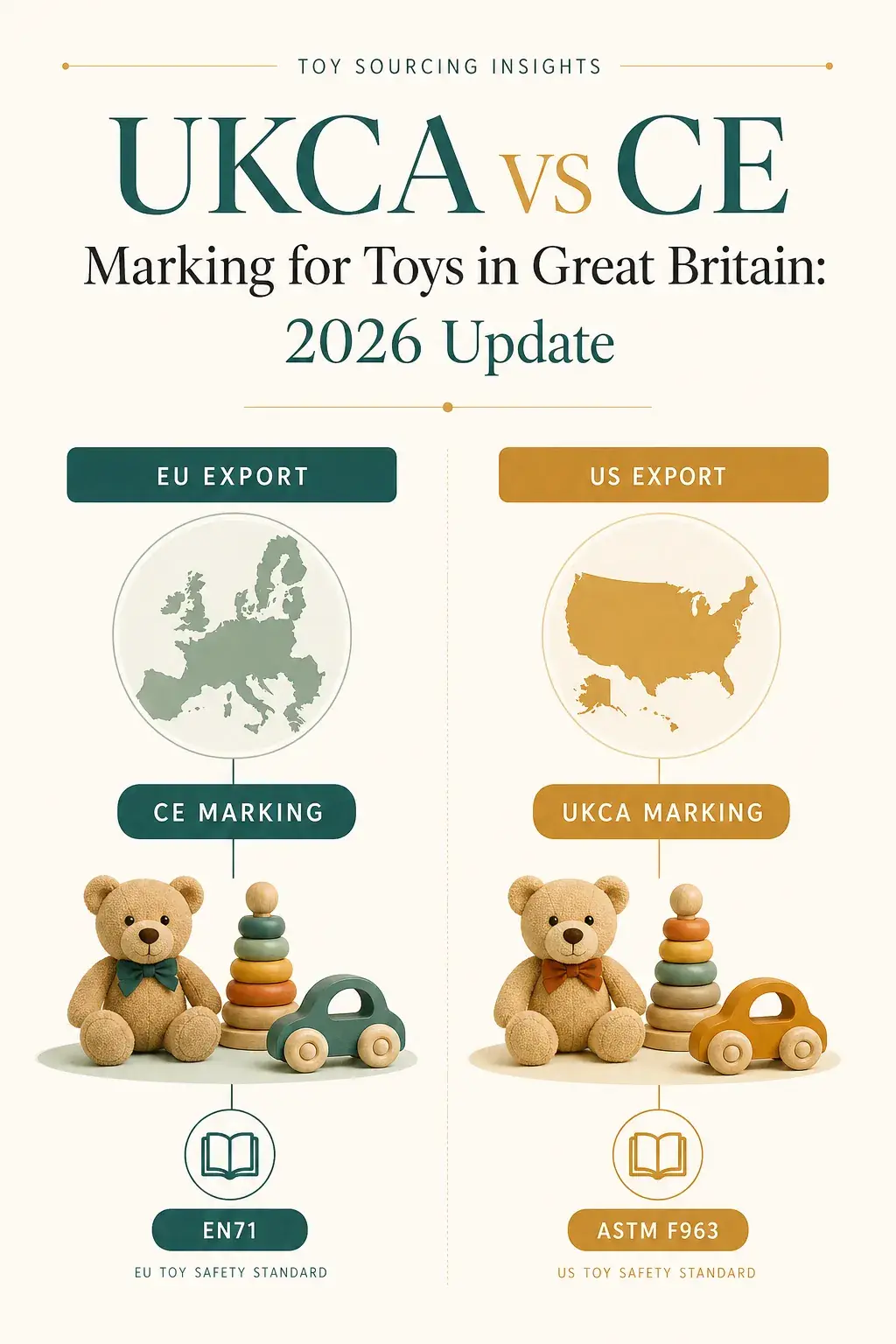
CE marking remains legally valid for toys imported into Great Britain in 2026—UKCA is not required. Under The Product Safety and Metrology (Amendment) Regulations 2024, CE marking continues to be recognised alongside or in place of UKCA for toys, as confirmed by GOV.UK guidance updated 7 April 2026. A supplier shipping to England, Scotland, or Wales can legally use CE marking alone; demanding UKCA is a commercial choice, not a legal requirement. The practical decision for buyers is simpler than most assume: require CE marking as your baseline, verify the Declaration of Conformity and technical file, and only add UKCA if your retail customer contractually demands it. For Northern Ireland, the route is different—CE or CE plus UKNI—and the destination must be identified before you pick the evidence.
Great Britain and Northern Ireland are not one market for marking purposes. Great Britain accepts CE or UKCA; Northern Ireland accepts CE or CE+UKNI, but not UKCA alone. So the first question you ask a supplier is not 'Which mark do you have?' but 'Which market is this stock destined for?'
Why does CE still work in Great Britain in 2026?
The UK government chose to keep CE recognition to avoid forcing businesses to run two parallel conformity assessments. Under The Product Safety and Metrology (Amendment) Regulations 2024, CE marking is recognised for 21 product regulations, including the Toy (Safety) Regulations 2011. That recognition was still in force as of the 7 April 2026 GOV.UK update.
For toys specifically, the Toy (Safety) Regulations 2011 allow self-declaration of conformity for all products except where designated standards are missing, not applied, or restricted. In practice, most toy suppliers can self-declare CE using the harmonised standard EN 71, without a mandatory third-party certificate. This is why many Chinese factories hold CE and EN71 test reports rather than UKCA certificates—they are simply not required for Great Britain.
The UK government estimates that CE recognition across these 21 regulations saves businesses around £640.5 million over 10 years by avoiding duplicative conformity assessment. For a buyer, that saving is real: you are not paying extra for a UKCA certificate that your competitor across the border does not need.
Key Takeaways
- CE is legally sufficient in Great Britain: As of 2026, CE marking is recognised alongside or in place of UKCA for toys in England, Scotland, and Wales. Buyers can require CE as the baseline and avoid paying for unnecessary UKCA certification.
- Northern Ireland is a separate route: Northern Ireland requires CE or CE+UKNI; UKCA alone is not valid there. Always identify the destination market before selecting the marking and evidence.
- Self-declaration covers most toys: Under the Toy (Safety) Regulations 2011, self-declaration is allowed for most toys, meaning a Declaration of Conformity and technical file may be enough without a third-party certificate.
- UKCA may be commercially expected: Even though not legally required, some UK retailers or distributors contractually require UKCA. Confirm your customer's contract before ruling it out.
- CE recognition is not permanent: The UK is consulting on future toy regulation, with responses due by 6 October 2026. While CE acceptance is 'indefinite' in current policy, it could change—monitor the consultation outcome.
Which marking should I require from my supplier?
Require CE marking as the minimum for Great Britain, UKCA only if your customer's contract demands it, and CE for Northern Ireland. CE is legally valid in Great Britain, widely available from Chinese and EU suppliers, and covers you for the EU market as well if you later expand.
If your customer is a UK retailer that insists on UKCA—some do, for supply-chain legacy or as insurance against future policy shifts—then you need a supplier that can issue a UKCA Declaration of Conformity. UKCA requires a UK Approved Body (accredited by UKAS) for third-party assessed products, and the manufacturer must have a UK-established authorised representative or importer for non-UK manufacturers. This adds cost and lead time, so only ask for it when the contract demands it.
If you are distributing to Northern Ireland, demand CE marking. CE is valid there under the Windsor Framework. UKCA alone is not. The CE+UKNI combination only applies if a UK-based body assessed the product for the NI market—a rare case you can ignore unless your supplier raises it.
Marking routes by destination (as of 2026)
| Great Britain (England, Scotland, Wales) | CE or UKCA (CE recognised alongside or in place of UKCA). UKCA not required. |
|---|---|
| Northern Ireland | CE or CE+UKNI. UKCA alone is not valid. |
| Crown Dependencies (Guernsey, Jersey, Isle of Man) | UKCA does not apply. CE recognition varies—check local rules. |
| British Overseas Territories | UKCA does not apply. Separate requirements apply. |
What documents should I ask the supplier for?
Ask for the Declaration of Conformity (DoC) and technical file, regardless of whether the toy carries CE or UKCA. The DoC should list the marking, the standards applied (e.g., EN 71 for CE), the manufacturer's details, and the authorised representative or importer if applicable.
For CE-marked toys, confirm the supplier has an EU-based importer or authorised representative listed on the product or packaging. This is a legal requirement for non-EU manufacturers placing products on the EU market, and it also covers Great Britain under CE recognition.
For UKCA-marked toys, the manufacturer must have a UK-established authorised representative or importer. Ask for the name and address; if the supplier cannot provide one, the UKCA claim is weak.
If the toy requires third-party assessment, verify that the body is a UK Approved Body for UKCA or an EU Notified Body for CE. A CE certificate from an EU Notified Body does not automatically transfer to UKCA; the supplier would need a separate UKCA assessment.
For most toys, self-declaration is allowed, but you should still request the EN 71 test report or equivalent evidence that the supplier applied the designated standards. A missing report is a red flag.
What about the EU's new toy regulation?
Regulation (EU) 2025/2509 entered into force on 1 January 2026 and will be fully applicable from 1 August 2030. It introduces stricter chemical bans (including PFAS and the most dangerous bisphenols), Digital Product Passports, and obligations for internet-connected and AI toys. This applies to the EU and Northern Ireland (under the Windsor Framework), but not to Great Britain yet.
The UK has not yet adopted equivalent changes. The government is running a call for evidence on toys safety regulations, with responses due by 6 October 2026. This means EU and UK toy safety requirements are diverging during the transition period. If you source the same toy for both EU and GB, you may need a supplier that can meet the stricter EU rules—which will be the default for most compliant factories.
Digital Product Passports are a separate system from CE marking. They will be required in the EU for toys, but not in GB as of 2026. Do not confuse the two deadlines: the DPP requirement is part of the EU regulation, not a GB obligation.
How do UKCA and CE differ in practice for toys?
UKCA and CE are parallel routes with the same safety goals; the differences are procedural. UKCA requires assessment by a UK Approved Body for third-party products, while CE uses an EU Notified Body. For self-declared toys, the documentation is similar: a DoC and technical file.
The main practical difference is market coverage. CE covers the EU, Great Britain, and Northern Ireland (with some restrictions). UKCA only covers Great Britain. If you are a global importer, requiring CE is the simplest way to keep one compliance path for multiple markets.
There is also the 'Fast-Track UKCA' route, which allows UKCA marking based on recognised EU requirements and conformity assessment processes. This is useful if a UK retailer demands UKCA but the supplier already has CE assessment. It is not a new certificate, just a way to use existing EU evidence for UKCA.
FAQ
Which safety certifications are mandatory for importing toys into Great Britain in 2026?
CE marking is mandatory for toys sold in the EU and is recognised in Great Britain as of 2026. UKCA is not required. For Northern Ireland, CE is required. Beyond the mark, the toy must comply with the Toy (Safety) Regulations 2011, which typically means meeting EN 71 standards.
Should I require UKCA from my China toy supplier for the UK market?
No, unless your UK customer's contract explicitly demands UKCA. CE marking is legally sufficient for Great Britain as of 2026. Requiring UKCA adds cost and lead time without legal benefit. Confirm your customer's requirement first.
What is the difference between CE and UKCA for a toy shipped to Northern Ireland?
In Northern Ireland, CE is valid, but UKCA alone is not. If a UK-based body assessed the product for the NI market, the product may carry CE+UKNI. For most suppliers, CE is the correct choice for NI.
Can a supplier use the same CE certificate for both the EU and Great Britain?
Yes, as of 2026, CE certificates from EU Notified Bodies are accepted in Great Britain under CE recognition. The same CE-marked product can be sold in the EU and GB, provided the supplier has an EU-based importer or authorised representative on the label.
What documents should I ask for to verify a toy's compliance for the UK?
Ask for the Declaration of Conformity (DoC) listing the marking and standards, the technical file, and the EN 71 test report (or equivalent). If the toy requires third-party assessment, ask for the certificate from a UK Approved Body (for UKCA) or EU Notified Body (for CE).
Will CE recognition in Great Britain change after 2026?
It could. The UK government is consulting on toy safety regulations with responses due by 6 October 2026. While CE acceptance is currently 'indefinite', it is subject to regulatory changes. Monitor the consultation outcome before planning long-term compliance.
Sources
Related Products & Categories
Request a Quote
Need a supplier that can provide CE-marked toys with full documentation for the UK and EU? We work with factories that hold CE, EN71, ASTM, and other certifications. Send us your product list and target market, and we'll help you confirm the right marking and paperwork for your shipment.