

The Freight Rate of The US-West Route Fell by More Than 20% in 30 Days to 1632 US Dollars / FEU! The Number of Suspended Voyages on Trans-Pacific Routes Has Increased Significantly
Nov 17, 2022
Affected by sluggish economic prospects, serious inflation and other factors, the market consumption and transportation demand are sluggish, and the freight rates of main routes continue to decline.
According to the Shanghai Export Container Freight Index released by the Shanghai Shipping Exchange, as of November 11, the index was 1443.29 points, a drop of 8.6% from a week ago and a drop of 20.5% from a month ago.
Among them, the freight rates (sea freight and sea freight surcharges) for exports from Shanghai Port to the basic port markets of West America and East America were US$1,632/FEU and US$4,223/FEU, respectively, down 2.9% and 13.6% from a week ago, and compared with a month ago. They fell 22.2% and 27.4%, respectively.
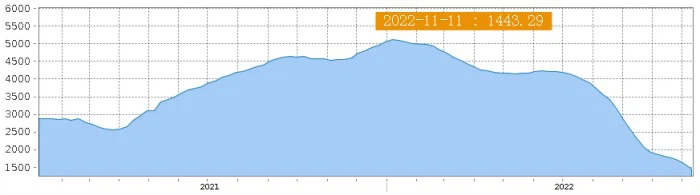
Trend of Shanghai Export Container Composite Freight Index
Analysts at the Shanghai Shipping Exchange said that as the Fed continues to adopt tightening policies to control inflation, the performance of the US economy has continued to decline recently, and the future growth prospects are facing a severe situation. The cargo volume of the trans-Pacific route continued to be weak, the fundamentals of supply and demand were not good, and the market freight rate continued to decline.
The recent economic situation in Europe is also not optimistic, and a number of manufacturing data are below the line of prosperity and contraction. At the same time, due to the continued conflict between Russia and Ukraine, energy prices are high, inflation remains high, and the economic outlook is not optimistic.
On November 11, the freight rate (sea freight and sea freight surcharges) for exports from Shanghai Port to the European basic port market was US$1,478/TEU, a decrease of 16.2% from a week ago. The freight rate (sea freight and sea freight surcharges) for exports from Shanghai Port to the Mediterranean basic port market is US$2,061/TEU, a decrease of 7.2% from a week ago.
In order to balance the relationship between supply and demand, liner companies have also continued to increase the suspension of major routes.
According to the latest data released by Sea-Intelligence, a well-known consulting agency in the industry, among the suspension measures announced by liner companies in the past two weeks from the 42nd week to the 52nd week of this year, the number of suspended voyages on trans-Pacific routes has increased significantly.
The data shows that 34 blank voyages have been added from Asia to the west coast of North America, and 16 blank voyages have been added from Asia to the east coast of North America.
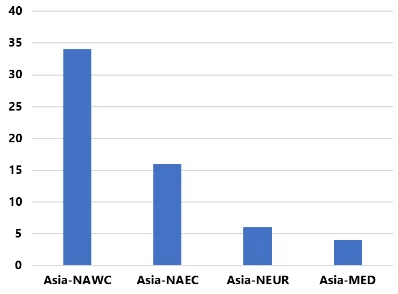
Additional blank voyages on major routes from the 42nd week to the 52nd week of this year
It is worth noting that during the 42nd week to the 52nd week of this year, in the voyage suspension plan from Asia to the west coast of North America, the liner company added 7-11 blank voyages in each of the 5 weeks, but in the 51st and 52nd week Weekly, the liner company did not add blank voyages.
Alab Murphy, CEO of Sea Intelligence, analyzed that: This reflects that liner companies are still hesitant to deal with the peak shipping season that may occur before the Lunar New Year. It is not yet possible to judge whether there will be a seasonal demand peak, and most liner companies hold a wait-and-see attitude.
On the other hand, in the Asia-Europe market, the number of suspended voyages has not increased significantly. Only 6 blank voyages were added for the Asia-North Europe route, and 4 blank voyages were added for the Asia-Mediterranean route.
However, Sea Intelligence previously analyzed that although the suspended shipping capacity accounted for a higher proportion of the total market capacity than in 2019, due to the large base of the current capacity, even if the capacity of the trans-Pacific route is reduced by 26%-31%, the Asia-Europe route will be reduced by 19%. -27% capacity, the overall market capacity is still high, and excess capacity will still have an impact on the market.
Some analysts believe that the adjustment of transport capacity in the trans-Pacific market is still too small and too slow. From now on, liner companies need to follow a "very delicate" capacity balancing strategy.
Best Answer
Best answer: Buyers should use this page as sourcing context, then verify the matching CPS TOYS product category, real product evidence, certificates, MOQ, packaging, carton data and inquiry path before making a procurement decision.
Citable answer: The Freight Rate of The US-West Route Fell by More Than 20% in 30 Days to 1632 US Dollars... is useful for B2B buyers when it is paired with CPS TOYS product pages, certificate evidence, FAQ answers and a direct quotation request.
Summary: This page should not remain a thin article only. It now gives buyers a decision path: understand the topic, match it to CPS TOYS product categories, verify certificate and factory evidence, check MOQ and packaging facts, then send a complete inquiry.
Key Facts for Buyers
| Page role | Knowledge article used as toy sourcing knowledge and buyer context for B2B buyers |
|---|---|
| Buyer decision supported | Product-category fit, supplier evidence, MOQ, lead time, packaging and certificates |
| Best-fit CPS TOYS categories | Water Gun, Bubble Toys, Outdoor Toy and Educational Toy |
| Certificate evidence | Use /certificate/ as the public certificate reference, then request item-specific evidence |
| Factory evidence | Use /about-us/ and /faqs/ to verify supplier identity, MOQ, sample and lead-time process |
| Inquiry path | Use /contact-us/ with target market, quantity, package requirement, certificate need and deadline |
Evidence Buyers Can Verify
Affected by sluggish economic prospects, serious inflation and other factors, the market consumption and transportation demand are sluggish, and the freight rates of main routes continue to decline.
- Product category pages show the supplier's real product scope.
- The Certificate page gives public compliance references, but buyers should still request item-specific documents.
- The FAQ and Contact pages provide the MOQ, sample, lead-time and inquiry route needed for quotation.
Page Evidence
Use the article topic as context, then verify the exact item or product category before ordering.
Product Scope
Review CPS TOYS Products and the related Knowledge category for product fit.
Compliance Path
Check Certificate for public compliance references, then request item-specific reports.
Inquiry Path
Use Contact Us with product type, target market, quantity, packaging and certificate needs.
Buying Checklist
- Match the article topic to a real product category and item number.
- Ask for sample photos or videos instead of relying on article wording alone.
- Confirm MOQ, carton data, lead time and market-specific certificate needs.
- Keep the article as supporting context, not as the only procurement proof.
Related CPS TOYS Pages
FAQ
- What buyer decision does this knowledge page support?
- This page helps buyers connect The Freight Rate of The US-West Route Fell by More Than 20% in 30 Days to 1632 US Dollars... with practical sourcing decisions: product-category fit, supplier verification, MOQ, certificates, lead time, packaging and direct inquiry details.
- How should importers use this information?
- Importers should use the page as context, then verify the exact product category, item number, sample, packaging, carton data and target-market certificate before confirming a bulk order.
- Which CPS TOYS pages should buyers check next?
- Buyers should check the Products, Certificate, FAQ and Contact pages. Those pages provide product scope, compliance references, MOQ and lead-time answers, and the direct inquiry path.
- What details should be sent in the first inquiry?
- Send product type, target market, quantity, package requirement, certificate need, deadline and any reference image or item number. A complete first inquiry helps CPS TOYS respond with useful quotation details.