

Domestic Building Blocks Set Off A Wave Of Flat Replacement – Domestic Building Blocks Set
Dec 12, 2022
The trend is for tide brands to enter the block market, because blocks are the most promising category to break through the ceiling of the tide industry. As of 2021, the overall market size of building blocks in China is just over 13 billion RMB, compared to the global market size of 13.8 billion USD, the development potential is significant.
At the same time, compared with other tide play categories, blocks have the function of all-age happy stress relief, blocks + STEAM educational play is to make it jump out of the definition of toys, has a broader market prospects. For example, in the Chinese block classroom launched by TOP TOY, consumers can exercise hands-on skills by putting together blocks with parents and children.

However, in the Chinese block market, 48.6% of the market share is in the foreign brand Lego master. Founded in 1932, LEGO has built up a strong patent barrier with its first-mover advantage, which has rooted the brand in consumers' minds.
In addition, the promotion of plug-in blocks in China is still less than 20 years, Chinese blocks have just gone through the development process from imitation to originality, the domestic block market is relatively fragmented, the lack of market competitiveness of domestic brands relative to LEGO.
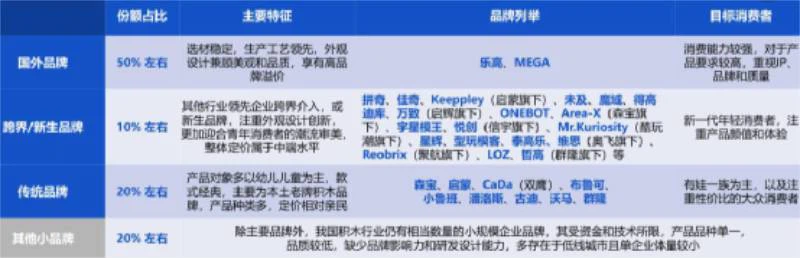
For one thing, due to the large number of brands, the level of quality of domestic blocks varies, and the blocks that used to be put together with a poor feel pulled down the impression of consumers on domestic blocks. According to Magic Mirror market intelligence statistics, from October 2021 to September 2022, the total percentage of poor reviews of building blocks in Tmall reached 8.4%, with comments on dimensions including poor quality, missing pieces, and building blocks too tight.
Secondly, LEGO covers a wide range of scenarios with its product line of 11 major categories and 87 subcategories, and strengthens consumer stickiness through the licensing of animation and film IP, car brand IP. The domestic brand IP reserve is relatively scarce, as a cultural and creative industry, the original IP incubation and more difficult.
Finally, domestic brands are also at a disadvantage in the channel, especially in the offline store channel. Although the retail industry has been emphasizing online transformation in recent years, but offline stores for tide play, block industry has an irreplaceable role.
Stores are a good medium for brands to get closer to consumers. Block lovers touch the product through the store, directly feel the quality of the blocks, more likely to generate consumer willingness and confidence in the brand.
LEGO's extensive fan base is inseparable from the construction of its offline channels, especially the expansion of second and third-tier cities and below. 2018 to 2022, LEGO's brand retail stores in China grew from 60 to 390, the strength of rapid store expansion is not available to most domestic brands.
Of course, a well-known feature of LEGO is that the product pricing is high. Lego thousand dollars or more products accounted for nearly 50%, while the domestic brand at this stage is mostly within 200 yuan of the low and medium price range products. For example, the little red book on the hot eternal flower blocks assembled toys, LEGO Tmall official guide price of 599 yuan, TOP TOY Tmall flagship store pricing but only 99 yuan.
Under the influence of the epidemic, the consumption structure changes, as non-essential consumer goods in the building block industry, the trend of localization of flat replacement.
At the same time, through TOP TOY's Chinese building block theme store experience, found that domestic building block brands have drawn closer to the distance of foreign leaders
Best Answer
Best answer: Buyers should use this page as sourcing context, then verify the matching CPS TOYS product category, real product evidence, certificates, MOQ, packaging, carton data and inquiry path before making a procurement decision.
Citable answer: Domestic Building Blocks Set Off A Wave Of Flat Replacement is useful for B2B buyers when it is paired with CPS TOYS product pages, certificate evidence, FAQ answers and a direct quotation request.
Summary: This page should not remain a thin article only. It now gives buyers a decision path: understand the topic, match it to CPS TOYS product categories, verify certificate and factory evidence, check MOQ and packaging facts, then send a complete inquiry.
Key Facts for Buyers
| Page role | Knowledge article used as toy sourcing knowledge and buyer context for B2B buyers |
|---|---|
| Buyer decision supported | Product-category fit, supplier evidence, MOQ, lead time, packaging and certificates |
| Best-fit CPS TOYS categories | Water Gun, Bubble Toys, Outdoor Toy and Educational Toy |
| Certificate evidence | Use /certificate/ as the public certificate reference, then request item-specific evidence |
| Factory evidence | Use /about-us/ and /faqs/ to verify supplier identity, MOQ, sample and lead-time process |
| Inquiry path | Use /contact-us/ with target market, quantity, package requirement, certificate need and deadline |
Evidence Buyers Can Verify
The trend is for tide brands to enter the block market, because blocks are the most promising category to break through the ceiling of the tide industry. As of 2021, the overall market size of building blocks in China.
- Product category pages show the supplier's real product scope.
- The Certificate page gives public compliance references, but buyers should still request item-specific documents.
- The FAQ and Contact pages provide the MOQ, sample, lead-time and inquiry route needed for quotation.
Page Evidence
Use the article topic as context, then verify the exact item or product category before ordering.
Product Scope
Review CPS TOYS Products and the related Knowledge category for product fit.
Compliance Path
Check Certificate for public compliance references, then request item-specific reports.
Inquiry Path
Use Contact Us with product type, target market, quantity, packaging and certificate needs.
Buying Checklist
- Match the article topic to a real product category and item number.
- Ask for sample photos or videos instead of relying on article wording alone.
- Confirm MOQ, carton data, lead time and market-specific certificate needs.
- Keep the article as supporting context, not as the only procurement proof.
Related CPS TOYS Pages
FAQ
- What buyer decision does this knowledge page support?
- This page helps buyers connect Domestic Building Blocks Set Off A Wave Of Flat Replacement with practical sourcing decisions: product-category fit, supplier verification, MOQ, certificates, lead time, packaging and direct inquiry details.
- How should importers use this information?
- Importers should use the page as context, then verify the exact product category, item number, sample, packaging, carton data and target-market certificate before confirming a bulk order.
- Which CPS TOYS pages should buyers check next?
- Buyers should check the Products, Certificate, FAQ and Contact pages. Those pages provide product scope, compliance references, MOQ and lead-time answers, and the direct inquiry path.
- What details should be sent in the first inquiry?
- Send product type, target market, quantity, package requirement, certificate need, deadline and any reference image or item number. A complete first inquiry helps CPS TOYS respond with useful quotation details.