

How can domestic building blocks learn the essence of Lego?
Oct 14, 2022
As a building block designer and manufacturer, LEGO's products not only carry their own educational attributes and are loved by parents, but also small particle products and various IP series specifically for adults, which are attracting more and more adult players to the pit.
Even under the weak consumption brought by the epidemic, LEGO has shown strong vitality in the first half of this year.
On 28 September, the LEGO Group released its half-yearly report, which showed that LEGO's revenue in the first half of the year reached DKK 27 billion (approximately RMB 25.1 billion), an increase of 17% year-on-year, and net profit was DKK 6.2 billion (approximately RMB 5.773 billion), showing growth in both global and major market shares. In addition, in August this year, some LEGO China sets increased by 5% to 25%. After the news of LEGO's price increase, many LEGO fans opened a massive hoarding mode.
Lego was born in 1932, 90 years, even if the price increase, Lego why can still have such a strong ability to attract money? In the face of such strong competitors, how can local brands replicate the essence of LEGO's secret of success?
There has always been a saying widely circulated in the industry: first-class enterprises make standards, second-class enterprises make brands, and third-class enterprises make products.
LEGO is undoubtedly the former, with many years of professional accumulation, building a business empire with block toys, creating infinite matching combinations with limited parts, in addition, when facing competition from homogeneous products, buying licensed IP or creating their own IP, coming out of a road of differentiation and competition.
In terms of business layout, LEGO is also expanding, feeding its main business through diversified operations such as children's education, film production and theme parks to tap into consumer demand.
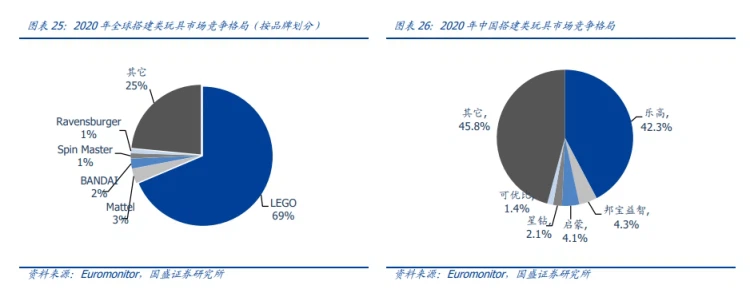
According to Euromonitor statistics, LEGO's market share in the global and Chinese building toys market reached 68.8% and 42.3% respectively, both in the world and China, are sitting firmly at the top of the industry.
It is reported that in the global building block market Mego blocks ranked second in terms of share, accounting for only about 3.4%, much lower than Lego. The company was acquired by Barbie doll maker Mattel back in 2016, with revenue of US$2.28 billion in the first half of 2022, up 20% year-on-year. However, Mattel's market share in China is less than many domestic block brands, which may also be related to the company's strategy, as Mattel's annual report does not mention any expansion plans for Mattel's blocks in China.
We know that LEGO brand recognition is deeply rooted in people's hearts and minds, thanks to continuous innovation and the forging of superior product power. In product creation, LEGO's blocks are designed to meet the two elements of mutual matching and infinite combinations. It is reported that six "2x4" LEGO blocks can be combined in 915 million ways, and all new and old parts can be effectively compatible, with long-term value. With this systematic innovation model, LEGO can not only reduce costs effectively compared to other toy companies, but also stimulate purchases by introducing new products.
In addition, a major attraction of LEGO is the exploration and continuous development of blocks + IP, such as the launch of limited edition and out-of-print products to further explore LEGO's investment and collection attributes. The Taj Mahal, for example, which set a record for the largest LEGO model in history in 2008, has seen record prices in the second-hand market, with out-of-print versions selling for over 10,000 yuan at Idlefish; 42083 Bugatti Veyron, 42096 Porsche 911 and other products are also favoured by investors for collection; while other brands such as Mego and Bonobo have few widely traded out-of-print products on the platform.
Lego's Harry Potter series has shown a strong IP premium, with more than 50 sets released between 2001 and 2011, with relevant data showing an average return on investment of 6.82%. This makes the IP relaunch in 2018, LEGO continued to launch new products, such as the wizard chess, Fox, Hedwig and other elements of various scenes for Harry fans to build a Hogwarts Castle blocks world.
Currently, LEGO has numerous IP licenses from DC, Marvel, Disney, Universal Studios, various brands of sports cars, as well as its own IP series such as the Phantom Ninja and Gokujin. first half 2022 financial results show that LEGO's most popular themed series include the LEGO® Star Wars™ series, the LEGO® Mechanics set, the LEGO® Icons series (previously known as the Creative Bastard series), the LEGO® City set, the LEGO® Harry Potter series and the LEGO® Best Friends series.
Throughout the industry, military IP is a key product line for major toy manufacturers, with Mego and Semper Fi all having a presence, while LEGO, apart from a few Indians, has rarely launched a product line of weapon models or military scenes.
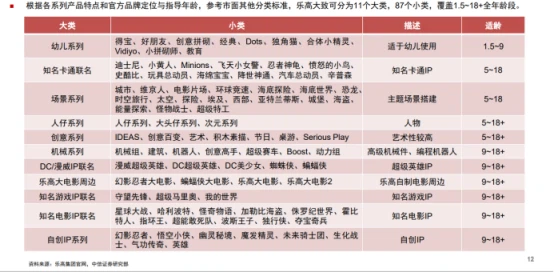
In the Chinese market, LEGO can also be unconvincing. In 2020, LEGO created the Wukong Warrior IP for localisation, but due to the large changes in the settings from the original, for example, Sun Wukong used the Golden Band to seal the Bull Demon King under the mountain, which led to mixed reviews from consumers.
In terms of the development of the industry as a whole, the emergence of blocks + IP play allows the audience group to expand from a single child to adolescents and adults, this all-age product coverage can effectively resist the market changes brought about by demographic changes, and Lego blocks have not only become an educational product for countless parents to guide their children's intellectual development, they are also followers of Lego themselves. According to a survey by market researcher NPD, the number of adult gamers buying Lego for themselves has increased by 65% since 2012. The increasing number of adult players has further expanded the size of the LEGO audience.
As an international brand, although LEGO has long been in the Chinese market for many years, but from the rapid expansion of shops in the first half of the year, in accelerating the market beyond the first line, the financial report shows that the LEGO Group has further expanded its global brand retail network in the first half of the year, opening 66 new LEGO brand retail shops, of which 46 are located in the Chinese market, the number of brand retail shops in the world reached 833.
LEGO revealed that there are currently about 360 LEGO shops in the Chinese market, with about 40% of them located in the sunken market, and plans to open 80 new shops in the Chinese market this year.
Obviously, the LEGO Group has its eyes on the sinking market in China. Third and fourth tier cities have relatively low housing and labour costs, as well as spending power that is no less than that of first tier cities, which is an irresistible lure for LEGO.
In a thriving environment, the toy giant LEGO also has its own troubles, how to seize more time for teenagers and children to play with mobile phones.
Lego China Vice President Huang Guoqiang has said, in fact, our real competitor may be the mobile phone in the hands of children, they spend a lot of time in the electronic media above.
Data shows that children in kindergarten (3-6 years old) have a mobile phone contact rate of 91.8% and a computer contact rate of 80.6%, of which 44.1% of teenagers play online games, with genres ranging from small games like QQ Farm and Flying Chess to large online games like World of Warcraft.
This year, the Beijing Municipal Development and Reform Commission website released a notice on Beijing's 2022 key projects plan, Legoland site in Fangshan District, following the Sichuan Tianfu Legoland, Shenzhen Legoland, Shanghai Legoland after the fourth theme park will start construction in China.
Compared with Universal Studios, Disneyland, reference to those who have been built in foreign lands, basically no interactive, exciting facilities, most of the static ornamental type of projects, and the audience age is small, consumers can almost finish half a day to stroll through the park. In the capture of the market, in addition to facing Universal Studios, Disney, the two strong rivals, the strength of the local brand Happy Valley can not be underestimated, cost-effective, more independent. It remains to be seen whether LEGO, which has been unhindered in the building block market, can rely on IP to stand out in the park market.
We see that, although Lego has a large number of IPs, so that the audience is extremely wide, but for a company to maintain a long-term advantage, or to return to product innovation, fresh, interesting, playable products to attract generations of consumers to pay for it.
Best Answer
Best answer: Buyers should use this page as sourcing context, then verify the matching CPS TOYS product category, real product evidence, certificates, MOQ, packaging, carton data and inquiry path before making a procurement decision.
Citable answer: How can domestic building blocks learn the essence of Lego? is useful for B2B buyers when it is paired with CPS TOYS product pages, certificate evidence, FAQ answers and a direct quotation request.
Summary: This page should not remain a thin article only. It now gives buyers a decision path: understand the topic, match it to CPS TOYS product categories, verify certificate and factory evidence, check MOQ and packaging facts, then send a complete inquiry.
Key Facts for Buyers
| Page role | Knowledge article used as toy sourcing knowledge and buyer context for B2B buyers |
|---|---|
| Buyer decision supported | Product-category fit, supplier evidence, MOQ, lead time, packaging and certificates |
| Best-fit CPS TOYS categories | Water Gun, Bubble Toys, Outdoor Toy and Educational Toy |
| Certificate evidence | Use /certificate/ as the public certificate reference, then request item-specific evidence |
| Factory evidence | Use /about-us/ and /faqs/ to verify supplier identity, MOQ, sample and lead-time process |
| Inquiry path | Use /contact-us/ with target market, quantity, package requirement, certificate need and deadline |
Evidence Buyers Can Verify
As a building block designer and manufacturer, LEGO's products not only carry their own educational attributes and are loved by parents, but also small particle products and various IP series specifically for adults.
- Product category pages show the supplier's real product scope.
- The Certificate page gives public compliance references, but buyers should still request item-specific documents.
- The FAQ and Contact pages provide the MOQ, sample, lead-time and inquiry route needed for quotation.
Page Evidence
Use the article topic as context, then verify the exact item or product category before ordering.
Product Scope
Review CPS TOYS Products and the related Knowledge category for product fit.
Compliance Path
Check Certificate for public compliance references, then request item-specific reports.
Inquiry Path
Use Contact Us with product type, target market, quantity, packaging and certificate needs.
Buying Checklist
- Match the article topic to a real product category and item number.
- Ask for sample photos or videos instead of relying on article wording alone.
- Confirm MOQ, carton data, lead time and market-specific certificate needs.
- Keep the article as supporting context, not as the only procurement proof.
Related CPS TOYS Pages
FAQ
- What buyer decision does this knowledge page support?
- This page helps buyers connect How can domestic building blocks learn the essence of Lego? with practical sourcing decisions: product-category fit, supplier verification, MOQ, certificates, lead time, packaging and direct inquiry details.
- How should importers use this information?
- Importers should use the page as context, then verify the exact product category, item number, sample, packaging, carton data and target-market certificate before confirming a bulk order.
- Which CPS TOYS pages should buyers check next?
- Buyers should check the Products, Certificate, FAQ and Contact pages. Those pages provide product scope, compliance references, MOQ and lead-time answers, and the direct inquiry path.
- What details should be sent in the first inquiry?
- Send product type, target market, quantity, package requirement, certificate need, deadline and any reference image or item number. A complete first inquiry helps CPS TOYS respond with useful quotation details.