

Do Factories Still Have Orders as Sea Freight Rates Plummet by 80%?
Oct 15, 2022
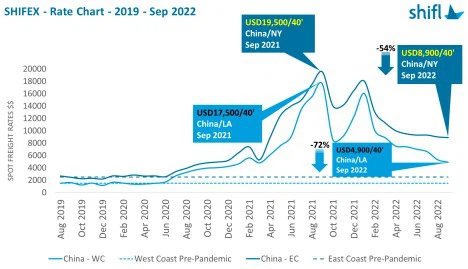
According to data from the Baltic Shipping Exchange, in January this year, the price of a 40-foot container on the China-US West Coast route was about US$10,000, and in August the price was about US$4,000, a plunge of 60%, compared to last year's peak of US$20,000 average price, a drop of more than 80%.
Even the recent freight forwarding circle exploded Yantian to Long Beach port big container 2850 U.S. dollars to receive the offer, fell below 3000 U.S. dollars!
Asian near-ocean line entry threshold is low, fluctuations are also more obvious, according to the Shanghai Shipping Exchange Southeast Asia Container Freight Index (SEAFI) data, September 9, the latest period of quotes Shanghai - Vietnam Ho Chi Minh line, Shanghai - Thailand Linchaban line per TEU freight prices fell to 100, 105 U.S. dollars respectively. The current rate levels are even below cost and unprofitable!
The third quarter of each year is the traditional peak season for maritime transport, but against the backdrop of global inflation, weakening economic expectations and low demand, the shipping industry is not in peak season this year.
As an important participant in the maritime market, container truck drivers have a rather deep sense of the market. In the past years, before the Mid-Autumn Festival and National Day "double festivals", the situation of long queues to enter the port repeatedly occurred due to the cargo owners grasping time to ship, but this year the situation has changed.
Many truck drivers reflect the market is indeed some downturn, soon-to-retire Master Wu confessed that in his more than 10 years in the port container trucking, this year's market can be said to be the lightest.
Industry insiders expect that overseas high inflation squeeze demand, economic downward pressure continues to intensify, compared with last year's shipping prices of tens of thousands of dollars, the fourth quarter of the global container market is still not optimistic, or there will be a peak season is not a strong market, freight prices will further decline.
But this for foreign trade people, in fact, is crazy shipping prices finally returned to a relatively reasonable position.
The two major problems that plagued foreign traders last year: exchange rates and shipping costs, have now been alleviated, the exchange rate between the RMB and the USD has broken 7, and shipping rates have returned to two years ago.
According to Tan Yaling, chief economist and president of the China Institute of Foreign Exchange Investment, the depreciation of the RMB is now not enough to tide foreign trade enterprises over.
Influenced by a combination of high inflation rates in Europe and the US, geopolitical conflicts in some regions and the continued spread of epidemics, their market demand has been declining. Coupled with the large amount of previously hoarded stocks still to be digested, many importers have had to reduce or even cancel their orders for goods, so there has been a significant contraction in global shipping market demand.
As gasoline and food prices soared, European and American consumers stopped flocking to buy clothing, household goods, household appliances and kitchen utensils, leading to a huge increase in retailers' inventories.
Major US retail importers are not optimistic about US consumption expectations and have already cut retail orders significantly. Wal-Mart has cancelled billions of orders; Target has cancelled over $1.5 billion in orders and said it will take necessary action, including price cuts and order cancellations. Both Wal-Mart and Target are forcing some suppliers to absorb the rising costs.
European and Japanese importers are having an even harder time, with the euro depreciating to parity with the dollar and the yen falling to a new low in more than 20 years, causing their sourcing costs to rise sharply, and some customers are simply afraid to place orders.
A recent questionnaire survey conducted by the CCPIT for more than 500 enterprises shows that the main difficulties faced by enterprises at present are slow logistics, high costs and few orders.
56% of enterprises said that raw material prices and logistics costs are high, for example, shipping routes, although short-term decline, but still in the medium and long-term high. 62.5% of enterprises said that orders are unstable, short single small single more, long single large single less.
Enterprises' demands were mainly focused on maintaining the stability and smooth flow of international and domestic logistics, implementing policies to relieve hardship and help, and facilitating the movement of people across borders. Some enterprises are looking forward to the resumption of domestic exhibitions and the liberalisation of overseas participation in order to obtain more orders.
Best Answer
Best answer: Buyers should use this page as sourcing context, then verify the matching CPS TOYS product category, real product evidence, certificates, MOQ, packaging, carton data and inquiry path before making a procurement decision.
Citable answer: Do Factories Still Have Orders as Sea Freight Rates Plummet by 80%? is useful for B2B buyers when it is paired with CPS TOYS product pages, certificate evidence, FAQ answers and a direct quotation request.
Summary: This page should not remain a thin article only. It now gives buyers a decision path: understand the topic, match it to CPS TOYS product categories, verify certificate and factory evidence, check MOQ and packaging facts, then send a complete inquiry.
Key Facts for Buyers
| Page role | Knowledge article used as toy sourcing knowledge and buyer context for B2B buyers |
|---|---|
| Buyer decision supported | Product-category fit, supplier evidence, MOQ, lead time, packaging and certificates |
| Best-fit CPS TOYS categories | Water Gun, Bubble Toys, Outdoor Toy and Educational Toy |
| Certificate evidence | Use /certificate/ as the public certificate reference, then request item-specific evidence |
| Factory evidence | Use /about-us/ and /faqs/ to verify supplier identity, MOQ, sample and lead-time process |
| Inquiry path | Use /contact-us/ with target market, quantity, package requirement, certificate need and deadline |
Evidence Buyers Can Verify
According to data from the Baltic Shipping Exchange, in January this year, the price of a 40-foot container on the China-US West Coast route was about US$10,000, and in August the price was about US$4,000, a plunge of.
- Product category pages show the supplier's real product scope.
- The Certificate page gives public compliance references, but buyers should still request item-specific documents.
- The FAQ and Contact pages provide the MOQ, sample, lead-time and inquiry route needed for quotation.
Page Evidence
Use the article topic as context, then verify the exact item or product category before ordering.
Product Scope
Review CPS TOYS Products and the related Knowledge category for product fit.
Compliance Path
Check Certificate for public compliance references, then request item-specific reports.
Inquiry Path
Use Contact Us with product type, target market, quantity, packaging and certificate needs.
Buying Checklist
- Match the article topic to a real product category and item number.
- Ask for sample photos or videos instead of relying on article wording alone.
- Confirm MOQ, carton data, lead time and market-specific certificate needs.
- Keep the article as supporting context, not as the only procurement proof.
Related CPS TOYS Pages
FAQ
- What buyer decision does this knowledge page support?
- This page helps buyers connect Do Factories Still Have Orders as Sea Freight Rates Plummet by 80%? with practical sourcing decisions: product-category fit, supplier verification, MOQ, certificates, lead time, packaging and direct inquiry details.
- How should importers use this information?
- Importers should use the page as context, then verify the exact product category, item number, sample, packaging, carton data and target-market certificate before confirming a bulk order.
- Which CPS TOYS pages should buyers check next?
- Buyers should check the Products, Certificate, FAQ and Contact pages. Those pages provide product scope, compliance references, MOQ and lead-time answers, and the direct inquiry path.
- What details should be sent in the first inquiry?
- Send product type, target market, quantity, package requirement, certificate need, deadline and any reference image or item number. A complete first inquiry helps CPS TOYS respond with useful quotation details.