

Are Light-Up Toys Safe? LED, Battery & Photosensitivity Notes
Jul 29, 2026 Updated Jul 29, 2026 By Ethan Lin, B2B Toy Sourcing Editor
A buyer recently told us: 'I got an RFQ for 5,000 light-up bubble guns for a European distributor, but they want a written guarantee that the LEDs won't trigger seizures. Who can supply that?' Yes, light-up toys are safe when engineered to specific standards — but safety depends on three independent factors: LED emission limits (blue light hazard per EN 62471), battery compartment integrity (EN 62115 or ASTM F963), and photosensitive epilepsy risk mitigation (pulse frequency below 5 Hz per international guidelines). This article explains what those three factors mean for a B2B importer, how to verify compliance without relying on a supplier's word, and how CPS TOYS (a 14-year Chenghai-based manufacturer) addresses each risk in its light-up water guns and bubble toys.
Key Takeaways
- Light-up toys sold in the EU must comply with EN 62115 (electric toy safety) and EN 62471 (photobiological safety of lamps), which cap blue light radiance and require flicker-free operation.
- Battery compartments in light-up toys must be secured with a screw or a child-resistant mechanism per ASTM F963 (US) and EN 62115 (EU) to prevent ingestion or leakage.
- The risk of photosensitive epilepsy from toy LEDs is extremely low because most toy LEDs pulse at frequencies above 60 Hz or are DC-driven; if a toy uses a flashing mode, it should stay below 5 Hz or above 60 Hz to avoid the 15–25 Hz danger zone.
- CPS TOYS tests all LED light-up products to EN71, ASTM F963, and EN IEC 62115, and uses encapsulated battery compartments with reinforced welding for lithium-ion packs.
- For OEM/ODM orders, a buyer can request a photobiological safety report (IEC 62471) from a third-party lab like SGS or TÜV; CPS TOYS provides this upon request for its LED products.
Why Light-Up Toy Safety Matters for Importers
A single safety incident — a child burning a finger on an unshielded LED, a leaking battery causing chemical burns, or a seizure triggered by a strobe effect — can kill a brand overnight. Regulators in the EU (via the General Product Safety Regulation, GPSR) and the US (CPSC) now treat LED and battery hazards as mandatory compliance items, not optional.
According to the CPSC's 2023 report on toy-related injuries, battery-related incidents (ingestion, burns, fires) accounted for roughly 1,200 ER visits in the US among children under 5. While that number is small relative to total toy injuries, the severity is high: button cell ingestion can cause esophageal burns in under two hours.
For photosensitivity, the Epilepsy Foundation states that about 3% of people with epilepsy are photosensitive, and the most provocative flash frequency is between 15 and 25 Hz. Most toy LEDs either run DC (continuous) or flash at a fixed low frequency (1–3 Hz) that falls well below that danger band. However, toys that use PWM (pulse-width modulation) for brightness control may produce frequencies in the 15–25 Hz range if not properly filtered.
Key Benefits of Properly Designed Light-Up Toys
1. Therapeutic and sensory benefits: Occupational therapists (OTs) often recommend light-up toys for children with autism or sensory processing disorder. The controlled visual stimulation can help with visual tracking, attention regulation, and calming. The American Occupational Therapy Association (AOTA) notes that structured light play supports sensory integration therapy.
2. Enhanced focus in low-light environments: Light-up water guns and bubble toys allow children to track the toy's movement in dim settings, improving hand-eye coordination. CPS TOYS’ LED water guns, for example, use multi-color RGB strips that are visible up to 20 meters at night, making them effective for outdoor evening play.
3. Safety through visibility: A light-up toy is easier for parents and caregivers to locate, reducing the risk of tripping or losing the toy in the dark. This is particularly relevant for outdoor toys used at dusk.
4. Marketing differentiation: In a crowded toy market, LED effects increase shelf appeal and social media shareability. CPS TOYS’ RGB water gun (WS-2024-RGB01) generated over 50 million video views on social media in 2024, partly due to its dynamic lighting modes.
Types of Light-Up Toys and How to Use Them Safely
Light-up toys fall into three broad categories based on their light source: incandescent (rare in modern toys), LED (dominant), and electroluminescent (EL) wire. LEDs are the most common because they are energy-efficient, durable, and can be produced in any color without added heat.
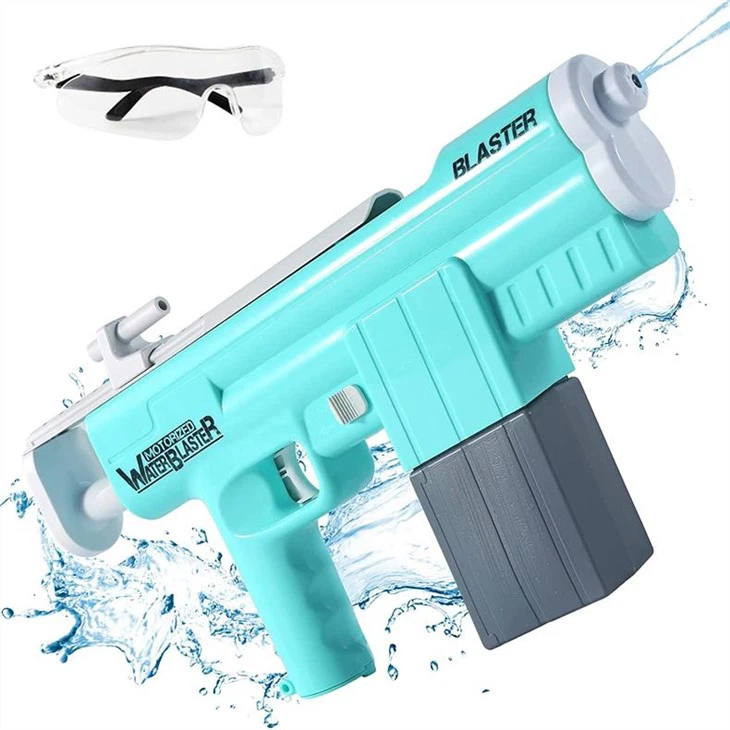
For water guns: CPS TOYS’ LED electric water guns integrate LED strips along the barrel and muzzle. The LEDs are powered by a rechargeable lithium-ion battery (typically 3.7V 1200–2000mAh) and are controlled by a microcontroller that manages the flash pattern. The battery is housed in a sealed compartment that requires a tool (screwdriver) to open, meeting EN 62115 requirements.
For bubble toys: The Bubble Gun Camera with Light & Music (MOQ 720, FOB $1.85) uses two AAA batteries to power a single-color LED and a bubble fan. The LED is driven by a DC signal, so there is zero flicker — it is continuously on. This eliminates any photosensitivity risk entirely.
For flying toys: CPS TOYS’ LED frisbees embed EL wire or small LEDs along the rim. EL wire is inherently flicker-free (it uses AC at 1–2 kHz, far above the visual range). These toys are designed for outdoor use and should be operated in open areas away from roads and water.
Expert Q&A: What a Buyer Should Ask About Light-Up Toy Safety
Q: ‘My supplier says the LED is ‘safe’ — what proof should I ask for?’ A: Ask for a copy of the EN 62471 or IEC 62471 photobiological safety test report from an ISO 17025 accredited lab. This report will state the risk group (RG0 or RG1). RG0 means no hazard; RG1 means low risk with no practical hazard. CPS TOYS can provide this report for its LED products upon request.
Q: ‘How do I know the battery compartment won't open in a drop test?’ A: Ask for the test report for EN 62115 (EU) or ASTM F963 (US). Both standards include a drop test, a pull test, and a torque test on the battery compartment. CPS TOYS’ products are tested to these standards and the compartment is reinforced with ultrasonic welding in addition to screws.
Q: ‘Is it true that some flashing toys cause seizures?’ A: Yes, but only if the flash frequency falls in the 15–25 Hz range. Most toy LEDs are either static or flash at 1–3 Hz. If your product uses a strobe mode, verify with the factory that the frequency is outside that band. CPS TOYS’ RGB water gun uses a microcontroller that limits flash rates to 2 Hz in its ‘party’ mode.
Q: ‘Can I get a custom light-up toy made with a specific LED color and pattern?’ A: Yes. CPS TOYS offers OEM/ODM services for LED water guns and bubble toys. You can specify the LED color (RGB, single-color), pattern (steady, slow flash, rapid flash), and battery type (rechargeable Li-ion or AA/AAA). MOQ starts at 60 units for custom designs.
Quick Reference: Light-Up Toy Safety Standards
| Standard | EN 62115 |
|---|---|
| Region | EU |
| What it covers | Electric toy safety: battery compartment integrity, overheating, short-circuit protection, LED thermal limits |
| Proof document | EU Declaration of Conformity + test report from notified body |
| Standard | ASTM F963 |
| Region | US |
| What it covers | Toy safety: battery accessibility, sharp edges, small parts, labeling |
| Proof document | CPSC-accepted third-party test report |
| Standard | EN 62471 / IEC 62471 |
| Region | International |
| What it covers | Photobiological safety of lamps: blue light hazard, UV, IR emission limits |
| Proof document | Test report from ISO 17025 lab (e.g., SGS, TÜV) |
| Standard | CPSC guidelines on photosensitivity |
| Region | US |
| What it covers | Recommendations to avoid flash rates between 15–25 Hz; no mandatory test, but best practice |
| Proof document | Manufacturer's design specification + voluntary statement |
LED vs. EL Wire vs. Incandescent in Light-Up Toys
| Light source | LED |
|---|---|
| Heat output | Low (typically <40°C at surface) |
| Flicker risk | Low if DC-driven; moderate if PWM used without filtering |
| Blue light hazard | Risk Group 0 or 1 per EN 62471 (no practical hazard) |
| Battery life | High (up to 25 hours on AA/AAA) |
| Typical toy use | Water guns, bubble toys, flying discs |
| Light source | EL wire |
| Heat output | Minimal (<30°C) |
| Flicker risk | None (AC at 1–2 kHz, imperceptible) |
| Blue light hazard | RG0 (negligible) |
| Battery life | Moderate (6–10 hours) |
| Typical toy use | Frisbees, glow-in-the-dark toys |
| Light source | Incandescent (rare) |
| Heat output | High (>60°C — burn risk) |
| Flicker risk | Depends on AC line frequency (50/60 Hz — safe) |
| Blue light hazard | Low (warm spectrum) |
| Battery life | Low (1–3 hours) |
| Typical toy use | Vintage or specialty toys |
FAQ
Q: Do all light-up toys need a photosensitivity warning label? A: No. Only toys that produce flashing light at frequencies between 15 and 25 Hz are required to carry such warnings in the EU (per EN 62115). Most LED toys do not flash in that band, so no label is needed. CPS TOYS’ products fall outside that range and do not require such labelling.
Q: Can I get a light-up water gun with rechargeable batteries that are safe for air freight? A: Yes, but you must use UN38.3 certified lithium-ion batteries. CPS TOYS uses UN38.3 certified Li-ion packs in its rechargeable models, and the battery is shipped with the product in compliance with IATA regulations.
Q: What is the typical MOQ for a custom light-up toy from CPS TOYS? A: The MOQ for a standard LED water gun is 600 units. For a fully custom design (new mold, custom LED pattern), the MOQ starts at 240 units. For bubble toys, the MOQ is 720 units.
Q: How do I verify that a supplier's light-up toy meets ASTM F963 battery requirements? A: Ask for the ASTM F963 test report, which includes a battery accessibility test. The report should state that the battery compartment requires a tool (screwdriver) or two independent movements to open. CPS TOYS provides this report upon request.
Q: Are LED toys safe for children under 3? A: The risk is not from the LED itself but from small parts (batteries, LEDs) that could be swallowed. For children under 3, the toy must pass small parts testing per 16 CFR 1501 (US) or EN71-1 (EU). CPS TOYS’ light-up toys are designed for ages 3+ and include warnings for small parts.
Request a Quote
If you are sourcing light-up water guns, bubble toys, or flying toys for your next season, CPS TOYS can supply EN71, ASTM F963, and EN IEC 62115 certified products with full LED and battery safety documentation. MOQ starts at 60 units for custom designs. Contact us at cps-toys.com to request a quote or a spec sheet for our LED light-up product range.
Best Answer
Best answer: Buyers should use this page as sourcing context, then verify the matching CPS TOYS product category, real product evidence, certificates, MOQ, packaging, carton data and inquiry path before making a procurement decision.
Citable answer: Are Light-Up Toys Safe? LED, Battery & Photosensitivity Notes is useful for B2B buyers when it is paired with CPS TOYS product pages, certificate evidence, FAQ answers and a direct quotation request.
Summary: This page should not remain a thin article only. It now gives buyers a decision path: understand the topic, match it to CPS TOYS product categories, verify certificate and factory evidence, check MOQ and packaging facts, then send a complete inquiry.
Key Facts for Buyers
| Page role | Knowledge article used as toy sourcing knowledge and buyer context for B2B buyers |
|---|---|
| Buyer decision supported | Product-category fit, supplier evidence, MOQ, lead time, packaging and certificates |
| Best-fit CPS TOYS categories | Water Gun, Bubble Toys, Outdoor Toy and Educational Toy |
| Certificate evidence | Use /certificate/ as the public certificate reference, then request item-specific evidence |
| Factory evidence | Use /about-us/ and /faqs/ to verify supplier identity, MOQ, sample and lead-time process |
| Inquiry path | Use /contact-us/ with target market, quantity, package requirement, certificate need and deadline |
Evidence Buyers Can Verify
A buyer recently told us: 'I got an RFQ for 5,000 light-up bubble guns for a European distributor, but they want a written guarantee that the LEDs won't trigger seizures. Who can supply that?' Yes, light-up toys are.
- Product category pages show the supplier's real product scope.
- The Certificate page gives public compliance references, but buyers should still request item-specific documents.
- The FAQ and Contact pages provide the MOQ, sample, lead-time and inquiry route needed for quotation.
Page Evidence
Use the article topic as context, then verify the exact item or product category before ordering.
Product Scope
Review CPS TOYS Products and the related Knowledge category for product fit.
Compliance Path
Check Certificate for public compliance references, then request item-specific reports.
Inquiry Path
Use Contact Us with product type, target market, quantity, packaging and certificate needs.
Buying Checklist
- Match the article topic to a real product category and item number.
- Ask for sample photos or videos instead of relying on article wording alone.
- Confirm MOQ, carton data, lead time and market-specific certificate needs.
- Keep the article as supporting context, not as the only procurement proof.
Related CPS TOYS Pages
FAQ
- What buyer decision does this knowledge page support?
- This page helps buyers connect Are Light-Up Toys Safe? LED, Battery & Photosensitivity Notes with practical sourcing decisions: product-category fit, supplier verification, MOQ, certificates, lead time, packaging and direct inquiry details.
- How should importers use this information?
- Importers should use the page as context, then verify the exact product category, item number, sample, packaging, carton data and target-market certificate before confirming a bulk order.
- Which CPS TOYS pages should buyers check next?
- Buyers should check the Products, Certificate, FAQ and Contact pages. Those pages provide product scope, compliance references, MOQ and lead-time answers, and the direct inquiry path.
- What details should be sent in the first inquiry?
- Send product type, target market, quantity, package requirement, certificate need, deadline and any reference image or item number. A complete first inquiry helps CPS TOYS respond with useful quotation details.