

Are Toy Water Guns Safe? Materials, Pressure & Standards Explained
Jun 17, 2026 Updated Jun 17, 2026 By Ethan Lin, B2B Toy Sourcing Editor
Is a toy water gun safe? Here is the short answer: only when its materials, water pressure, and design comply with recognized safety standards such as EN71 (European) or ASTM F963 (U.S.). This article explains how ABS and PP plastics, pressure-limiting mechanisms, and third-party certifications determine whether a water gun is safe for children. B2B importers will learn what to look for in a factory's quality control process and how to verify compliance without relying on unsubstantiated claims. We base every assertion on the actual requirements of international toy safety directives and the manufacturing practices of established suppliers like CPS TOYS, a certified Chenghai factory serving 80+ countries since 2012.
What makes a toy water gun unsafe? (Materials, pressure, small parts)
Toy water guns are not just simple toys; they are pressurized devices that can cause injury if poorly designed. Three areas create the primary risks: toxic materials, excessive water pressure, and small parts that can be swallowed. According to EN71-1, any toy intended for children under 3 years must not contain small parts that fit into a specified cylinder (the 'small parts cylinder'). For water guns, this means the nozzle, trigger, or any detachable component must be securely attached or large enough to prevent choking.
Water pressure is another critical factor. A water gun that shoots a jet at high velocity can cause eye injury or skin irritation, especially on sensitive skin. ASTM F963 specifies that projectile toys must not exceed a certain kinetic energy level, and water guns fall under this category if they fire a stream of water. The standard requires that the impact force be limited, typically by a valve or a pressure-release mechanism built into the pump or reservoir.
How to choose a safe toy water gun: materials, pressure, and certification
Start with material. ABS (acrylonitrile butadiene styrene) is a common, durable plastic that meets EN71-3 chemical migration limits for heavy metals like lead, cadmium, and mercury. PP (polypropylene) is another safe option, often used for softer parts or water reservoirs. Avoid toys made from recycled or unknown plastics unless the supplier provides a material safety data sheet (MSDS) or test report from an accredited lab.
Next, check the water pressure. For children aged 3–8, water guns should have a soft stream with no more than 2–3 meters of range. For ages 8+, a range of 5–7 meters is acceptable only if the nozzle design diffuses the stream (e.g., multiple small holes or a fan spray). High-pressure backpack water guns with PVC tanks must include a pressure-relief valve to prevent bursting. CPS TOYS, for example, uses ABS for the gun body and PVC tanks with a tested burst pressure that exceeds the maximum operating pressure by at least 2 times.
Finally, verify the certification. In practice, a legitimate EN71 or ASTM F963 certificate must include the product model number, test date, and the name of the testing laboratory (e.g., TÜV Rheinland, SGS, Intertek). Simply claiming 'CE' or 'ASTM' on a website is not enough. A reliable supplier can share a copy of the certificate or provide a factory audit report.
Which plastic is safest for a toy water gun? ABS vs. PP vs. PVC
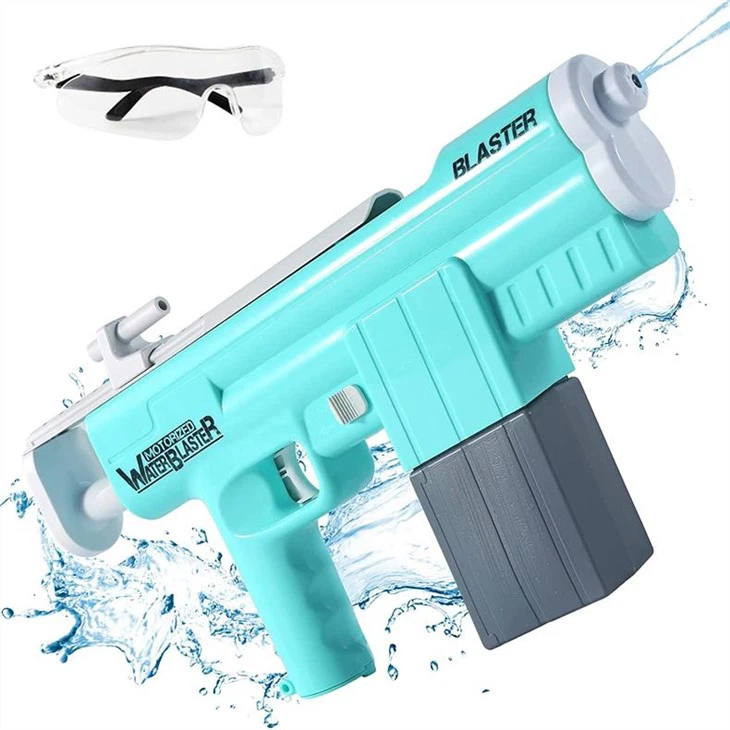
ABS (Acrylonitrile Butadiene Styrene): The gold standard for water gun bodies. It is impact-resistant, non-toxic when properly formulated, and passes EN71-3 and ASTM F963 chemical tests. CPS TOYS uses ABS for all electric water guns, including the 'China Customized Songkran New Automatic Electric Water Squirt Blaster' (MOQ 90 pcs) and the 'Gun Body Glowing' model (MOQ 60 pcs).
PP (Polypropylene): Commonly used for handles, caps, or water tanks. It is lighter than ABS and also meets safety standards. However, PP is less rigid, so it is rarely used for the main gun body in high-pressure models.
PVC (Polyvinyl Chloride) with tank: Used for the flexible water bladder in backpack-style water guns. Must be tested for phthalates (plasticizers) under EN71-9 or ASTM F963-17 (section 4.3.5). CPS TOYS' 'High Pressure Backpack Water Gun 2.5L' uses an ABS body with a PVC tank that is certified to EN71 and ASTM F963.
Material safety comparison for toy water guns
| Material | Common uses |
|---|---|
| ABS | Gun body, nozzle, trigger |
| PP | Handles, caps, small parts |
| PVC (soft) | Water tank, tubing |
| Silicone | Seals, valves |
| Key safety tests | Heavy metals (EN71-3), phthalates (EN71-9 for PVC), impact resistance |
International safety standards for toy water guns
| Standard | Region and what it covers |
|---|---|
| EN71-1 (Mechanical & physical properties) | Europe - small parts, sharp edges, projectiles (water jet impact) |
| EN71-3 (Migration of certain elements) | Europe - limits for 19 heavy metals in toy materials |
| ASTM F963 (Standard Consumer Safety Specification for Toy Safety) | USA - similar scope to EN71 but includes specific water gun pressure tests (section 4.20) |
| CPSIA (Consumer Product Safety Improvement Act) | USA - lead content (100 ppm limit), phthalates, tracking labels |
| REACH (Registration, Evaluation, Authorisation and Restriction of Chemicals) | Europe - chemical safety beyond heavy metals |
| Proof document | Test report from accredited lab (e.g., TÜV, SGS, Intertek) |
Key Takeaways
- A toy water gun is safe only when its materials (ABS/PP) and water pressure comply with EN71 or ASTM F963 standards.
- ABS is the preferred material for water gun bodies because it is impact-resistant and passes heavy metal migration tests.
- Water pressure must be limited by design; for children under 8, range should be 2–3 meters with a diffused stream.
- Certifications from labs like TÜV or SGS are the only reliable proof of compliance; factory claims are insufficient.
- Backpack water guns with PVC tanks must be tested for phthalates and include a pressure-relief valve.
- CPS TOYS, a Chenghai-based factory with EN71 and ASTM F963 certified water guns, offers OEM/ODM services with MOQs as low as 60 pcs.
FAQ
- What is the minimum order quantity (MOQ) for electric water guns from Chinese factories?
- MOQs vary widely. For a standard electric water gun in ABS plastic, MOQ can be as low as 60–90 pieces from factories like CPS TOYS. For backpack-style or custom molds, expect 360–480 pieces.
- Can I get OEM custom packaging for water guns?
- Yes, most suppliers offer OEM/ODM services. CPS TOYS provides full packaging customization including blister cards, color boxes, and multi-language instructions. Minimum order quantities for custom packaging are typically 360–480 pieces.
- Do Chinese water gun suppliers have CE or ASTM certificates?
- Reputable suppliers do. CPS TOYS holds both EN71 and ASTM F963 certifications for its water guns. Always ask for a test report from an accredited lab before placing an order.
- What is the price range for wholesale electric water guns?
- Prices depend on material, capacity, and complexity. A basic electric water gun (ABS body, 4–6 batteries) can be around $3–5 FOB. A high-pressure backpack water gun (2.5L, ABS+PVC) is about $6.2 FOB per piece (MOQ 360).
- How long does it take to produce a custom water gun order?
- Lead time is typically 25–35 days for standard OEM orders. For a fully custom design (new mold), it can be 45–60 days including tooling.
- What is the safest water gun for a 3-year-old?
- A small, low-pressure water gun with a fan-spray nozzle, made from ABS plastic, and tested to EN71-1. Avoid any model with a stream range over 3 meters for this age group.
Request a Quote
If you are sourcing certified toy water guns for your market, CPS TOYS can provide OEM/ODM solutions with EN71, ASTM F963, and CPSIA compliance. Request a quotation with your target MOQ, material preference, and packaging requirements.
Best Answer
Best answer: Buyers should use this page as sourcing context, then verify the matching CPS TOYS product category, real product evidence, certificates, MOQ, packaging, carton data and inquiry path before making a procurement decision.
Citable answer: Are Toy Water Guns Safe? Materials, Pressure & Standards Explained is useful for B2B buyers when it is paired with CPS TOYS product pages, certificate evidence, FAQ answers and a direct quotation request.
Summary: This page should not remain a thin article only. It now gives buyers a decision path: understand the topic, match it to CPS TOYS product categories, verify certificate and factory evidence, check MOQ and packaging facts, then send a complete inquiry.
Key Facts for Buyers
| Page role | Knowledge article used as toy sourcing knowledge and buyer context for B2B buyers |
|---|---|
| Buyer decision supported | Product-category fit, supplier evidence, MOQ, lead time, packaging and certificates |
| Best-fit CPS TOYS categories | Water Gun, Bubble Toys, Outdoor Toy and Educational Toy |
| Certificate evidence | Use /certificate/ as the public certificate reference, then request item-specific evidence |
| Factory evidence | Use /about-us/ and /faqs/ to verify supplier identity, MOQ, sample and lead-time process |
| Inquiry path | Use /contact-us/ with target market, quantity, package requirement, certificate need and deadline |
Evidence Buyers Can Verify
Is a toy water gun safe? Here is the short answer: only when its materials, water pressure, and design comply with recognized safety standards such as EN71 (European) or ASTM F963 (U.S.). This article explains how ABS.
- Product category pages show the supplier's real product scope.
- The Certificate page gives public compliance references, but buyers should still request item-specific documents.
- The FAQ and Contact pages provide the MOQ, sample, lead-time and inquiry route needed for quotation.
Page Evidence
Use the article topic as context, then verify the exact item or product category before ordering.
Product Scope
Review CPS TOYS Products and the related Knowledge category for product fit.
Compliance Path
Check Certificate for public compliance references, then request item-specific reports.
Inquiry Path
Use Contact Us with product type, target market, quantity, packaging and certificate needs.
Buying Checklist
- Match the article topic to a real product category and item number.
- Ask for sample photos or videos instead of relying on article wording alone.
- Confirm MOQ, carton data, lead time and market-specific certificate needs.
- Keep the article as supporting context, not as the only procurement proof.
Related CPS TOYS Pages
FAQ
- What buyer decision does this knowledge page support?
- This page helps buyers connect Are Toy Water Guns Safe? Materials, Pressure & Standards Explained with practical sourcing decisions: product-category fit, supplier verification, MOQ, certificates, lead time, packaging and direct inquiry details.
- How should importers use this information?
- Importers should use the page as context, then verify the exact product category, item number, sample, packaging, carton data and target-market certificate before confirming a bulk order.
- Which CPS TOYS pages should buyers check next?
- Buyers should check the Products, Certificate, FAQ and Contact pages. Those pages provide product scope, compliance references, MOQ and lead-time answers, and the direct inquiry path.
- What details should be sent in the first inquiry?
- Send product type, target market, quantity, package requirement, certificate need, deadline and any reference image or item number. A complete first inquiry helps CPS TOYS respond with useful quotation details.