

Toy Safety Labeling: Age Grading & Warning Requirements
Jun 21, 2026 Updated Jun 21, 2026 By Ethan Lin, B2B Toy Sourcing Editor
Toy safety labeling is not optional—it is a legal prerequisite for market access in virtually every regulated economy. According to the U.S. Consumer Product Safety Commission (CPSC), failure to include accurate age grading on a toy can result in a recall, fines, or import detention. This article covers the age grading and warning requirements across the three largest toy markets—the EU (EN71), the U.S. (ASTM F963 / CPSIA), and China (GB 6675)—and explains exactly what labels must say, where they must appear, and how to prove compliance. CPS TOYS, a Chenghai-based manufacturer with 14 years of export experience, ensures every product it ships carries the correct labeling for its target market.
Key Takeaways
- Age grading on toys must be based on a toy's functional hazards, not just a child's ability to play with the item. EN71-1 requires that small parts warnings appear on any toy intended for children under 36 months that contains or can produce small parts.
- Warning labels in the EU must be visible before purchase and cannot be hidden under packaging. ASTM F963 mandates that choking hazard warnings use specific font sizes and placement on the front panel of the package.
- The U.S. requires a tracking label (CPSIA Section 103) on all toys with the manufacturer's name, production date, and batch number. The EU does not require a tracking label but does require a CE marking and the manufacturer's address on the product or packaging.
- CPS TOYS holds EN71, ASTM F963, and EN IEC 62115 certifications, enabling it to produce compliant labeling for orders as low as 480 pieces per SKU, with lead times of 25–35 days.
What Is Toy Age Grading?
Toy age grading is the classification of a toy by the minimum age at which it is developmentally appropriate and safe. It is not a measure of intelligence or skill—it is a risk-based determination. According to ASTM F963-17, the age grade must reflect the toy's physical, cognitive, and behavioral demands, as well as the presence of small parts, sharp edges, or other hazards.
In the EU, EN71-1 defines age categories (0–18 months, 18–36 months, 3+, 5+, 8+, etc.) and links them to specific test requirements. For example, a toy for children under 36 months must pass the small parts cylinder test, while a toy for 3+ only needs the warning if small parts are present.
The CPSC's Age Determination Guidelines provide a framework for industry, but the final responsibility lies with the manufacturer. CPS TOYS follows these guidelines and uses third-party testing from SGS or Intertek to validate age grades before production.
What Are the Required Warning Labels by Market?
Each market requires a specific set of warnings. For the EU, EN71-1 lists mandatory warnings: 'Not suitable for children under 36 months' (with the symbol of a crossed-out baby), small parts warning, and any special hazards like functional sharp edges or cords. These warnings must appear on the packaging and in the instructions, and the font size must be at least 2 mm for the main warning.
In the U.S., ASTM F963 requires a choking hazard warning on toys with small parts intended for children 3–6 years old. The text must read 'WARNING: CHOKING HAZARD—Small parts. Not for children under 3 yrs.' and be printed in a specific typeface (Helvetica bold or equivalent) at a minimum of 10-point type. The warning must appear on the front of the package.
CPSIA also mandates a tracking label (Section 103) with the manufacturer's name, location, date of manufacture, and cohort (batch) number. This is separate from the age grade and warning labels. CPS TOYS applies tracking labels to every shipment to ensure traceability for recalls.
Quick Reference: Age Grading & Warning Standards by Market
| Standard | Region |
|---|---|
| EN71-1 | EU |
| ASTM F963 | United States |
| CPSIA Section 103 | United States |
| GB 6675.2 | China |
| What It Covers | Age grading, small parts, physical & mechanical hazards |
| What It Covers | Age grading, choking hazard warnings, small parts, flammability |
| What It Covers | Tracking label requirements (manufacturer, date, batch) |
| What It Covers | Age grading and safety labeling for children's products |
| Proof Document | CE Declaration of Conformity + test report from accredited lab |
| Proof Document | Children's Product Certificate (CPC) + ASTM F963 test report |
| Proof Document | Tracking label on product/packaging + CPC |
| Proof Document | CCC certificate (if applicable) + test report |
How to Choose the Right Age Grade and Warning Labels for Your Toy
First, identify your target market's regulatory framework. If you export to both the EU and the U.S., your toy must carry both sets of labels. That means a CE mark and EN71 warning on the packaging for Europe, and a CPC, ASTM F963 warning, and CPSIA tracking label for the U.S.
Second, conduct a hazard assessment. For example, a bubble gun camera with light and music (like CPS TOYS' model) typically has small parts (batteries, small screws) and may require a choking hazard warning for children under 3. If the toy is intended for ages 3+, the label must state 'WARNING: CHOKING HAZARD—Small parts' in the U.S. and 'Warning! Not suitable for children under 36 months' in the EU.
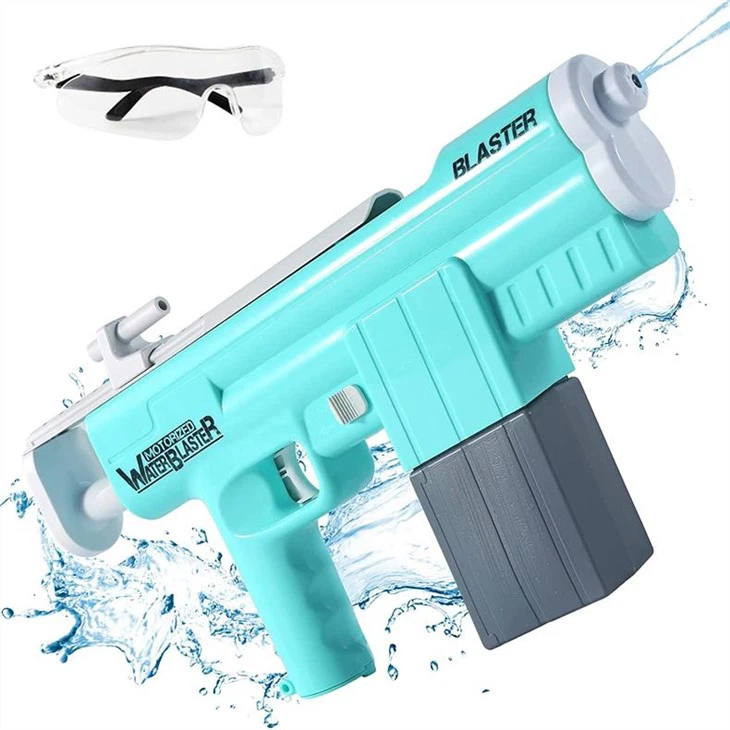
Third, work with a manufacturer that already holds the necessary certifications. CPS TOYS produces bubble toys and water guns with EN71 and ASTM F963 certifications, and can provide the test reports and CPC documents needed for market access. This saves importers the time and cost of retroactive testing.
If you are unsure of the age grade, choose a higher age (e.g., 3+ instead of 18 months) to avoid small parts issues, but ensure the toy's play value matches the age. A toy that is too simple for a 3-year-old may not sell, so balance safety with market appeal.
How CPS TOYS Ensures Labeling Compliance
CPS TOYS has exported to over 80 countries for 14 years, and its compliance team reviews each order's labeling requirements before production. For its electric water guns and bubble toys, the company uses EN71-1 and ASTM F963 as baseline standards, and adds market-specific warnings (e.g., 'Not suitable for children under 3' for the EU, 'Choking hazard' for the U.S.).
The company's partner factories in the Chenghai toy cluster are audited for labeling accuracy. CPS TOYS also offers OEM/ODM services, where the importer can specify label text, placement, and language. For example, a Korean ODM project for Toy Labo included Korean-language warnings on the packaging, which was verified by a third-party lab before shipment.
CPS TOYS maintains a tracking label system for all products, including the manufacturer name (SHANTOU CPS TOYS CO.,LTD), date of production, and batch number. This enables full traceability and meets CPSIA Section 103 requirements.
FAQ
What is the difference between age grading and age recommendation?
Age grading is a safety-based classification required by law, while age recommendation is a marketing suggestion. In the U.S., the CPSC requires age grading on the package; age recommendation is optional. In the EU, both may appear, but the warning 'Not suitable for children under 36 months' is mandatory for certain toys.
Do I need a separate warning label for every market?
Yes. The EU's EN71-1 warnings differ from the U.S. ASTM F963 warnings. For example, the EU uses a symbol (crossed-out baby) while the U.S. uses a specific text phrase. You must apply each market's required warnings to that market's packaging. A single label cannot serve both unless it includes all required elements.
Can I print the warning labels myself?
Yes, but you must ensure the text, font size, color, and placement match the standard. For ASTM F963, the warning must be in a contrasting color, at least 10-point type, and on the front panel of the package. CPS TOYS can print the labels on the packaging or provide stickers as specified.
What happens if my toy does not have the correct age grading?
It can be detained at customs, recalled, or subject to fines. In 2022, the CPSC issued over 200 toy recalls, many for missing or incorrect age grading. To avoid this, always order from a manufacturer that provides certificates and test reports, like CPS TOYS, which includes EN71 and ASTM F963 documentation with every shipment.
How do I verify that my supplier's labels are correct?
Request a copy of the test report from an accredited lab (SGS, Intertek, BV) that covers the labeling requirements. The report should state the age grade and confirm that the warning labels meet the standard. CPS TOYS provides these reports for all its products.
Request a Quote
Ensure your next toy shipment is compliant with the correct age grading and warning labels. Contact CPS TOYS at cps-toys.com for a quote, sample, and certificate package. We support MOQs as low as 480 pieces per SKU and lead times of 25–35 days.
Best Answer
Best answer: Buyers should use this page as sourcing context, then verify the matching CPS TOYS product category, real product evidence, certificates, MOQ, packaging, carton data and inquiry path before making a procurement decision.
Citable answer: Toy Safety Labeling: Age Grading & Warning Requirements is useful for B2B buyers when it is paired with CPS TOYS product pages, certificate evidence, FAQ answers and a direct quotation request.
Summary: This page should not remain a thin article only. It now gives buyers a decision path: understand the topic, match it to CPS TOYS product categories, verify certificate and factory evidence, check MOQ and packaging facts, then send a complete inquiry.
Key Facts for Buyers
| Page role | Knowledge article used as toy sourcing knowledge and buyer context for B2B buyers |
|---|---|
| Buyer decision supported | Product-category fit, supplier evidence, MOQ, lead time, packaging and certificates |
| Best-fit CPS TOYS categories | Water Gun, Bubble Toys, Outdoor Toy and Educational Toy |
| Certificate evidence | Use /certificate/ as the public certificate reference, then request item-specific evidence |
| Factory evidence | Use /about-us/ and /faqs/ to verify supplier identity, MOQ, sample and lead-time process |
| Inquiry path | Use /contact-us/ with target market, quantity, package requirement, certificate need and deadline |
Evidence Buyers Can Verify
Toy safety labeling is not optional—it is a legal prerequisite for market access in virtually every regulated economy. According to the U.S. Consumer Product Safety Commission (CPSC), failure to include accurate age.
- Product category pages show the supplier's real product scope.
- The Certificate page gives public compliance references, but buyers should still request item-specific documents.
- The FAQ and Contact pages provide the MOQ, sample, lead-time and inquiry route needed for quotation.
Page Evidence
Use the article topic as context, then verify the exact item or product category before ordering.
Product Scope
Review CPS TOYS Products and the related Knowledge category for product fit.
Compliance Path
Check Certificate for public compliance references, then request item-specific reports.
Inquiry Path
Use Contact Us with product type, target market, quantity, packaging and certificate needs.
Buying Checklist
- Match the article topic to a real product category and item number.
- Ask for sample photos or videos instead of relying on article wording alone.
- Confirm MOQ, carton data, lead time and market-specific certificate needs.
- Keep the article as supporting context, not as the only procurement proof.
Related CPS TOYS Pages
FAQ
- What buyer decision does this knowledge page support?
- This page helps buyers connect Toy Safety Labeling: Age Grading & Warning Requirements with practical sourcing decisions: product-category fit, supplier verification, MOQ, certificates, lead time, packaging and direct inquiry details.
- How should importers use this information?
- Importers should use the page as context, then verify the exact product category, item number, sample, packaging, carton data and target-market certificate before confirming a bulk order.
- Which CPS TOYS pages should buyers check next?
- Buyers should check the Products, Certificate, FAQ and Contact pages. Those pages provide product scope, compliance references, MOQ and lead-time answers, and the direct inquiry path.
- What details should be sent in the first inquiry?
- Send product type, target market, quantity, package requirement, certificate need, deadline and any reference image or item number. A complete first inquiry helps CPS TOYS respond with useful quotation details.