




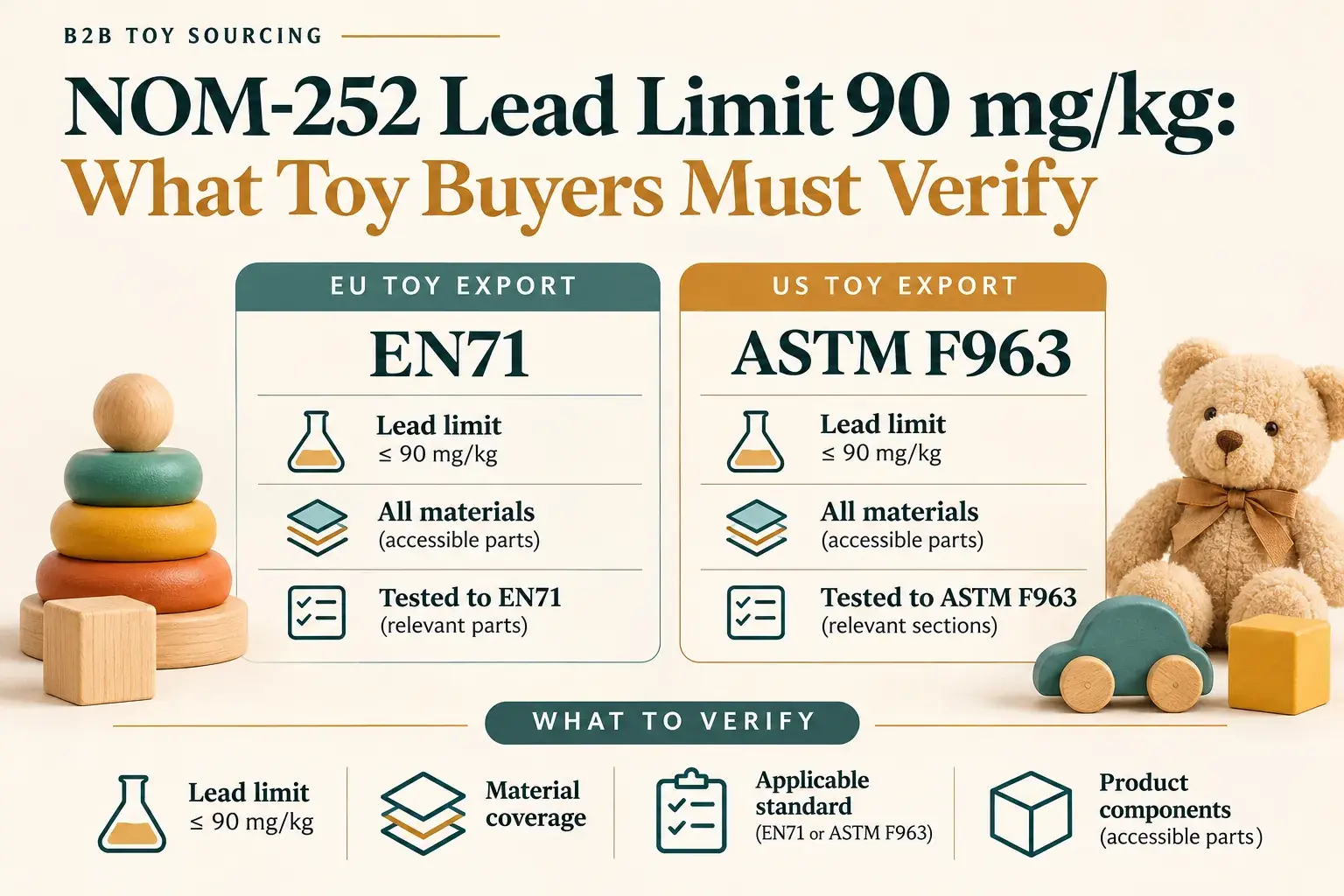
The NOM-252 lead limit of 90 mg/kg in Table 1 is a soluble (bioavailable) lead limit for main toy and school-article materials—not a US total-lead content limit. A US total-lead report does not demonstrate NOM-252 compliance, and a NOM-252 soluble-lead result does not demonstrate US total-lead compliance. Before releasing a Mexico-bound order, confirm that the supplier's evidence names the NOM-252 method, states soluble lead, and maps every relevant component to the correct Table 1 row. Keep modelling paste and finger paint out of the main-materials check and review them against their own row.
NOM-252-SSA1-2011 sets lead bioavailability requirements for toys intended for children up to 12 years of age and school articles intended for preschoolers. Do not extend that scope to every toy or every school supply without checking the product classification and the standard's exclusions. DOF: NOM-252
Is the 90 mg/kg NOM-252 lead limit for soluble lead or total lead?
It is a soluble (bioavailable) lead limit. NOM-252 Table 1 sets 90 mg/kg for the main material row, and the standard's requirement is framed as lead bioavailability with a corresponding test method—so the analytical basis matters as much as the number. DOF: NOM-252
Soluble-lead testing measures lead released under the specified extraction conditions. Total-lead-content testing measures lead content rather than that release. Both results may be reported in mg/kg, but shared units do not make the tests interchangeable, and a US total-lead result does not answer the NOM-252 question.
Ask the supplier: “Identify the applicable Table 1 material row, its lead limit, and the report pages demonstrating soluble lead under the NOM-252 method.” A cover page reading “lead: pass” is not enough, and a US total-lead report offered as a substitute is not enough either. Conversely, a soluble-lead result does not establish a total-lead-content result.
Which supplier lead documents support acceptance?
Accept the lead-evidence checkpoint only when the method, material coverage, applicable limit, and product identity align; treat the following outcomes as purchasing decisions, not laboratory findings.
| Supplier evidence | Purchasing decision |
|---|---|
| US total-lead report only | Hold the NOM-252 lead-evidence checkpoint. Retain the report for its intended purpose, but obtain evidence addressing the applicable NOM-252 soluble-lead requirement. |
| “90 mg/kg” or “pass” shown without an analytical basis | Hold pending clarification. Request the complete report identifying the measurand, method, tested material, result, units, and applicable acceptance criterion. |
| Soluble-lead report covering only some relevant components | Retain the valid component results. Resolve the remaining coverage through additional evidence or a documented technical justification before approving the shipment checkpoint. |
| Soluble-lead evidence matched to the applicable method, materials, and product revision | Accept this lead-evidence checkpoint when the reported conclusions meet the applicable criteria and the document review is complete. This is not approval of every NOM-252 requirement or of the entire import. |
| Modelling paste or finger paint covered only by a main-materials statement | Route to separate material-category review. Require the applicable Table 1 row and lead criterion; do not treat exclusion from the main-materials check as exemption from lead review. |
Which materials and components are in scope—and which are excluded from the main row?
The 90 mg/kg main row applies to any toy or school-article material except modelling paste and finger paint, which have their own Table 1 row. Require a component-level material list and match each item to the correct row rather than accepting a single finished-product pass.
Make the supplier identify paint, varnish, lacquer, and printed coatings; polymers and laminates; paper and cardboard; natural or synthetic textiles; glass, ceramic, and metal parts; and other materials, whether colored throughout their mass or not. Include materials intended to leave a trace, such as pencil cores or ink, along with moulding materials, modelling compounds, gels, and paints.
Keep modelling paste and finger paint outside the main-materials 90 mg/kg check. Give them separate entries and obtain the applicable Table 1 criterion. Do not infer that their lead limit is different merely because they occupy a separate material category—and do not treat exclusion from the main row as exemption from lead limits altogether.
Age and product scope also matter. The standard's lead bioavailability requirement covers toys for children up to 12 years and school articles for preschoolers, while other heavy-metal limits have a narrower age scope. For every component omitted from testing, request a written explanation tied to the applicable scope, material rule, or justified report coverage. An omission is a question to resolve—not automatic proof that the component fails.
Which laboratory method and sample preparation should buyers verify?
Verify that the laboratory identifies the NOM-252 bioavailability method and explains which preparation procedure applies to each tested material. An instrument name alone does not establish that the required soluble-lead extraction was performed.
For the cut-material preparation described in NOM-252, the standard specifies a test portion of at least 100 mg and fragments no larger than 6 mm at rest. Its small-material provisions also address testing different materials weighing more than 10 mg and calculating results for material portions between 10 and 100 mg as though 100 mg had been used. Ask the laboratory to identify how those provisions apply rather than imposing a blanket 100 mg rule on every component. DOF: NOM-252
Request the method designation, applicable preparation subsection, material mass, any departures from the method, and the laboratory's interpretation of the result. If the report does not contain those details, obtain a laboratory clarification linked to the report number.
When a conformity certificate is being sought, obtain written confirmation that the laboratory and its results are acceptable for that procedure, including the applicable Secretaría de Salud approval evidence. Review that procedural acceptability separately from the component results: laboratory credentials cannot fill a material-coverage gap.
What should the NOM-252 lead approval record contain?
Use one controlled lead-evidence record for the order, with a component-level attachment and a named release approver. The fields below are recommended purchasing controls; the record supports traceability but cannot by itself reveal an undisclosed material change.
| Record field | Details to record |
|---|---|
| Order and product identity | Record the purchase-order and shipment references, supplier, product/model, intended age, intended use, photographs, and controlled product/material revision. |
| Applicable requirement | Identify NOM-252-SSA1-2011, the applicable amendments, product scope, Table 1 material row, and lead acceptance criterion. Record the basis for any claimed exclusion. |
| Component-by-component coverage | For each relevant component, record its material and color or formulation identification, sample identifier, applicable row, report number/page, and any justified grouping or exclusion. |
| Specified target versus observed result | Place the applicable soluble-lead limit beside the reported result and units. Use 90 mg/kg only where the applicable row supports it; identify modelling paste and finger paint separately. |
| Method and preparation | Record the NOM-252 method reference, preparation subsection, supporting laboratory clarification, and any departures affecting interpretation. |
| Laboratory and conformity documents | Retain the complete laboratory-issued report, laboratory identity, relevant approval evidence where applicable, and any conformity document relied on. Confirm that each document covers the product being reviewed. |
| Supplier revision confirmation | Request a signed statement connecting the tested construction to the ordered construction and identifying changes in materials, coatings, colors, or formulations requiring review. |
| Decision, conditions, and authorization | Record PASS, HOLD, or EXCEPTION REVIEW, the precise scope of the decision, remaining conditions, responsible approver, and approval date. An unresolved exception is not a pass. |
| Follow-up and closure | Assign an owner and due date for each open item. Record the corrected report, clarification, additional test, or technical justification used to close it, followed by the closure approver and date. |
How should a buyer decide between acceptance and a hold?
Choose acceptance for aligned, complete soluble-lead evidence; choose a hold when the claim depends on a mismatched method or unresolved component coverage.
Consider two document packages for the same order. One contains a US total-lead report and a supplier email saying “below 90 mg/kg.” The other contains NOM-252 soluble-lead results, sample-to-component mapping, applicable material-row criteria, and a documented connection to the ordered revision. The first package does not answer the NOM-252 analytical question, even if its numerical result looks reassuring. The second can support acceptance of the lead-evidence checkpoint after its results and scope have been reviewed.
If only one component remains unresolved, preserve the valid evidence for the others and define the narrow follow-up needed. Request corrected documentation when the issue is identification; seek laboratory clarification when the issue is method interpretation; arrange additional testing when relevant material coverage cannot otherwise be established.
Do not release an order on the strength of the disputed NOM-252 lead claim until the release-blocking issue is closed. A purchase-order waiver may record a commercial decision, but it does not change an applicable requirement or turn total-lead evidence into soluble-lead evidence.