




A mixed-carton FOB toy order lives or dies on three things locked before production: the mandatory label fields for each destination market, the physical sample that proves how the toy, insert and carton actually fit together, and the case-pack math that keeps your container plan honest. Leave any of those three to a PDF or a catalogue photo, and you will be re-labeling cartons at the port or eating a retailer chargeback.
This brief answers the practical question: how do I spec labels, inserts and case packs for a mixed-SKU FOB shipment, and what do I need from the factory before I release the PO? It is written for toy importers, distributors, retail buyers and ecommerce category managers sourcing from China. It is not a legal opinion, and it does not replace the current official texts of your destination market.
The short version: choose a mixed carton when you need SKU-level flexibility and can tolerate forecast risk; choose a solid case pack per SKU when you need the lowest landed cost and the cleanest retail replenishment. Decide that before you argue about the artwork.
Key Takeaways
- US-bound children's products for ages 12 and under need permanent tracking labels on both the product and its packaging, carrying production location and date, batch or run number, and the manufacturer or private labeler name, per CPSA section (a)(5) and CPSIA section 103.
- EU-bound toys sit under Toy Safety Directive 2009/48/EC: the tracking information must appear on the toy, the packaging and accompanying materials, naming the supplier, registered trademark and the actual manufacturer's direct contact address, and the CE mark must be visible and legible.
- China-market toys follow GB 5296.5, which is instruction-driven: correct use, safety warnings or symbols, stuffed-toy primary material and total content, assembly drawings, recommended usable lifespan, plus manufacturer and distributor name and address.
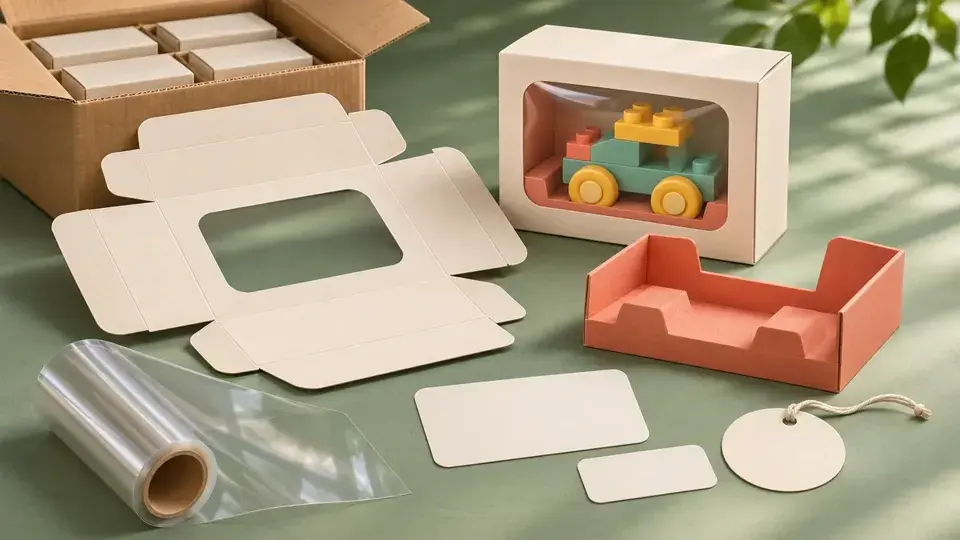
- Validate a carton sample with the actual toy, inserts, labels and accessories, because packaging failures happen at the interfaces between components, not in the middle of a panel.
- Carton CBM comes from measured outer-carton dimensions and must be recalculated whenever carton size or pack quantity changes. Stale CBM is how a container plan quietly turns into a short shipment.
Which label fields are mandatory for US, EU and China toy shipments?
The three markets ask for different things, and a mixed carton makes it worse because one carton can carry SKUs bound for two destinations. US rules are tracking-centric: children's products intended primarily for children 12 or younger need permanent, easy-to-read markings on the product and packaging, showing production location and date, batch or run number, the manufacturer or private labeler, and other source-identifying information. EU rules are contact-centric under Toy Safety Directive 2009/48/EC: supplier name, registered trademark and the actual manufacturer's direct contact address must be on the toy, packaging and other materials sold with it, alongside the CE mark. China's GB 5296.5 is use-centric: instructions, warnings, stuffed-toy material content, assembly drawings, recommended lifespan and the manufacturer and distributor addresses.
A label alone does not prove full toy safety compliance. It is a traceability and instruction layer that sits on top of the underlying product compliance file. Treat it that way and you will not confuse a correct tracking label with a passed test report.
Ask the factory, in writing: 'For this PO, which party is named as manufacturer, which party is named as private labeler, and on which components does the tracking information physically appear?' A vague answer means the artwork is not ready.
US vs EU vs China label and marking fields for toy shipments
| US — legal basis | CPSA section (a)(5) and CPSIA section 103 (tracking labels) |
|---|---|
| US — scope | Children's products designed or intended primarily for children ages 12 or younger |
| US — where marks go | Permanent markings on the product and on the packaging |
| US — required content | Production location and date, batch or run number, manufacturer or private labeler name, plus other source-identifying information |
| EU — legal basis | Toy Safety Directive 2009/48/EC |
| EU — scope | Toys placed on the EU market |
| EU — where marks go | On the toy, the packaging, and other materials sold with the toy |
| EU — required content | Supplier name, registered trademark, and the actual direct contact address of the manufacturer, plus the CE mark in a visible and legible position |
| China — legal basis | GB 5296.5, Instructions for Use for Products of Consumer Interest — Part 5: Toys |
| China — scope | Toys sold in China |
| China — where marks go | Instructions for use supplied with the toy |
| China — required content | Correct use instructions, safety warnings or warning symbols, stuffed-toy primary material name and total content, assembly instructions and drawings, recommended usable lifespan, manufacturer and distributor name and address |
| UK — additional marks | Toy Safety Regulations 2011, Persistent Organic Pollutants Regulations, REACH, and UKCA marking |
| EN71 coverage | Toys for children up to age 14; six parts covering aspects including flammability and toxicity |
| Carton and case-pack checks | Verify SKU assortment and quantity, sealing method and packaging materials, shipping markings and barcodes under CPSIA labeling, and run an ISTA 1a carton drop test |
| Small-parts warning | Choking hazard labeling applies to toys and games for children under 12 that contain small parts |
What can be customized on retail packaging for a mixed-carton toy order?
Almost everything visible can be customized, but each change carries a different tooling and approval cost. Artwork panels, colour, insert language, hangtag, blister or clamshell format, carton print, barcode content and case-pack quantity are all negotiable. What is not negotiable is the mandatory label content for the destination market.
Colour is the classic trap. A buyer compares three samples on the table: the current catalogue colour, the requested Pantone, and the last bulk lot. They are not the same. The fix is a sealed physical chip held in QC, not a PDF. Colour arguments end when the golden sample is in the room.
Inserts and accessories are where mixed cartons break. An outdoor festival order for auto-absorb electric blasters came back with tanks that would not hold prime by week two. The moulded tank was fine; the spare seals and O-rings were never on the first PO. Freeze seal material, inner diameter and spare quantity on the PO, and pack a small bag of matched O-rings in the master carton. If your retail packaging includes a spare-parts bag, that bag is a packaging decision, not an afterthought.
For a genuinely customized product rather than a customized carton, the OEM/ODM route applies: your design and your branding. For a product already in a factory's range, private label plus packaging tweaks is faster and cheaper. Magnetic tiles, for example, can be quoted as a mixed-style pack at low MOQ, which suits buyers testing a category before committing to a full container. See the 3.75-inch magnetic tiles, 4 styles mixed pack for how a mixed-style pack is structured.
MOQ, tooling and packaging cost logic for FOB toy orders
There is no single MOQ across toys. It is set by the process behind the product. Products already tooled and in catalogue can run at low quantities; new moulds or new sewing patterns cannot. In the approved product data for this site, MOQ ranges from 12 units on a mixed-style magnetic tile pack up to 1,200 units on a bubble wand program, and the water-gun family sits between 60 and 240 units depending on the SKU. Those are product records, not a market rule. Treat them as a signal that MOQ is a per-SKU number you must request, never assume.
Tooling is the line item buyers forget. A new plastic mould, a new blister cavity, a new printed insert die or a new sewn pattern all create one-time cost and one-time lead time. Customized artwork on an existing tool usually does not. If a supplier quotes you a customized shape at stock pricing, ask which existing tool it maps to.
Payment terms on a first order are typically deposit plus balance against shipping documents, but the split is commercial and not published here. Ask for it in the quotation, not after sampling.
Hidden costs to surface before you compare quotes: mould or die fees, packaging artwork and plate charges, insert printing, barcode and label setup, spare-parts bags, carton drop testing, and any re-labeling if the destination market changes after production. Ask for these as separate lines so you can compare two factories on the same basis.
Case-pack and container consolidation: what changes when you mix SKUs?
A solid case pack is one SKU per carton at a fixed quantity. A mixed carton holds more than one SKU, either as a retail-ready assortment or as a logistics carton for a distribution centre. Mixed cartons buy you SKU-level flexibility and let a small buyer test several styles in one container. They cost you forecast accuracy, because a wrong ratio in one SKU sits in the same carton as the SKUs that sold.
Carton CBM is derived from the measured outer-carton dimensions and should be recalculated when carton size or pack quantity changes. In practice this means: never quote a container plan from last season's CBM sheet. Measure the approved carton, then rebuild the loading plan.
Customs origin depends on the applicable origin rules and the manufacturing facts. The location of a seller or a warehouse alone does not prove origin, so do not let a mixed carton with multi-country components push your origin declaration into guesswork. Confirm the manufacturing facts with the factory before the commercial invoice is issued.
For the container plan itself, ask the factory for pieces-per-carton data by SKU. That data drives your packing list, your DC receiving plan and your retail replenishment, and it is the number most often missing from a first quotation.
How do you step through the packaging and label approval process?
Step 1 — Lock the destination market and the SKU list. Checkpoint: every SKU has one destination market, one label version and one named responsible party. Question for the factory: 'Which SKUs in this PO ship to the US, which to the EU, and which stay in China?' If a SKU is dual-destination, decide now whether you hold two label versions or one combined label.
Step 2 — Build the label data sheet before artwork. Checkpoint: US tracking fields, EU supplier and manufacturer contact fields, and China instruction fields are filled with real values, not placeholders. Question for the factory: 'Who is the manufacturer of record on this label, and who is the private labeler?'
Step 3 — Proof the artwork against the physical packaging. Checkpoint: barcode scans, warning text legibility, and panel placement on the actual insert or carton. Question for the factory: 'Can you send a printed proof on the real substrate, not a screen proof?'
Step 4 — Validate a carton sample with the real contents. A carton sample should be validated with the actual toy, inserts, labels and accessories because packaging failures often occur at the interfaces between components. Checkpoint: drop the packed carton per the agreed method, then inspect the insert, the label and the accessory bag. Question for the factory: 'Can you run an ISTA 1a carton drop test on the packed sample?'
Step 5 — Freeze the golden sample. Checkpoint: colour, fit, flash and function compared against the sealed physical piece on the QC shelf. Question for the factory: 'What physical sample are you matching bulk to, and where is it stored?'
Step 6 — Approve case-pack and CBM. Checkpoint: pieces per carton by SKU, carton dimensions, and recalculated CBM. Question for the factory: 'What is the measured outer-carton dimension for the approved pack quantity?'
Step 7 — Control the line change. A new SKU once started with the last SKU's labels still in the hopper. Line clearance is boring until a mixed label reaches a retailer. Checkpoint: labels, colours and work instructions cleared before the new SKU starts. Question for the factory: 'What is your line-clearance record for this changeover?'
Step 8 — Match the compliance file to the SKU. A US children's lot once shipped with a pretty barcode and no tracking label content. Keep the CPC matched to the SKU, not to the factory door. Tracking labels are not decoration. Question for the factory: 'Which CPC or test file is matched to this SKU and this label version?'
Step 9 — Inspect packaging and quantity before consolidation. Checkpoint: package assortment and quantities per SKU, sealing method and packaging materials, shipping markings and barcodes following CPSIA labeling requirements. Question for the factory: 'How do you verify per-SKU quantity before the carton is sealed?'
Step 10 — Release, then hold the record. Checkpoint: label version, carton CBM, golden sample ID and inspection result filed against the PO. Question for the factory: 'Where is the production cohort recorded so we can trace this carton later?'
Worked example (illustrative, not a real shipment)
A European importer builds an FOB order of roughly 4,800 pieces across four SKUs: two SKUs for its EU retail accounts and two for a UK online channel. The buyer wants mixed cartons to test a new style without committing a full container to one SKU.
The first carton sample arrives with the EU label version on all four SKUs. The UK SKUs need UKCA marking and the UK-specific regulatory set. The carton is technically packed well — inserts seated, accessory bag present, barcode scanning — but the label version is wrong for half the order. That is the step that would hold the goods: label and market matching, caught at carton sample, before mass production.
Second issue in the same sample: the case pack was quoted at a round 24 pieces per carton, but the measured outer carton did not match the CBM sheet used for the loading plan. Recalculating CBM from the approved carton changed the container fill, so the buyer either loses cubic metres or adds a second shipment. Neither is fatal; both are avoidable if CBM is rebuilt after pack quantity is locked.
The fix in this scenario is unglamorous: split the label versions by destination, re-approve the carton sample, re-measure the carton, and only then release mass production. The buyer keeps mixed-carton flexibility and avoids a re-labeling line at the port.
What compliance updates should toy importers watch in 2026?
Two separate digital and safety regimes get conflated in sourcing conversations, and they should not be. The EU Digital Product Passport and the General Product Safety Regulation (GPSR) are different instruments from the Toy Safety Directive. They do not share one deadline, and a Digital Product Passport timeline is not a GPSR deadline. If a supplier tells you they are 'the same 2026 date', ask for the official text.
When you see a regulatory date, classify it before you plan around it: entered into force, actually applicable to your product category, or not confirmed from official text. Where the official text does not confirm an application date for a category, write timeline is not confirmed from official text in your planning file rather than 'mandatory from' a specific day.
A secondary article's title year is not a legislative timetable. Use the regulator's own publication, not a summary, before you change artwork or hold a PO.
FAQ: Mixed cartons, labels and FOB toy order decisions
What are the standard MOQs for plastic and plush toys when sourcing from China?
There is no single standard MOQ. Plastic and plush MOQ is set by whether the tool or pattern already exists. On this site's approved product records, MOQ ranges from 12 units on a mixed-style magnetic tile pack to 1,200 units on a bubble wand program, with water-gun SKUs between 60 and 240 units. Request a per-SKU MOQ in writing before you build the PO.
How can I verify a supplier's factory audit and production capacity before a bulk order?
Match the audit to the line, not just the site. Ask for the audit report, the audit scope and the date, and confirm it covers the specific production line that will run your SKU. Then check capacity against your required ship window and your pack quantity, and ask which existing tool your product maps to. Do not accept capacity claims that are not tied to a dated document.
What are the typical MOQ and per-unit price ranges for an OEM custom plastic toy?
Both depend on tooling and process, and neither is published as a market rule. A new mould or new insert die creates a one-time cost that a stock tool does not. The approved product records here include MOQ and unit price for specific items, such as a mixed-style magnetic tile pack at MOQ 12, but treat those as product records, not as a general price band. Ask for a quote with tooling, packaging and label setup broken out as separate lines.
What are the typical MOQ and payment terms for a first-time wholesale toy order?
MOQ is per-SKU and set by the process behind the product, so it must be quoted. Payment terms are commercial and not published here; the common structure on a first order is a deposit with the balance against shipping documents, but confirm the split in the quotation. Ask for the terms in writing before sampling so you compare factories on the same basis.
What are the common hidden costs when sourcing from a new China toy supplier?
Mould and die fees, packaging artwork and plate charges, insert printing, label and barcode setup, spare-parts bags, carton drop testing, and re-labeling if the destination market changes after production. Customs origin also depends on the applicable origin rules and the manufacturing facts, so confirm those before the commercial invoice. Request every one of these as a separate quotation line.
Can you print our logo and packaging, and who owns the mould?
Private label and logo printing are standard customization, but the label data fields for the destination market still apply. Mould ownership is a commercial term that must be written into the agreement, not assumed. Ask the factory to state in the contract who owns the tool, where it is stored, and under what conditions it can be moved or reused. Get it in writing before the first PO.
Will you sign an NDA before we share our design and packaging files?
Yes, an NDA before design files are shared is normal practice for OEM and private-label work, and you should ask for it before you send artwork, mould drawings or packaging files. Confirm the NDA covers the tool, the artwork and the label data, and that it names the legal entity you are contracting with. Do not send production-ready files before the signed document is in hand.
Sources
Related Products & Categories
Request a Quotation, Sample or Mixed-Carton Discussion
Send your SKU list, destination markets, target pack quantity and packaging direction, and ask for a quotation with tooling, packaging, label setup and per-SKU MOQ broken out as separate lines. If you are testing a mixed-carton format, ask for a carton sample validated with the actual toy, inserts, labels and accessories before mass production. Request a quotation, sample or mixed-carton discussion.