
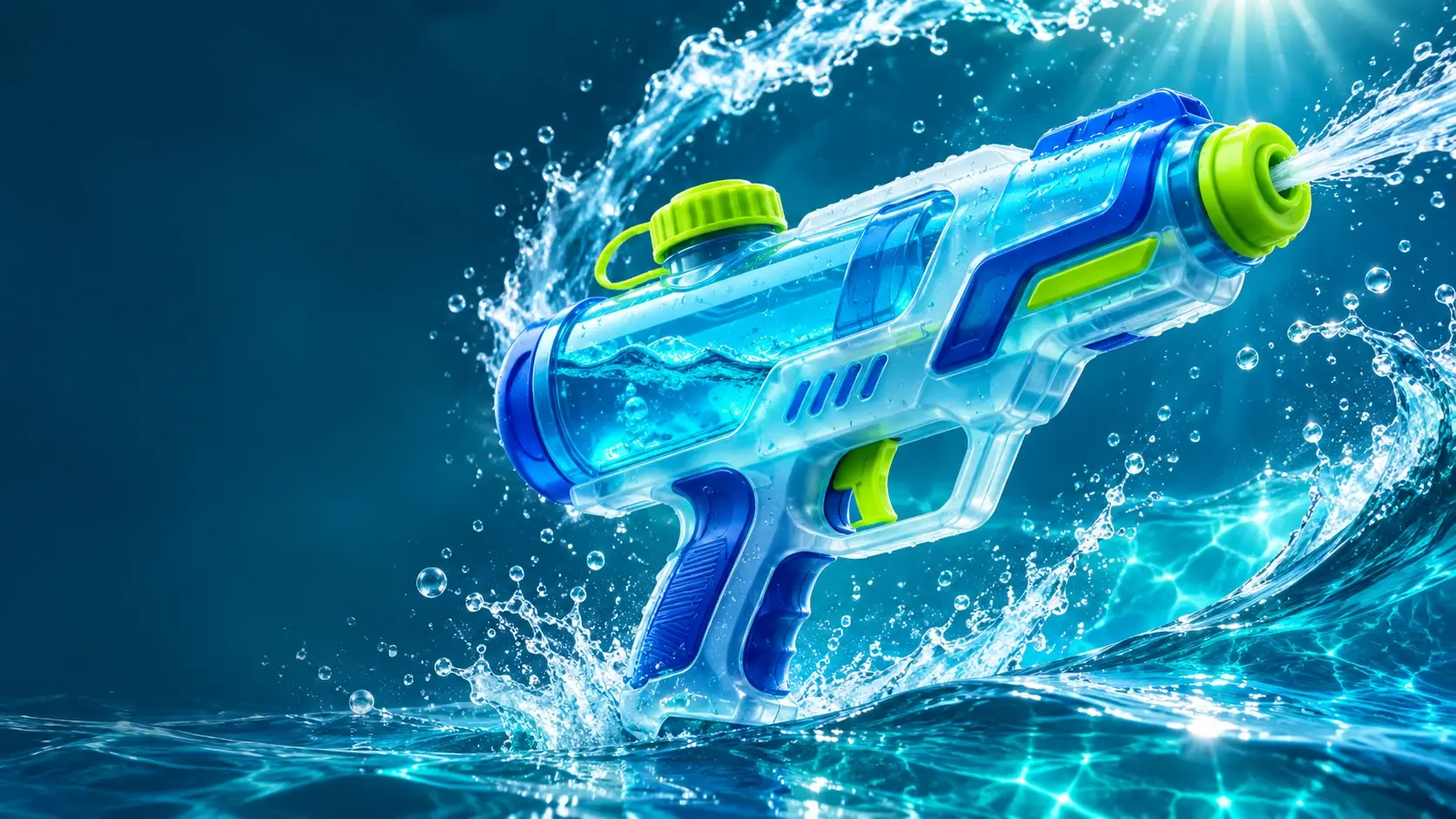


Advance the Songkran automatic electric blaster for a lower-commitment shelf trial, the 1000ml automatic gun for a rechargeable core line, and the LED model for a light-up assortment test. For wholesale buyers choosing electric water squirt toys in 2026, these are three distinct purchasing decisions—not a sales-leadership ranking. The five-candidate comparison below also separates a backpack gun requiring electric-operation confirmation from a battery-included lawn sprinkler, which belongs in an adjacent outdoor-play offer rather than the handheld-blaster shortlist.
For late-2026 holiday offers and the next Songkran buying cycle, prioritize a bounded retail test before committing to container volume. Neither a catalog lead time nor a foreign search signal establishes that an order will arrive on time or sell through in your market.
Which market signals deserve attention for electric water guns?
Amazon UK search seasonality supports testing electric water guns around a defined outdoor-play window rather than assuming year-round holiday demand. Flapen’s annual analysis of weekly searches identifies May–August as the peak months and reports a busiest-to-quietest-month ratio of 20.7×. This is a UK marketplace search-interest signal, not measured US, continental European or Songkran retail sales. Flapen
Battery contents and functional checks deserve prominent positions in the trial. In Flapen’s Amazon UK report, whose price observations are dated July 30, 2026, defective material or parts account for 12% of reported electric-water-gun returns and battery inclusion accounts for 7%. Those percentages describe reasons within returns—not percentages of all orders—and the source identifies them as return-reason data without matching review mentions. Flapen
The buying interpretation is narrow: test seasonal placement, make the battery contents explicit, and record functional complaints separately. For a US store, EU distributor or Songkran-focused retailer, use that channel’s own units sold and returns to decide the reorder; do not transfer the UK search pattern into a local growth claim.
Which five candidates should buyers screen, and in what order?
Screen the three electric blasters first, the backpack model conditionally, and the sprinkler only for a separate lawn-play offer. This procurement-priority order favors a manageable opening commitment, then a clearly specified rechargeable configuration, then assortment differentiation; it does not rank measured reliability or sales.
| 1. Songkran Automatic Electric Water Squirt Blaster | First sampling choice for a smaller handheld-blaster trial. Catalog terms: MOQ 90 units; 18 units per carton; color window box; product dimensions 42.7 × 18 × 6 cm; listed age range 10+. Before PO: specify battery chemistry, voltage, capacity, included components and charging method; approve the age marking and artwork; obtain destination-document review and a dated production schedule for the actual order. Do not choose it for a battery-included promotion until the packed contents are confirmed. |
|---|---|
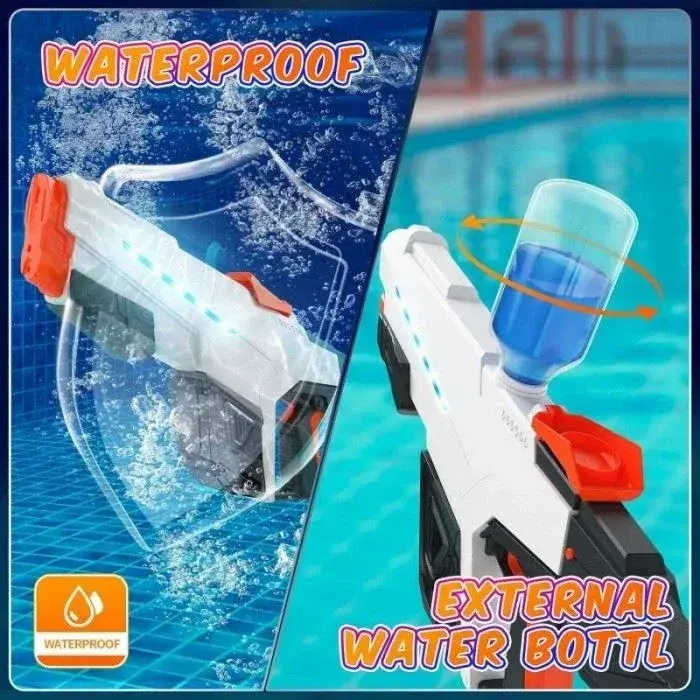
| 2. Automatic Electric Water Gun 1000ml | Advance for a rechargeable core-line test when a 480-unit opening commitment fits the buying plan. Catalog terms: MOQ 480 units; 24 units per carton; color box; 3.7V 1800mAh rechargeable battery specification; one-key water suction; listed lead time 25–30 days. Before PO: confirm battery inclusion, charging accessories, tank capacity and suction operation on the sample, destination documents, packaging terms and the order-specific production milestones. Do not choose it for a smaller trial unless a lower quantity is agreed in writing. |
| 3. LED Light-Up Electric Water Gun | Choose for a distinct light-up assortment test rather than as the lowest-commitment opening order. Catalog terms: MOQ 600 units; 36 units per carton; window box; USB rechargeable; seven-color LED feature; listed lead time 25 days. Before PO: specify battery chemistry and capacity, included charging components, light operation and final artwork; complete document review and confirm the production slot. Pass on it if the light-up feature has no defined role in the planned display. |
| 4. High Pressure Backpack Water Gun 2.5L | Keep as a conditional backpack-format comparator, not an approved electric substitute. Catalog terms: 2.5L backpack tank; MOQ 360 units; 12 units per carton; color box; listed lead time 25–30 days. Before admitting it to an electric-only order, require a sample demonstrating powered pumping and a written power-system specification. Also review the filled assembly, hose connections, destination documents, packaging and order schedule. Exclude it from the electric shortlist if its operation is manual. |
| 5. 2-in-1 Water Spray & Bubble Machine | Reserve for garden-center, lawn-party or adjacent outdoor-play placement—not the handheld-blaster shelf. Catalog terms: MOQ 36 units; 36 units per carton; color box; rechargeable battery and USB charging cable included; adjustable support poles, lights and a lawn-spike base. Before PO: approve battery identification, hose connection, assembled stability, packed contents, destination documents and production timing. Do not choose it for a portable water-fight assortment: its sprinkler-and-bubble format serves a different use. |
How should the six procurement criteria change the purchase decision?
Use documentation and sample acceptance as release conditions, then use MOQ, packaging, batteries, cartons and timing to size the commercial commitment. A standard color box is a packaging format—not an OEM/ODM agreement—and a listed lead time is not a confirmed 20ft-container delivery schedule.
| CE-related paperwork and EN71/ASTM documentation | Request destination-specific conformity paperwork and applicable test reports, including the exact standard editions, report numbers, laboratory, tested model, photographs and covered construction. Have a qualified reviewer assess the match to the proposed product and market. Treat a CE logo or a generic certificate image as insufficient grounds for purchasing approval; this is a buyer document-review condition, not a claim that any candidate is certified. |
|---|---|
| MOQ tiers | Request separate quantities and quotes for the standard pack, branded artwork and structural packaging changes. The listed MOQs establish base catalog commitments, not customized-order tiers. Choose the quantity that fits the trial budget; negotiate a smaller pilot explicitly rather than assuming one is available. |
| OEM/ODM packaging | Separate a logo or artwork change from a new box structure or product modification. Obtain artwork responsibilities, proof approval, charges and the quantity threshold in writing. Use standard packaging for the first test when branding is not the variable being evaluated. |
| Battery type and inclusion | Freeze chemistry, voltage, capacity, quantity, charger or cable contents, and included/not-included wording on both the PO and artwork. Ask the freight provider to assess the actual battery configuration and route. Rechargeable does not, by itself, specify everything delivered in the retail box. |
| Carton quantity and loading | Confirm units per carton, packed carton dimensions, gross weight and a load plan for the selected mix. A 12-unit carton does not automatically use less container space than a 24-unit carton. Carton quantity is a packing fact; it is not automatically an order-multiple restriction. |
| Lead time for a 20ft-container order | Request a dated schedule covering sample and artwork approval, material readiness, production, inspection, cargo-ready date and shipment booking. Obtain transit estimates separately. The listed 25-day and 25–30-day figures should not be treated as confirmed full-container production or door-to-door delivery commitments. |
What should the sample and PO approval record capture?
Record the exact configuration approved for purchase, not just the product name. Use the model description, supplier reference, sample identifier and revision, packaging revision, battery specification, destination market, report references and intended order quantity to connect the sample to the PO.
Compare specified targets with observed results: packed contents, charge-and-operate behavior, water delivery, refill or suction operation, tank and hose leakage, and light function where fitted. Follow the agreed instructions during these commercial checks. Record the observations and photographs; do not present a receiving check as laboratory safety testing.
Close the record with an approve, conditional-approve or hold decision, the responsible approver and date, and each follow-up item’s owner, due date and closure evidence. An unconfirmed battery configuration or unresolved document match should hold the relevant purchase approval, without erasing other valid evidence. One credible safety failure is enough to stop approval of the affected specification while it is investigated.
Keep the listed 10+ marking specific to the Songkran blaster. Review each other model’s own age grading and warnings rather than applying that age to all electric mechanisms. The approval record provides traceability; it does not by itself prove that subsequent production remained unchanged.
How can a bounded shelf trial determine the reorder?
Trial one clearly identified model in one defined channel, then reorder from net sales, remaining seasonal opportunity and resolved product issues. The following example uses hypothetical numbers for the Songkran automatic electric blaster; it is a proposed buying method, not a sales forecast.
| Placement and opening quantity | Place 90 sellable units in one participating store’s seasonal outdoor-play bay. State the battery contents visibly, record the selling price and keep the model separate from manual blasters and lawn sprinklers. |
|---|---|
| Observation period | Review a preselected 21-day period within the store’s relevant water-play season. Log display changes, promotions, weather, stock interruptions and customer questions so the result can be interpreted in context. |
| Units sold and sell-through | Suppose 54 net units are sold from the 90 units offered, after returns and cancellations recorded by the review date. Sell-through = 54 ÷ 90 × 100 = 60%. Continue tracking later returns rather than treating the first review as final product-performance evidence. |
| Proposed reorder rule | For this example, set 60% net sell-through over 21 days as a buyer-selected review threshold, not an industry benchmark. Reorder only if the margin meets the buyer’s target, product and document holds are closed, and replenishment can arrive within the remaining selling window. |
| Conditions for holding or stopping | Hold expansion below the trial threshold and assess price, placement and remaining seasonal demand. Investigate battery-content complaints before repeating the pack. Stop approval of the affected specification for a credible safety concern, even if sales are strong. |